The Clear Banner sub-blog on Jihadology.net is primarily focused on Sunni foreign fighting. It does not have to just be related to the phenomenon in Syria. It can also cover any location that contains Sunni foreign fighters. If you are interested in writing on this subject please email me at azelin [at] jihadology [dot] net.
—
Turkish Foreign Fighters and the Ogaden
By OSMahmood and North Caucasus Caucus
In recent months, there has been a major increase in international media coverage of Turkish citizens fighting alongside The Islamic State (IS). Much of the commentary has focused on the notion that this is abnormal behavior for citizens of the secular state. While this is partially true (the percentage of Turks in IS is even lower than some European countries by comparisons of percentage of total population), it should be recognized that at least for certain communities in Turkey, participating in jihadist conflicts is not abnormal, and those who participate are often honored. To provide a vivid example of this trend, this article will focus on a very specific case from 1996 of 14 Turkish foreign fighters who were killed in one of the lesser-known jihadi conflicts.
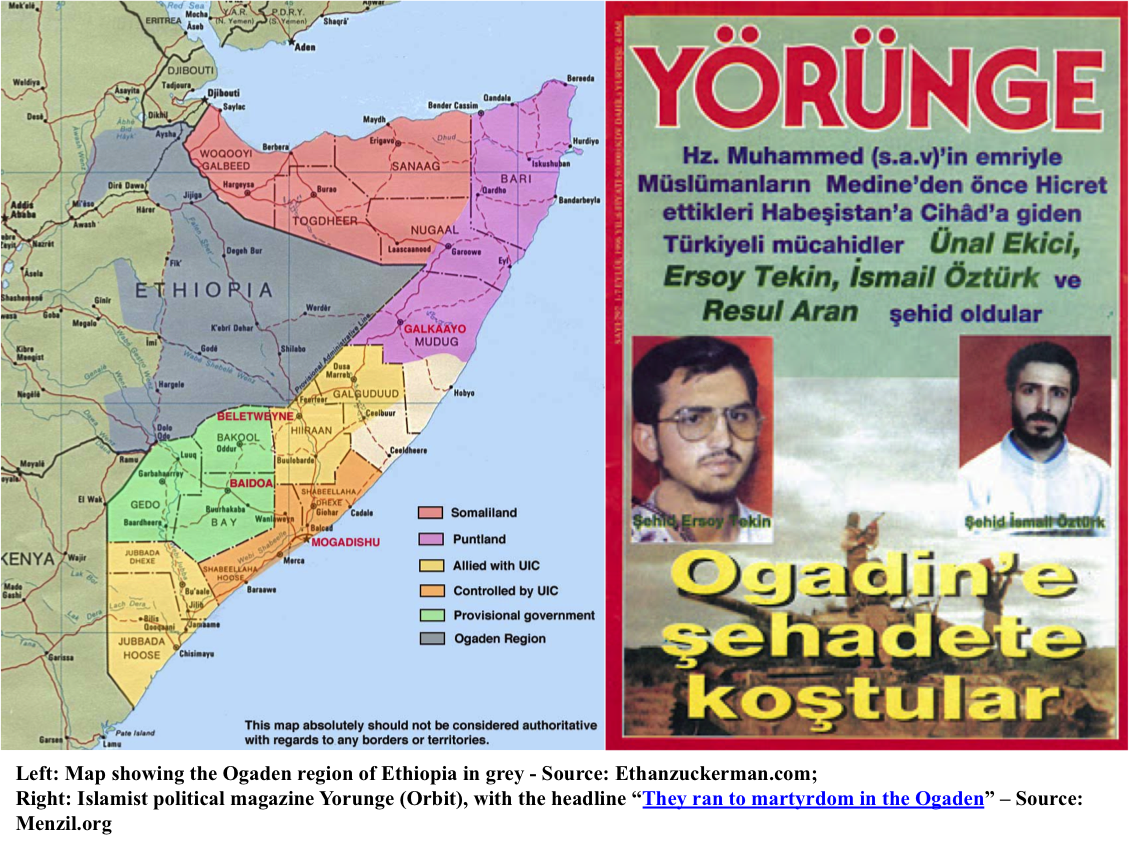
Conflict in the Ogaden
The year 1996 must have been a confusing time to be an aspiring jihadi. With the Dayton Accords ending the war in Bosnia the previous year, and the Khasavyurt Agreement temporarily halting hostilities in Chechnya, two of the premiere jihadist conflicts enticing foreign fighters came to an end. Given this context, some jihadis, including a group of young Turkish citizens, looked further afield to participate in one of the more obscure Islamist conflicts – the battle between ethnic Muslim Somalis and Ethiopian government forces in the Ogaden region of Ethiopia.
The Ogaden – A Basic Background
The Ogaden, consisting of the mainly ethnic Somali-inhabited eastern region of Ethiopia, has long had a contentious history. By the early 20th century, the region slowly came under the domain of the Christian empire based in the highlands of central Ethiopia, though control shifted to the British after the Second World War. The British returned the Ogaden to Ethiopia in 1948, along with the Haud in 1954 (the north-eastern section used as a grazing land by nomadic Somali herders), effectively signaling the demise of a ‘Greater Somalia’ that united all Somali-inhabited lands, much to the chagrin of many Somali nationalists.
The reincorporation of the Ogaden into Ethiopia sparked a host of resistance movements and a devastating Cold War-infused proxy battle with Somalia in 1977-78. Following the collapse of the Mengistu government in Ethiopia in 1991, the Ogaden National Liberation Front (ONLF) assumed control of the region under Ethiopia’s federal structure. The harmonious relationship between the ONLF and the new Ethiopian government, however, did not last – by 1994 the ONLF had divided, with a wing renouncing its political position in favor of armed resistance.
The Rise and Fall of Islamist Interest in the Ogaden
During this time, the struggle for the Ogaden caught the eye of Islamist actors in Somalia. While the ONLF operated as a secular, nationalist party within Ethiopia, often accused of narrowly representing the Ogaden clan, al-Ittihaad al-Islami (AIAI) in Somalia developed a branch focused on the Ogaden that infused Somali irredentism with Islamist rhetoric, adding a new, albeit somewhat peripheral dimension to the struggle. The conflict was often portrayed in terms of Somali Muslims rising up against a Christian entity. Based in Luuq along the Ethiopian-Somali border, AIAI’s Ogaden wing also established training camps within the Ogaden itself, and even conducted a series of attacks in Ethiopia’s two largest cities in 1995-6.
Osama bin Laden also developed an interest in the Ogaden during his stay in Sudan from 1992-96, so much so that during his August 1996 declaration of jihad against the United States, the al Qa’ida (AQ) leader referenced the region amongst a host of other global hotspots where Muslims have suffered at the hands of a “Judeo-Christian alliance.” Representatives from al Qa’ida traveled to the Ogaden in the early 1990s and aided in the establishment of training camps, with bin Laden himself reportedly investing $3 million to bring foreign fighters to the region, cementing the Ogaden on AQ’s early 1990s horizon [Note: The vast majority of open-source information regarding AQ activities in the Ogaden during this time period comes from declassified documents in the Harmony Database, obtained by the Combating Terrorism Center and analyzed in its 2007 report Al-Qaida’s (Mis)Adventures in the Horn of Africa].
Ethiopia, however, responded forcefully to the 1995-6 attacks, bombing camps in Luuq on 9 August 1996 and again in January 1997, effectively routing AIAI. Combined with Osama bin Laden’s move to Afghanistan and AQ’s struggles in Somalia, the Ogaden likely fell off AQ’s map. With AIAI decimated, resistance to Ethiopian rule returned to the realm of the secular, clan-based ONLF, a stiutation that largely persists to the present day.
Turkish Involvement in the Ogaden
Much of the information for this article was drawn from Turkish language sites dedicated to Turkish Islamist martyrs killed in conflicts outside Turkey (as well as those killed fighting Kurdish separatists), such as sehidlerimiz.com and menzil.org. These websites purport to reproduce contemporary reporting from the time of the fighters’ deaths and often provide images of the news articles, primarily from local newspapers. Due to the age and second hand nature of much of this material, some caveats apply, especially as data on Turkish fighters who may have gone to fight but ultimately survived is not available.
As in Syria, looking into the backgrounds of fighters reveals connections to other jihadist conflicts and/or friends and family serving as pulling factors. Below we will describe the experience of a number of the Turkish fighters – who likely joined with the Islamist AIAI’s Ogaden wing, and were all reportedly killed along the Ethiopian-Somali border on two different days between August and December 1996.
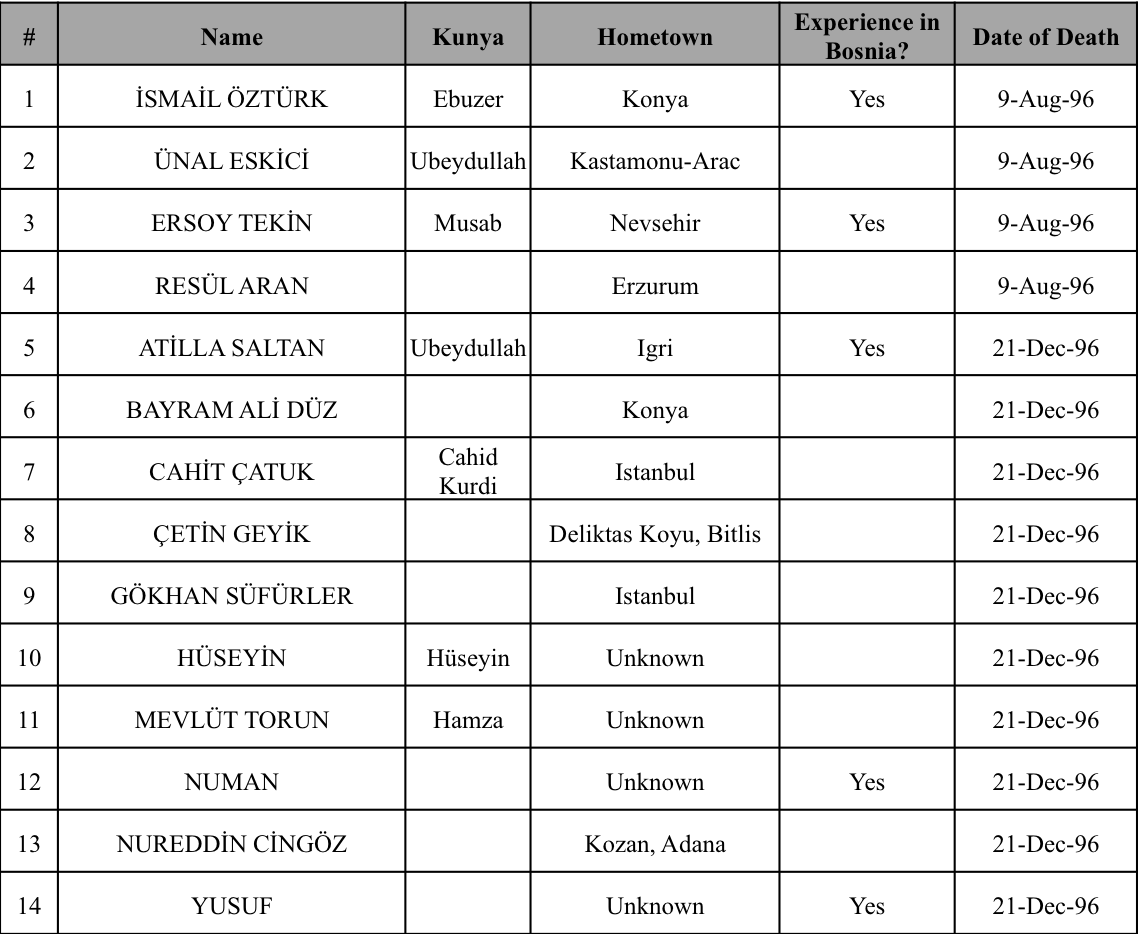
Backgrounds and Parental Involvement
From the available information, the majority of the 14 Turkish fighters killed in Ogaden had similar backgrounds – early 20s, often college students or professionals, and idealistic. One fighter, Nureddin Cingöz from Kozan, Adana, had graduated from a theological imam-hatip high school, where he allegedly won first place in a hadith knowledge competition. However, when he left with his friend, Bayram Ali Düz, for the Ogaden, both were students at Konya’s Selcuk University.

In some cases, fighters seemed to travel without support from their families. For example, Gökhan Süfürler graduated from a vocational high school in Istanbul before taking a job as an accountant working at a company in Kartal. After he left his job, Süfürler’s father wanted him to work at a different job before completing his military service, but Süfürler “claimed to have higher ideals,” according to his father. According to a letter he sent home, Süfürler wrote that he felt guilty living a good life in Turkey while injustice and deprivation occurred elsewhere. In an interview with Selam Gazetesi, Sufurler’s father explained that while he was born in Istanbul, his family was originally from Salonica, Greece and was quite secular. However, his father and other family members started praying more regularly after his son’s death.
In other cases, families appear to have been supportive. In an interview after his death in the Ogaden, Ismail Ozturk’s father stated that his son’s death should not be treated as a tragedy, but as martyrdom. Ozturk’s father went on to say that when his sons were young he brought back Islamic books from Libya where he was working, and that he tried to pass on his religious convictions. Ismail took his upbringing to heart and went to Bosnia, but the war ended two or three weeks after his arrival. He returned to Turkey changed and even more committed to jihad. He later tried to join the conflict in Chechnya, but was turned back by Russian preventative measures. After these failures, Ozturk decided try his luck in the Ogaden. This time, however, his father allegedly tried to convince him to stay and get married, demonstrating the at times shifting nature of familial support for such activities.
The Bosnian Connection
The conflict in Bosnia appears to have served as a central bridge to the Ogaden, with many fighters meeting there and deciding their next destination. One figure who seems to be especially important as a link between Bosnia and the Ogaden is Atilla Saltan. A young man from Agri in eastern Turkey, Atilla eventually got a job in advertising in Istanbul. While there, he became engaged in the study of the Quran and other religious activites, eventually leaving his job. He moved to Germany, staying with family and decorating a local mosque. His apparent motivation was to make his way to Bosnia to fight, arriving there in November 1995. When the ceasefire came into effect on 14 December 1995, however,
Category: Turkey
The Clairvoyant: Turks Or Uyghurs Arrested In Indonesia?
Earlier this week, reports surfaced that four Turks had been arrested in Poso, Indonesia related to links with the Islamic State. It was later revealed though that in fact they were Uyghurs from Xinjiang, China. Why the confusion? There is actually a relatively simple answer to this, which was recently provided by a jihadi online that also helps us better understand some of the processes for how individuals are making their way toward Syria.
According to an individual that uses the name Abdullah Abu Bakr, Uyghurs have a difficult time obtaining Chinese passports to travel abroad. I personally cannot attest or know the veracity of this claim since I do not follow Chinese policies on this issue closely. That said, if one takes it as stated, because of this, these wannabe Uyghur foreign fighters then create fake passports, specifically from Turkey. He then claims they venture to Malaysia or Thailand where they might spend some time in prison, but afterwards because they were caught with these fake Turkish passports they are then deported to Turkey. Once in Turkey, according to him, Turkish officials view the Uyghurs as Turkic peoples and therefore allow them to safely stay in Turkey, which then allows the Uyghurs to safely get into Syria. This again raises questions about Turkish potential in enabling of the foreign fighter flow into Syria. He then warns that if any of this process gets snuffed out then the individuals attempting to fight jihad in Syria (and/or Iraq) will get sent back to China and face prison there. In part, this is likely why Indonesia at first believed the individuals arrested were from Turkey.
Of course, he does not mention Indonesia, but I do not see why this process couldn’t have played out there as well, whereby individuals from Xinjiang using fake Turkish passports traversed to Indonesia. Once there, the hope being to be deported then to Turkey so they can make easy entrance into Syria. This illustrates not only the efforts that go into trying to get to Syria, but also highlights that there is a network of individuals that has created a system to try and get individuals over there even if the process might take some time, arduous, and risky. It also likely shows that there are more interlinked connections between the different jihadi facilitation networks in south/southeast Asia as well as how they then connect back to the facilitation networks based in Turkey and/or the Arab world.
What the Syrian conflict has done is regenerate old networks, connect separate past networks that now overlap, and the creation of new ones that are now part of the broader echo system related to global jihadism. These connections created for going to join up to fight in Syria/Iraq will also be important for any potential returnees and/or the use of external operations if it is in the cards either for the Islamic State or al-Qaeda’s branch Jabhat al-Nusra. All of this just highlights that there is a very sophisticated methodology for ways in which individuals not so close to Syria get there that helps not only those that want to get there, but cements key relations that could be relevant to future jihad in south/southeast Asian countries.
As-Saḥāb Media presents a new release from al-Qā’idah's Shaykh 'Aṭīyyat Allah al-Lībī: "Indisputable Answers for Turkish Jihādīs"

Click the following link for a safe PDF copy: Shaykh ‘Aṭīyyat Allah al-Lībī — “Indisputable Answers for Turkish Jihādīs”
____________
To inquire about a translation for this release for a fee email: [email protected]
GUEST POST: "Turkish Fighters in Syria, Online and Off"
NOTE: As with all guest posts, the opinions expressed below are those of the guest author and they do not necessarily represent the views of this blogs administrator and does not at all represent his employer at the Washington Institute for Near East Policy.
Jihadology.net aims to not only provide primary sources for researchers and occasional analysis of them, but also to allow other young and upcoming students as well as established academics or policy wonks to contribute original analysis on issues related to jihadism. If you would like to contribute a piece, please email your idea/post to azelin [at] jihadology [dot] net.
Past Guest Posts:
Mark Youngman, “Book Review of David Malet’s “Foreign Fighters: Transnational Identity in Civil Conflicts”,” June 20, 2013.
Hazim Fouad, “Salafi-Jihadists and non-jihadist Salafists in Egypt – A case study about politics and methodology (manhaj),” April 30, 2013.
Daveed Gartenstein-Ross and Tara Vassefi, “Perceptions of the “Arab Spring” Within the Salafi-Jihadi Movement,” November 19, 2012.
Jack Roche, “The Indonesian Jamā’ah Islāmiyyah’s Constitution (PUPJI),” November 14, 2012.
Kévin Jackson, “The Pledge of Allegiance and its Implications,” July 27, 2012.
Behnam Said, “A Brief Look at the History and Power of Anasheed in Jihadist Culture,” May 31, 2012.
Jonah Ondieki and Jake Zenn, “Gaidi Mtaani,” April 24, 2012.
Joshua Foust, “Jihadi Ideology Is Not As Important As We Think,” January 25, 2011.
Charles Cameron, “Hitting the Blind-Spot- A Review of Jean-Pierre Filiu’s “Apocalypse in Islam,” January 24, 2011.
Daveed Gartenstein-Ross, “Why Jihadi Ideology Matters,” January 21, 2011.
Joshua Foust, “Some Inchoate Thoughts on Ideology,” January 19, 2011.
Marissa Allison, “Militants Seize Mecca: Juhaymān al ‘Utaybī and the Siege of the Grand Mosque in Mecca,” June 9, 2010.
—
Turkish Fighters in Syria, Online and Off
By North Caucasus Caucus
Click here for a PDF version of this post
NOTE:
This piece provides a granular look at the backgrounds of Turkish citizens fighting in Syria, building on a recent article by Soner Cagaptay and Aaron Y. Zelin on the challenges Turkey may face in the future emanating from jihadis operating near Turkey’s southern border and the eventual return home of Turkish jihadis. While I have spent a considerable amount of time living, working and studying in Turkey, I am by no means an expert on Turkish jihadi groups or jihadi movements in general. I am a researcher on the politics of the Caucasus, but while researching foreign fighters in Syria from the Caucasus, I continually noted their engagement with Turkish jihadi material and felt it was an issue that needed further exploration.
INTRODUCTION
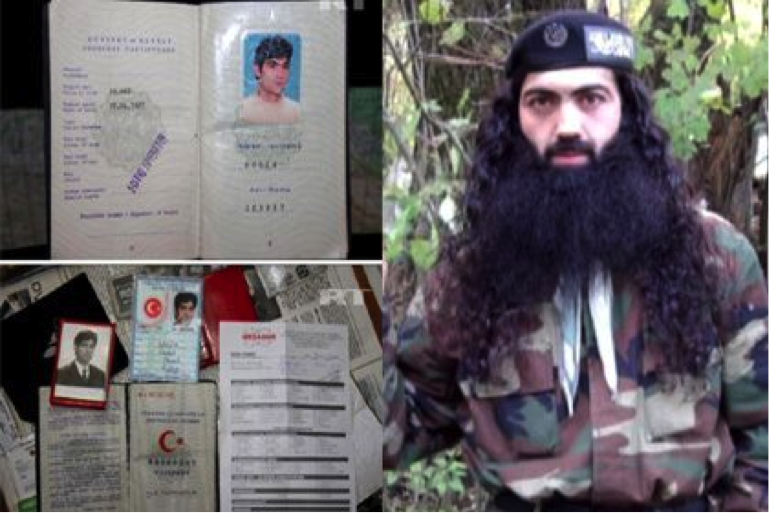
Over the last three decades, Turkish citizens have travelled to fight and die in conflicts both close and distant. Turkish citizens have fought in Iraq, Afghanistan (both against the Soviets and the United States), Bosnia, and the North Caucasus, sometimes occupying leadership positions in Islamist armed groups. For example, Cevdet Doger (aka Emir Abdulla Kurd) was second-in-command of foreign fighters in the North Caucasus before his death in May 2011.

Cevdet Doger and recovered Turkish identification tables, Source: sehidler.com
I will not venture to estimate how many Turkish citizens are fighting in Syria. In August 2012, Turkish journalist Adem Ozkose reported on the deaths of four Turkish fighters in Aleppo and said they were part of a group of 50 Turks fighting in that region. In the year since, it is conceivable that this number has grown along with Syria’s general population of foreign fighters.
SYRIA IN TURKISH ONLINE SPACES
There is a large amount of Turkish pro-jihadi material on Facebook relating to Syria. For example, the page, “Suriye İslam Devrimini Destekliyoruz,” (“We Support Syria’s Islamic Revolution”) has over 11,000 “Likes.” Al-Nusra Front (Nusret Cephesi in Turkish) and the Islamic State of Iraq and Sham (ISIS) both have Turkish language fan pages which are regularly shut down by Facebook but are always quickly reestablished. Turks interested in following jihadi activity in Syria are not wanting for online news coverage.
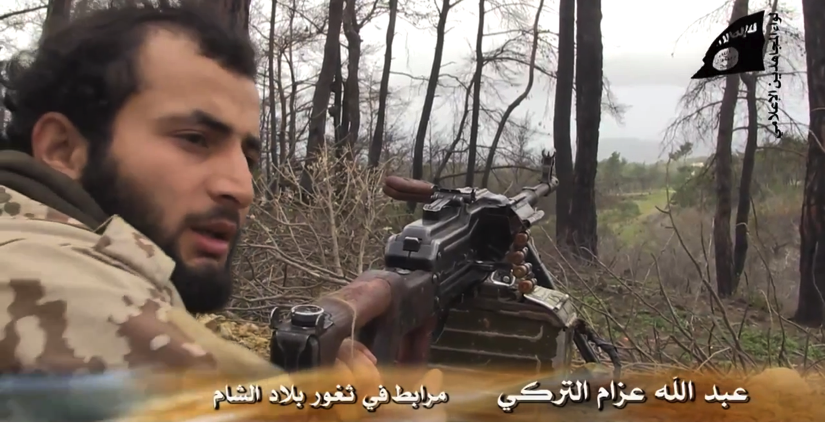
Just as Arabic-language material is translated and posted on Turkish-language sites, material from Turkish languages pages makes its way to Islamist users from other countries. For example, the pro-Islamist Turkish news website, Islah Haber, which regularly publishes news on Turkish fighter activity and deaths, uploaded an Arabic language video on 9 July 2013 that included several Turks speaking (with Arabic subtitles) about why they went to Syria. One fighter emphasized Assad’s killing of women and children and the hope of establishing a sharia-based state as a prime motivator.

The caption identifies him as “Abdullah Azzam the Turk, connected to Thughur Bilad al Sham,” Source: Islah Haber
YouTube videos are sometimes used in recruitment efforts. The Russian language website, fisyria.com, released a video on 03 July 2013 from Emir Seyfullah, an ethnic Chechen and then-spokesman of ISIS-affiliate Jaish al-Muhajirin wa Ansar. In the video, Emir Seyfullah speaks in heavily accented Turkish, calling for Turks to come help establish sharia in the land of Sham; his speech is intercut with footage of Syrian military jets on bombing runs. Jamestown’s Mairbek Vatchagaev wrote that Seyfullah is from the Pankisi Gorge region of Georgia. However, it is possible that he lived in Istanbul before the war in Syria. Many former fighters from the North Caucasus continue to live in Turkey. This has led to violence in the past, such as the September 2011 assassination of two former fighters, allegedly by Russian security services, in Istanbul’s Zeytinburnu neighborhood.

Screenshot of YouTube video about Turkish martyrs in Syria
The amount of material about Syria uploaded onto YouTube in all languages is nearly endless. However, one recent video provided insight into the extent of Turkish fighter involvement in Syria. On 05 July 2013, an account (now-deleted), associated with the Facebook page, “Suriye Devrimi Sehidleri,” (“Martyrs of the Syrian Revolution”) uploaded a video entitled, “Turkiyeli Sehidler” (Martyrs from Turkey). The video shows the images of 27 different alleged Turkish fighters killed in Syria.
Check out my new article at CNN co-authored with Soner Cagaptay: "Turkey’s Jihadi Dilemma"

In late May, the Turkish government uncovered a plan to use Sarin gas as part of a potential bomb attack in southern Turkey. Al Qaeda’s branch in Syria, Jabhat al-Nusra (JN), was allegedly behind the plot, and the subsequent arrests highlighted the increasing trouble jihadi radicals could pose for Ankara. Indeed, the longer Turkey turns a blind eye to jihadi rebels crossing its territory into Syria, the more likely there will be blowback.
The reality is that providing jihadists access to a neighboring country can result in unintended consequences as radicals ultimately bite the hand that feeds them, something Pakistan should have learned over Afghanistan, and Bashar al-Assad has discovered as Syria-backed al Qaeda elements from Iraqi territory have turned against the regime in Damascus.
Click here to read the rest.
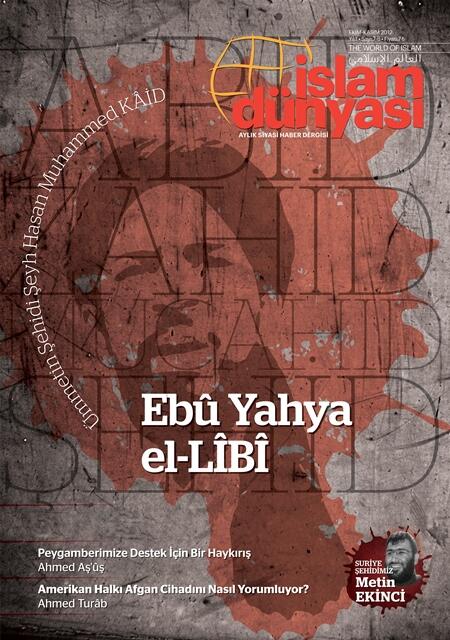
Fursān al-Balāgh Media presents a new issue of The Islamic World Magazine #7-8
NOTE: For previous issues see: #6, #5, #4, #3, #2, and #1.
—

Click the following link for a safe PDF copy: The Islamic World Magazine #7-8
__________
To inquire about a translation for this magazine issue for a fee email: [email protected]
New statement from the Islamic Emirate of Afghanistan: "Communiqué About the Release of Turkish Captives"

The Islamic Emirate of Afghanistan released 4 out of the 8 Turkish prisoners showing its good will, human and Islamic sympathy and regard for the Muslim Turkish Nation who were apprehended sometime ago by Mujahidin of the Islamic Emirate. The remaining 4 persons will also be released in the near future.
The Islamic Emirate of Afghanistan anticipates that the Turkish government will reciprocally express its good will and will take such measures which will consequently result in bringing the Afghan and Turkish Muslim masses close to each other and amplification of the devout brotherhood between them.
Regard
The Islamic Emirate of Afghanistan
3/7/1434 A.H. (lunar) ——- 23/2/1392 A.H. (solar)
13/5/2013 A.D.
__________
Check out my new Foreign Policy piece co-authored with Daveed Gartenstein-Ross: "Uncharitable Organizations"

In 1997, employees of the Al-Haramain Islamic Foundation (AHIF), a Saudi-based charity, were mulling how best to strike a blow against the United States in East Africa. According to the U.S. Treasury Department, one employee indicated that the plan they hatched “would be a suicide bombing carried out by crashing a vehicle into the gate at the Embassy.” A wealthy foundation official from outside the region agreed to fund the operation.
The employees’ plans would go through several iterations, but AHIF would eventually play a role in the ultimate attack. In 1998, simultaneous explosions ripped through the U.S. embassies in Tanzania and Kenya — attacks eventually traced back to al Qaeda operatives. Prior to the bombings, a former director of AHIF’s Tanzanian branch made preparations for the advance party that planned the bombings, and the Comoros Islands branch of the charity was used, according to the Treasury Department, “as a staging area and exfiltration route for the perpetrators.” The ultimate result was deadly: 224 people killed and more than 4,000 wounded.
This was, of course, before the 9/11 attacks and the subsequent crackdown on wealthy Islamist charity organizations such as AHIF, which provided a large portion of the funding that made international terrorism possible. As a monograph produced for the 9/11 Commission noted, prior to 9/11, “al Qaeda was funded, to the tune of approximately $30 million per year, by diversions of money from Islamic charities and the use of well-placed financial facilitators who gathered money from both witting and unwitting donors.”
But despite all the efforts made to shut down such groups, Islamist-leaning international charities and other NGOs are now reemerging as sponsors of jihadi activity. In countries like Tunisia and Syria, they are providing the infusion of funds that have allowed extremist groups to undertake the hard work of providing food, social services, and medical care. Jihadists, meanwhile, have discovered that they can bolster their standing within local communities, thereby increasing support for their violent activities. And governments are struggling to keep up.
Click here to read the rest.
Fursān al-Balāgh Media presents a new issue of The Islamic World Magazine #6
NOTE: For previous issues see: #5, #4, #3, #2, and #1.
—

Click the following link for a safe PDF copy: The Islamic World Magazine #6
_________
To inquire about a translation for this magazine issue for a fee email: [email protected]
Fursān al-Balāgh Media presents a new issue of The Islamic World Magazine #5
NOTE: For previous issues see: #4, #3, #2, and #1.
—

Click the following link for a safe PDF copy: The Islamic World Magazine #5
__________
To inquire about a translation for this magazine issue for a fee email: [email protected]