
Hizballah Cavalcade: What is the Liwa’a Abu Fadl al-Abbas (LAFA)?: Assessing Syria’s Shia “International Brigade” Through Their Social Media Presence

NOTE: For prior parts in the Hizballah Cavalcade series you can view an archive of it all here.

What is the Liwa’a Abu Fadl al-Abbas (LAFA)?: Assessing Syria’s Shia “International Brigade” Through Their Social Media Presence
By Phillip Smyth
Click here for a PDF version of this post
Making its first appearances in the fall of 2012, Liwa’a Abu Fadl al-Abbas (Abu Fadl al-Abbas Brigades or LAFA) represents a new addition to the Syrian battlefield and serves as another example of increased sectarianism in the Syrian Civil War. The organization claims its role is to defend the Sayida Zaynab Shrine and surrounding Shia populated neighborhoods located in southern Damascus.[1] The group is made-up of a mixture of a small number of native Syrian Shia with a majority of foreign Shia Muslim fighters.
LAFA has also maintained an outward appearance which mirrors the same type of spirit once found with the volunteer International Brigades during the Spanish Civil War. Despite the presented narrative, this does not necessitate the group is an ad hoc collection of individual Shia Muslims. The group heavily utilizes fighters originating from Iranian-backed organizations (such as Iraq’s Kata’ib Hizballah and Asa’ib Ahl al-Haq), has uniformed personnel, new weapons, a recognizable leadership structure, and openly identifies with Lebanese Hizballah. These factors point to an extremely organized fighting group and deeper levels of Iranian involvement in the organization.
Unlike larger and more established militant Shia Islamist groups such as Lebanon’s Hizballah or Iraq’s Asa’ib Ahl al-Haq, LAFA has no official website or official online forums. The group finds most of its internet representation through a mixture of quasi-official Facebook pages and YouTube stations. In fact, for the Western and Arabic-language press, LAFA’s existence only came to light when a YouTube music video featuring the group’s fighters was made public.[2] Thus, fifteen pro-LAFA Facebook pages, five Facebook pages associated with Lebanese Hizballah, one Hizballah forum, three pro-Muqtada al-Sadr forums, and five pro-LAFA/pro-Hizballah YouTube stations were reviewed for this study.
 “Labayka Ya Zaynab!”: Abu Fadl al-Abbas’s Messaging Campaign & Narrative


Designating itself firmly as a Shia militant organization, LAFA utilizes Shia Islamic imagery, slogans, and other symbols to push its case to Shia Muslims. As stated by the group and its supporters, the Abu Fadl al-Abbas Brigade’s main purpose is to “Defend the Saydah Zaynab Shrine”. Their specified raison d’etre, immediately projects an image of “Protectors” simply reacting to a foe bent on the destruction of Shi’ism.
A common chant heard and written by LAFA members and supporters is “Labayka Ya Zaynab!” (“We are here for you Zaynab”). The slogan directly refers to the defense of the Zaynab Shrine and has also become a rallying cry for Shia Islamist groups fighting in Syria. At funerals held for Lebanese Hizballah members killed in Syria, the same slogan regularly chanted. LAFA militants regularly say the phrase as they engage Syrian rebel forces. The cry reinforces the line that the group’s sole function is the protection of the Zaynab Shrine and that they are worthy of praise for their sacrifice for the entirety of Shi’ism.
The Shia Symbolism behind LAFA’s name originates with the story of Abu Fadl al-Abbas (A.K.A. Abbas Ibn Ali). Abu Fadl al-Abbas was a trusted and brave warrior who fought for his father, Imam Ali ibn Abi Talib.[3] Serving with Imam Husayn’s forces during the religiously important and historic Battle of Karbala, Abu Fadl al-Abbas had both of his arms cut off attempting to collect water for his besieged compatriots. Symbolizing his willingness to sacrifice and loyalty, until he was killed, Abbas continued to carry water back to his forces using his mouth.[4]
LAFA has attempted to utilize this story in their propaganda material. The image of a severed arm was actually featured in a number of pro-LAFA videos.[5] Additionally, the green flag on LAFA’s logo represents the flag Abu Fadl al-Abbas carried when he acted as flag bearer for Imam Husayn during the Battle of Karbala.
The story taps into the very roots of the Sunni-Shia split. For Shia, the Battle of Karbala symbolizes their rejection of oppressive Sunni rule. Combined with what appears to be a clear Sunni Islamist drive to dislodge Shia presence in Syria, for many Shia the story resonates in the contemporary sense. Since the shrine and neighborhoods LAFA claims to protect are surrounded by pockets of Syrian rebels, the field of battle is also reminiscent of the Battle of Karbala. With these prevailing themes, LAFA taps into the culturally important concept of Shia self-sacrifice. These themes were used extensively by Iran’s current leadership and has been refered to by some scholars as the, “Karbala narrative”.[6]
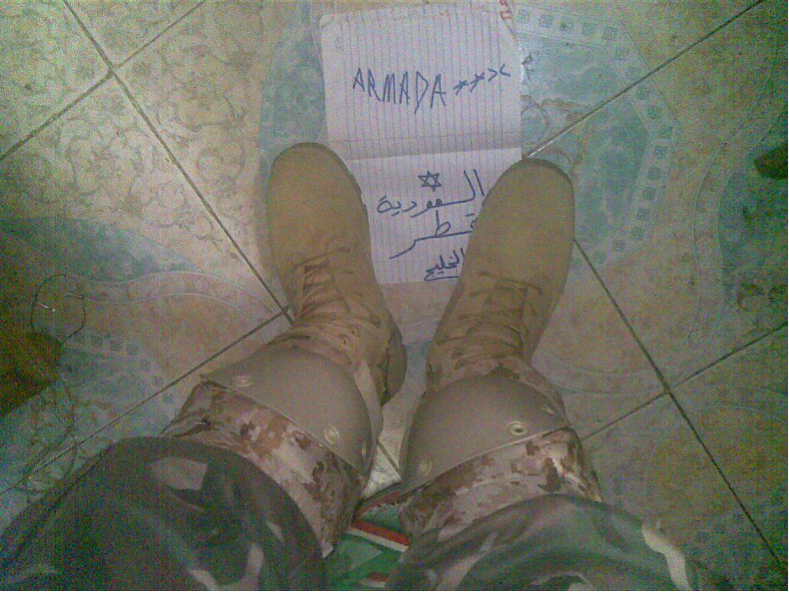
Untitled27
Figure 1: Another example of LAFA pushing the “Israel/Jewish-Sunni Gulf Arab” or “Israel/Jewish-Takfiri” conspiracy narrative. A LAFA member steps on a paper reading “Al-Saudia/Qatar/Al-Khaleej” (“Saudi, Qatar, the Gulf”) which are positioned under a Star of David. (Source: Facebook).
While LAFA describes its enemy as “Takfiris” or as “Gulf and Israeli” supported enemies, it neither specifically targets Sunni Muslims as a whole, nor marks the entire sect as apostates. Instead, the group brands its Syrian rebel enemies (no matter their political orientation, tactics utilized, or how secular) as “Wahhabists”, “Terrorists” and/or “Extremists”. Moreover, a number of online LAFA supporters refer to all Syrian rebels as “Kafirun” (“infidels”).
A major propaganda event for LAFA occurred when one of its members raised a red banner over the Zaynab Shrine’s golden dome. The message portrayal appeared to be one of valiantly opposing their Syrian rebel enemy and of embodying the flag-bearing role of Abu Fadl al-Abbas. The raising of the red banner signified willingness to become a martyr since it is the symbolic color for martyrdom in Shi’ism.[7] At the time of this writing, the film of the LAFA militant raising the red flag has been re-edited into eight YouTube films.
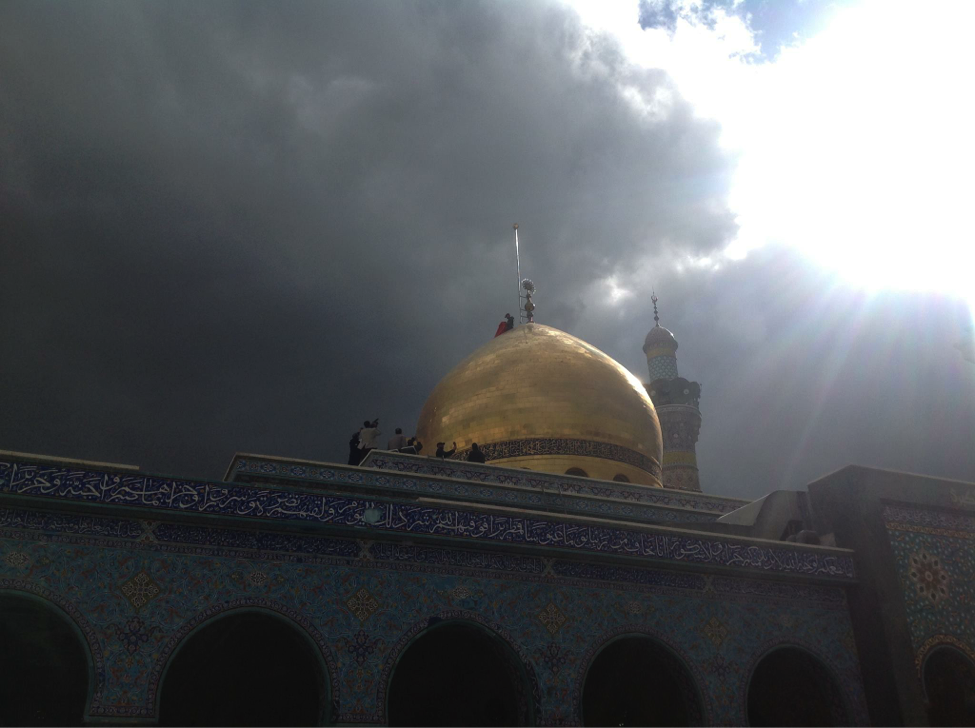
Untitled28
Figure 2: LAFA members and supporters raise a red banner reading “Ya Zaynab” (“O Zaynab”) over the shrine. (Source: Facebook).
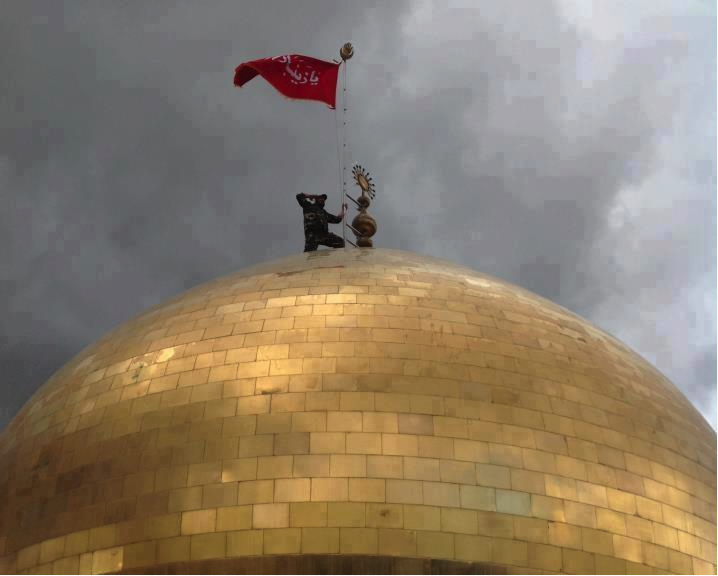
Untitled29
Figure 3: A photo of a LAFA member raises the red flag reading, “Ya Zaynab” (“O Zaynab”). (Source: Facebook).
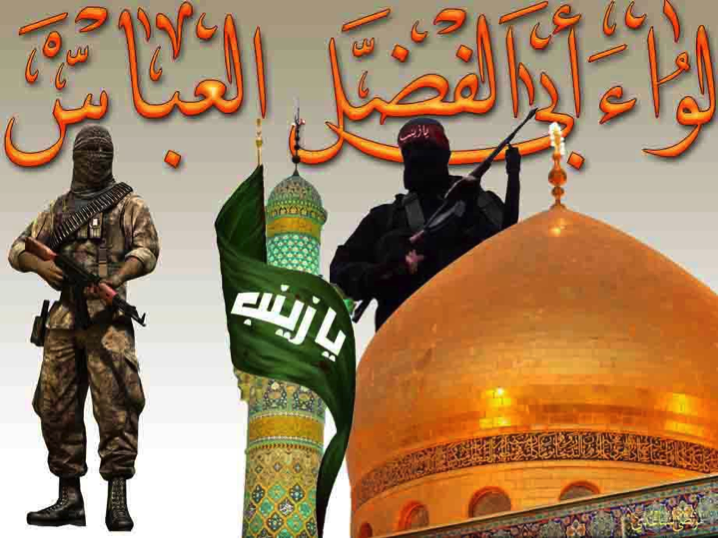
Untitled30
Figure 4: An example of the Zaynab Shrine in LAFA propaganda. “Liwa’a Abu Fadl Al-Abbas” is written in Arabic calligraphy. Wrapped around the shrine’s minaret is a flag reading, “Ya Zaynab” (“O Zaynab”). (Source: Facebook).
Untitled31
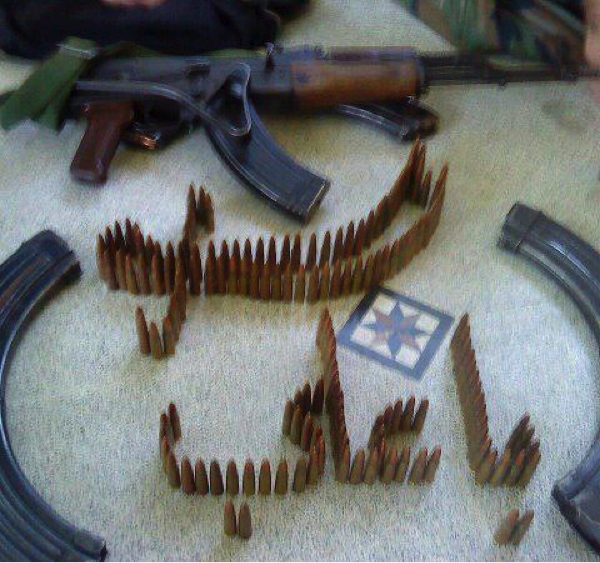
Figure 5: 7.62×39 rounds (the round used in the AK-47) have been arranged to spell, “Ya Ali” (O, Ali). The Ali reference refers to Imam Ali Ibn Abi Talib. For the Shia, he is considered the first Imam, his family. The ammunition also forms the Zulfiqar, Ali’s double pointed sword, which represents divinely guided power. (Source: Facebook).
Iranian-Backed Groups & Liwa’a Abu Fadl al-Abbas
The foreign fighter element of Liwa’a Abu Fadl al-Abbas has caught the attention of many analyzing the group. A key factor for new militia is that the majority of fighters killed come from both Iraq and Lebanon. The original parties they were aligned with were either beholden to Iranian radical ideology or created with Iranian aid. This factor points to a more direct Iranian involvement with the organization’s creation.
There has been a preponderance of reports citing large number of Iraqi Shia who have joined the group. Pro-LAFA social media is rife with many individuals praising Iraqi Shia efforts with the group. However, there have also been numerous Lebanese Shia—mainly Hizballah members—who fight or have fought with the group.
Journalist Nicholas Blanford identified that Hizballah involvement with the militia could be determined due to their utilization of semi-automatic fire, “a technique taught to Hezbollah combatants to improve accuracy and save ammunition”.[8] The clothing worn by LAFA members also points to another Hizballah-LAFA connection.[9] However, the links between the two organizations are far deeper than similar weapons techniques and uniforms.
As far back as August, 2012, there was unconfirmed evidence that Hizballah had positioned itself around the Zaynab shrine. At that time, Hassan Selim Meqdad, a Lebanese Shia was captured by Syrian rebels and was accused of being a Hizballah operative fighting in Syria. His family and Hizballah both denied the claims.[10]  When Meqdad was filmed, he told his captors he was one

Check out my new 'Policy Watch' for the Washington Institute: "Standoff Between the Tunisian Government and Ansar al-Sharia"


On May 10-11, Tunisian security services and police launched an unprecedented offensive against local Salafist group Ansar al-Sharia in Tunisia (AST), cracking down on members who were delivering public lectures or passing out their literature on the street. In response, AST leader Sheikh Abu Ayyad al-Tunisi made a veiled threat that youths would defend Islam in Tunisia just as they have in Afghanistan, Bosnia, Chechnya, Iraq, Somalia, and Syria — an indirect warning of potential full-blown jihad. Such a development would be a major break from Abu Ayyad’s public strategy over the past two years, in which he has argued that Tunisia is a land of dawa (i.e., proselytizing and associated Islamic outreach activities), not armed jihad. AST’s third annual conference in al-Qayrawan this weekend could help determine if the latest incident becomes a tipping point toward open conflict or an opportunity for both sides to back down.
Click here to read the rest.

The Global Islamic Media Front presents a new article from Millat Ibrāhīm's Abū Usāmah al-Gharīb: "Denial of What Was [Allegedly] Published From My Tongue About Rotten Democracy"

sN8zy
Click the following link for a safe PDF copy: Abū Usāmah al-Gharīb — “Denial of What Was [Allegedly] Published From My Tongue About Rotten Democracy”
__________

To inquire about a translation for this article for a fee email: [email protected]

GUEST POST: Jabhat al-Nusra's Relations With Other Rebels After the Bay'ah to Zawahiri

NOTE: As with all guest posts, the opinions expressed below are those of the guest author and they do not necessarily represent the views of this blogs administrator and does not at all represent his employer at the Washington Institute for Near East Policy.
Jihadology.net aims to not only provide primary sources for researchers and occasional analysis of them, but also to allow other young and upcoming students as well as established academics or policy wonks to contribute original analysis on issues related to jihadism. If you would like to contribute a piece, please email your idea/post to azelin [at] jihadology [dot] net.
Past Guest Posts:
Hazim Fouad, “Salafi-Jihadists and non-jihadist Salafists in Egypt – A case study about politics and methodology (manhaj),” April 30, 2013.
Daveed Gartenstein-Ross and Tara Vassefi, “Perceptions of the “Arab Spring” Within the Salafi-Jihadi Movement,” November 19, 2012.
Jack Roche, “The Indonesian Jamā’ah Islāmiyyah’s Constitution (PUPJI),” November 14, 2012.
Kévin Jackson, “The Pledge of Allegiance and its Implications,” July 27, 2012.
Behnam Said, “A Brief Look at the History and Power of Anasheed in Jihadist Culture,” May 31, 2012.
Jonah Ondieki and Jake Zenn, “Gaidi Mtaani,” April 24, 2012.
Joshua Foust, “Jihadi Ideology Is Not As Important As We Think,” January 25, 2011.
Charles Cameron, “Hitting the Blind-Spot- A Review of Jean-Pierre Filiu’s “Apocalypse in Islam,” January 24, 2011.
Daveed Gartenstein-Ross, “Why Jihadi Ideology Matters,” January 21, 2011.
Joshua Foust, “Some Inchoate Thoughts on Ideology,” January 19, 2011.
Marissa Allison, “Militants Seize Mecca: Juhaymān al ‘Utaybī and the Siege of the Grand Mosque in Mecca,” June 9, 2010.

By Aymenn Jawad Al-Tamimi
Much discussion arose last month when Abu Bakr al-Baghdadi of the Iraqi al-Qa’ida branch Islamic State of Iraq (ISI) declared that his group and Jabhat al-Nusra (JAN) are in fact one and the same, prompting Sheikh Jowlani of JAN to reply that he was not consulted on this decision, while pledging allegiance to Ayman al-Zawahiri and making clear the links between ISI and JAN.
It is likely that the decision to have an ISI-JAN merger announced was Zawahiri’s idea. From this likely supposition, many commentators claimed a turning point in JAN’s fortunes in Syria for the worse. Thus did Brian Fishman attempt to draw an analogy with Iraq, asserting: “It wouldn’t be the first time he [Zawahiri] botched the terror group’s strategy in the region.”
Fishman’s analogy is that the al-Qa’ida pledge in Iraq inevitably translated to brutalization of local Sunnis, which, along with “U.S. pressure” on al-Qa’ida, proved the decisive turning point against al-Qa’ida after the rise of the Sahwa (Awakening) movement. Hence he concludes, “For better or worse, the reckoning between al-Qa’ida’s Syria affiliate and other rebel groups is beginning.”
However, I contend that this view is well overblown. “Syria is/is not Iraq” is of course a statement frequently brought up in common debates over whether the outside world should intervene in militarily or provide lethal aid to rebel forces. The problem is that the general debate over comparisons of Syria to Iraq does not appreciate that the dynamics of how the civil war progressed in Iraq are vastly different from Syria.
Iraq’s sectarian civil war was focused on what might be termed a decisive ‘Battle for Baghdad’ between rival Sunni and Shi’a militias, with the former- demographically in a minority- believing that Sunni Arabs were in fact the majority and could win that civil war. By the end of 2006, large-scale ethnic cleansing of Sunnis from Baghdad had convinced many insurgents who had been working with al-Qa’ida that they could not win, and hence a key driving force behind the turn against al-Qa’ida.
On a side note, I should point out that the belief in a Sunni Arab majority in Iraq is by no means dead, and is back on the ascendancy, being promoted by some mainstream Sunni Arab politicians like Osama al-Nujaifi and by groups organizing demonstrations such as Intifada Ahrar al-Iraq (IAAI).
IAAI is essentially the activist wing of the neo-Ba’athist Naqshibandi militia movement. Concomitant with that belief in a Sunni Arab majority is the notion of marching on Baghdad to retake the city and calling for jihad, sentiments apparent at IAAI protests in areas like Hawija and Tikrit.
In any case, the development of Syria’s civil war is not analogous. For one thing, the timescale is much greater than in Iraq, and Sunni insurgents in Syria are not a minority who falsely believe they are in the majority.
False analogies with Iraq aside, an overview of statements made by various other rebel groups as well as developments on the ground show that nothing has changed for the worse for JAN. Beginning with the issue of statements on JAN’s pledge of allegiance to Zawahiri, the sentiment can be summarized as follows: ‘While we appreciate your efforts against the regime, we do not believe a pledge of allegiance to al-Qa’ida is in anyone’s interests.’ Thus, not a repudiation of JAN itself, but just al-Qa’ida.
Consider, for example, a statement (courtesy of Charles Lister) put out by a Deir ez-Zor battalion known as the Jaish al-Tawhid, which is aligned with the Salafist rebel coalition called the Syrian Islamic Front (SIF). The statement read: “As for Jabhat al-Nusra’s allegiance to al-Qa’ida, this is a matter for their concern, even though we do not support them [in it] as they have come to hold this view, and we recognize that Jowlani’s pledge of allegiance to Sheikh al-Zawahiri is a course of action that does not achieve legitimate interests.”
In a similar vein, Harakat Ahrar al-Sham al-Islamiya– one of the largest battalions in the SIF- recently put out a statement indicating that they did not approve of Abu Bakr al-Baghdadi’s declaration of a merger between ISI and JAN, saying that his announcement was not done in consultation with any proper religious authorities in Syria.
At the same time, the battalion made clear its appreciation of “the self-sacrifice and courage of Jabhat al-Nusra in battles and its good deeds and the goodness of its treatment of the people,” declared to be advancing “the interests of the Ummah.”
Notably, the statement recognizes the risks of conflict spreading in the wider region, but makes clear that “this does not constitute an arbitrary judgment for the artificial borders between the sons of the Ummah.” In other words, Harakat Ahrar al-Sham al-Islamiya does not see the notion of an ideological project beyond Syria’s borders as somehow illegitimate.
Coming to reactions outside this Salafist framework, we have the case of a statement put out immediately after JAN’s al-Qa’ida pledge by a self-proclaimed Free Syrian Army military council in the Damascus area, indicating that while JAN is not part of its structure, “its role in the defense of our oppressed people facing the regime of the tyrant [Assad] is valued.”
The al-Furqan Brigades likewise weighed in on JAN’s pledge of allegiance to al-Qa’ida. Their statement cited Qur’an 5:51, “O you who believe, do not take the Jews and Christians as friends; they are in fact friends of each other. And whosoever among you takes them [as friends] is one of them; and verily God does not guide the people of wrongdoers.”

al-Fārūq Foundation for Media Production presents a new statement from Muḥammad al-Ẓawāhirī: "On the Media Disinformation and Manipulation of Minds"

uQozl

Click the following link for a safe PDF copy: Muḥammad al-Ẓawāhirī — “On the Media Disinformation and Manipulation of Minds”

___________

To inquire about a translation for this statement for a fee email: [email protected]

New statement from Jamā'at Anṣār al-Muslimīn Fi Bilād al-Sūdān: "Innocence of the Mujāhidīn From the Blood of the Innocent Muslims"

UDwoJ
Click the following link for a safe PDF copy: Jamā’at Anṣār al-Muslimīn Fi Bilād al-Sūdān — “Innocence of the Mujāhidīn From the Blood of the Innocent Muslims”
___________

To inquire about a translation for this statement for a fee email: [email protected]
 

New article from ‘Abd Allah bin Muḥammad: "Is It Better to Take the Fight to the Inside of Iran?"

وردني سؤال عن جدوى تنفيذ عمليات عسكرية داخل الأراضي الإيرانية وفيما يلي جواب مختصر عن ذلك

نقل المعركة لأرض العدو مطلب مهم في أي حرب حتى تتوازن كفة الرعب ويذوق الذي تذوقه ولكن يختلف تأثير ذلك من بلد لآخر فالدول الغربية تتأثر كثيرا بالعمليات الداخلية اقتصاديا وأمنيا وسياسيا وبكل النواحي وحادثة محاولة تفجيرالطائرة في “ديترويت” في أمريكا خير دليل على ذلك فمع ان العملية لم تنجح إلا انها تسببت في انفاق 40 مليار دولار على تشديد اجراءات السلامة في المطارات !

أما الدول الشرقية فهي غالبا لا تتأثر بالعمليات الداخلية لأن الأنظمة الشمولية والمافيوية كالصين وروسيا لا تقييم وزنا كبيرا للعامل البشري على عكس الدول الغربية التي قد تسقط حكوماتها بسبب التهاون في سلامة مواطنيها ! ولعل حادثة مسرح موسكو وميدان “تيانامن” ففي الأولى فتح الروس الغازات السامة داخل المسرح لانهاء عملية احتجاز الرهائن التي أخذت بعدا اعلاميا عالميا وأعادت تسليط الضوء على الحرب في الشيشان وتداعياتها التي جعلت مجموعة القائد عربي باراييف تقوم بمثل هذه المهمة فقامت القوات الخاصة الروسية بفتح الغاز وتسببت بموت 200 رهينة روسي لتنهي المسألة بدون أن تتأثر بموتهم لطبيعة النظام الذي لا يقيم وزنا لهم أساسا وكذلك الحال في المظاهرات الطلابية في ميدان تيانامن في الصين والتي قام الجيش بادخال الدبابات لسحق جثت الطلبة المعتصمين دون أي رحمة ! فمثل هذه التعديات لا يمكن أن تحدث إلا في مثل هذه الأنظمة الشرقية أما الأهداف الذي تتأثر بضربها كثيرا هذه الأنظمة فهي الأهداف الإقتصادية وخير مثال على ذلك ما حدث في الغزو السوفيتي لأفغانستان فعندما كان يقتل الآلاف من الجنود الروس لم تبدي موسكو تأثرا ولكن عندما طالت الحرب واستنزف الاقتصاد وبدأت المتاعب لم تمضي سنوات إلا وتفكك الإتحاد السوفيتي كسبب غير مباشر للإنفاق على حرب أفغانستان !

وإيران تصنف من القسم الثاني الذي لا يقيم وزنا كبيرا للعنصر البشري بالمقارنة مع الاقتصاد وما حدث في الحرب العراقية الإيرانية في الثمانينات يؤكد ذلك فقد قاد خوميني الحرب باسلوب الأمواج البشرية كي يقتحم التحصينات العراقية فكان الهجوم يبدأ ب 20 ألف مقاتل على شكل سلاسل وأمواج متلاحقة ليربك الجيش العراقي ومع أنه اسلوب بدائي إلا أنه حقق بعض النتائج ويكفي تخيل هذه المعارك لندرك مدى رخص مواطني إيران عند ملاليهم

ولذا اعتقد ان دعم الجهاد في سوريا سيكون له بالغ الأثر على إيران أكثر من أي عمليات داخل الأراضي الإيرانية – إلا ان استهدفت هذه العمليات أهداف اقتصادية – لأن سوريا الآن هي مسرح استنزاف اقتصادي مستمر لإيران فهي من تنفق على الحرب وعلى بقاء النظام وإن كانت تغطي ذلك من حليفها المالكي بالعراق إلا أنها خسارة لها في النهاية فهذه المليارات التي تنفقها إيران من خزينة النفط العراقي على الحرب في سوريا وعلى كسب ولاء مصر واغراء الأردن كان من الممكن ان تصب في خزينتها أو أن تقاوم بها العقوبات الاقتصادية المفروضة عليها بدرجة أكبر ! ولذا يمكن ان نقول أن قتالنا ضد إيران في سوريا هو كقتالنا ضد السوفيت في أفغانستان فكما أن الجهاد الأفغاني قد تسبب في تفكك الإتحاد السوفيتي فإن الجهاد الشامي سيؤدي بإذن الله إلى تفكك الهلال الشيعي وانكماشه ومن ثم تفكك إيران نفسها باستقلال البلوش والأحواز والأذريين كما حدث في انهيار المعسكر الشيوعي بعد حرب أفغانستان وتحرر أوربا الشرقية ومن ثم تفكك الإتحاد السوفيتي وانكماشه في روسيا الإتحادية والله أعلم

__________

To inquire about a translation for this article for a fee email: [email protected]

New statement from the Islamic Emirate of Afghanistan: "Communiqué About the Release of Turkish Captives"


The Islamic Emirate of Afghanistan released 4 out of the 8 Turkish prisoners showing its good will, human and Islamic sympathy and regard for the Muslim Turkish Nation who were apprehended sometime ago by Mujahidin of the Islamic Emirate. The remaining 4 persons will also be released in the near future.
The Islamic Emirate of Afghanistan anticipates that the Turkish government will reciprocally express its good will and will take such measures which will consequently result in bringing the Afghan and Turkish Muslim masses close to each other and amplification of the devout brotherhood between them.

Regard

The Islamic Emirate of Afghanistan

3/7/1434 A.H. (lunar) ——- 23/2/1392 A.H. (solar)

13/5/2013 A.D.

__________

al-Fārūq Foundation for Media Production presents a new article from Abū al-Ṭayyīb Ibrāhīm: "The Pearl of Tawḥīd 'Lā Ilah Ilā Allah' Banished By the Tyrants"

cir0S
Click the following link for a safe PDF copy: Abū al-Ṭayyīb Ibrāhīm — “The Pearl of Tawḥīd ‘Lā Ilah Ilā Allah’ Banished By the Tyrants”
__________

To inquire about a translation for this article for a fee email: [email protected]