
I walk through a Tunisian market around midday, at the entrance to the fortress of Sousse, a town about 90 minutes southeast of the capital Tunis on the coast. A man is selling Salafi books and copies of the Quran from a maple wood table, 12 feet long, in front of a small masjid inside the old fortress walls, which were built in the ninth century by the Aghlabid caliph Ziyadat Allah I.
Two men are sitting nearby, at the edge of a dry, broken-down fountain, enjoying the sunny and mild weather. I approach them, along with three Tunisian friends, to ask for an interview. One dismisses me outright, gets up and leaves. He thinks I am in the American mukhabarat(intelligence). The other accepts. I sit next to him, shake his hand, and we both exchange salam alaykum pleasantries.
“Are You Muslim or a non-Muslim?” he asks.
This was the start of my conversation with Ramzi, a Salafi, who takes issue with the term since he sees himself as a Muslim. Based on the description of the activities he has been involved in, it is possible he is a member of Ansar al-Sharia in Sousse (AST), but he would not confirm. Ramzi has a traditional Salafi look, sporting a marine green thawb, black skullcap, and a fully-grown beard, but with a well-trimmed mustache. By his own account, he had spent six years in exile in Morocco before returning to Tunisia following the ouster of former President Zine el-Abidine Ben Ali.
“Bidun sura aw fidiyo” are his conditions for an interview — no pictures or video. A couple of weeks prior, Ramzi had talked with the France 2 series Envoyé Spécial, which did an exposé titled “La Tunisie sous la menace salafiste” (“Tunisia, under Salafist Threat). He told them his name was Nasim. Ramzi promises only five minutes, though the conversation lasts 15.
Ansar al-Sharia in Tunisia is an organization that believes in al Qaeda’s worldview, but primarily at this juncture only focuses on local recruitment and missionary activities. AST typically sets up lectures from prominent Tunisian Salafi clerics, passes out mainstream Salafi literature at weekly markets, provides food, medicine, and clothing in charitable convoys, and publishes about its activities on Facebook as well as highlights key news events and new releases relating to the global jihadi world.
Unlike al Qaeda and its like-minded groups around the greater Middle East and North Africa, on the whole, AST has been a non-violent organization — besides alleged involvement in the attack on the U.S. Embassy in Tunis in September 2012. Its main focus has been on dawa (missionary work). This is an under studied aspect of many current jihadi organizations. Much of this has come about as a consequence of the excesses of Abu Musab al-Zarqawi and al Qaeda in Iraq last decade.
Groups like AST largely follow the ideas of Sheikh Abu Muhammad al-Maqdisi who has attempted to steer the community toward a more “pure” jihad. Maqdisi emphasizes the importance of consolidating power through education and dawa rather than focusing on fighting to damage the enemy. The groups working to change the emphasis on their actions, fostering the possibility of gaining a constituency in the same manner that ideologically different Islamists like the Muslim Brotherhood, Hamas, and Hezbollah have been doing for years. That being said, because AST believes in al Qaeda’s ideology, it could be susceptible to engaging in violence in addition to dawa activities in the future if it sees it fit. It is difficult to predict if and when this might happen, but it should not be ruled out.
Click here to read the rest.
Category: Tunisia
Check out my new article for Foreign Affairs: "Tunisia's Post-Revolution Blues"

At least Tunisia is not as bad as Egypt — that is the hardly comforting good news coming out of the country where the Arab Spring began, more than two years ago. The bad news is that Tunisia has come up far short of the lofty expectations set by Tunisians and outsiders in January 2011, when protests finally forced President Zine el-Abidine Ben Ali from office. Among the Middle East’s post-revolutionary governments, Tunisia still has the best chance of turning into a consolidated democracy, but barriers old and new are making the task far more difficult.
As I discovered during a recent research trip, Tunisians are deeply worried about their country’s sluggish economy, worsening security situation, and never-ending political stalemate. The protests that began the revolution centered on the lack of job opportunities, and Tunisians at all levels of society are still demanding economic improvement. Now, however, they are increasingly fearful for their own safety, the assassination of the popular left-leaning and secular politician Chokri Belaid being just the latest cause for concern, and they are growing disillusioned with the country’s acute political polarization. Together, the lack of progress on these fronts has left once hopeful observers worrying that if Tunisia, a small, educated, and religiously and ethnically homogenous country, is having so much trouble with its transition, then perhaps every other Arab Spring country is doomed, too.
Click here to read the rest.
Minbar at-Tawḥīd wa-l-Jihād presents three new Fatāwā from Shaykh Abū al-Mundhir al-Shinqīṭī

Click the following links for safe PDF copies:
Shaykh Abū al-Mundhir al-Shinqīṭī — Is It First Jihād in Syria or Da’wah in the Land of Tunisia?
Shaykh Abū al-Mundhir al-Shinqīṭī — Are We Allowed To Kill Any Christian In Our Town Because One Of Them Killed A Muslim?
Shaykh Abū al-Mundhir al-Shinqīṭī — Our Amīr Commanded Us In the Field of Jihād To Leave Crosses In Churches .. Should We Obey Him?
___________
To inquire about a translation for these fatāwā for a fee email: [email protected]
Check out my new Foreign Policy piece co-authored with Daveed Gartenstein-Ross: "Uncharitable Organizations"

In 1997, employees of the Al-Haramain Islamic Foundation (AHIF), a Saudi-based charity, were mulling how best to strike a blow against the United States in East Africa. According to the U.S. Treasury Department, one employee indicated that the plan they hatched “would be a suicide bombing carried out by crashing a vehicle into the gate at the Embassy.” A wealthy foundation official from outside the region agreed to fund the operation.
The employees’ plans would go through several iterations, but AHIF would eventually play a role in the ultimate attack. In 1998, simultaneous explosions ripped through the U.S. embassies in Tanzania and Kenya — attacks eventually traced back to al Qaeda operatives. Prior to the bombings, a former director of AHIF’s Tanzanian branch made preparations for the advance party that planned the bombings, and the Comoros Islands branch of the charity was used, according to the Treasury Department, “as a staging area and exfiltration route for the perpetrators.” The ultimate result was deadly: 224 people killed and more than 4,000 wounded.
This was, of course, before the 9/11 attacks and the subsequent crackdown on wealthy Islamist charity organizations such as AHIF, which provided a large portion of the funding that made international terrorism possible. As a monograph produced for the 9/11 Commission noted, prior to 9/11, “al Qaeda was funded, to the tune of approximately $30 million per year, by diversions of money from Islamic charities and the use of well-placed financial facilitators who gathered money from both witting and unwitting donors.”
But despite all the efforts made to shut down such groups, Islamist-leaning international charities and other NGOs are now reemerging as sponsors of jihadi activity. In countries like Tunisia and Syria, they are providing the infusion of funds that have allowed extremist groups to undertake the hard work of providing food, social services, and medical care. Jihadists, meanwhile, have discovered that they can bolster their standing within local communities, thereby increasing support for their violent activities. And governments are struggling to keep up.
Click here to read the rest.
Minbar at-Tawḥīd wa-l-Jihād presents a new Fatwā Shaykh Abū al-Mundhir al-Shinqīṭī: "What is the Ruling on Burning Shrines of Righteous People in Tunisia?"

Click the following link for a safe PDF copy: Shaykh Abū al-Mundhir al-Shinqīṭī — %22What is the Ruling on Burning Shrines of Righteous People in Tunisia?%22
__________
To inquire about a translation for this fatwā for a fee email: [email protected]
Check out my new al-Wasat post: "The Night’s Watch: Ansar al-Shari’ah in Tunisia’s ‘Neighborhood Committees’"

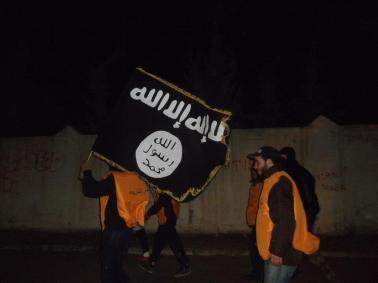
Following the untimely assassination of Chokri Belaïd (Shukri Bilayd), a Tunisian lawyer, opposition leader with the left-secular Democratic Patriots’ Movement and one of the leader’s of the Popular Front to which his party had adhered when the coalition was formed, there was a sense that security within Tunisia could break down. Although it appears, for now, that the situation has calmed down and many are returning to their normal everyday activities, on February 7th, Ansar al-Shari’ah in Tunisia (AST) for the first time activated its ‘Neighborhood Committees.’ The mobilization of these committees within a mere few hours illustrated the strength of AST’s organizing structures as well as its memberships obedience to orders coming from the top.
The ‘Neighborhood Committees,’ which were originally called ‘Security Committees,’ were announced and set up on October 6, 2012 as a preemptive precautionary measure in case there was a security vacuum within the country. In other words, aspirationally, the establishment of a de facto non-state controlled martial law force if need be (more on if they were successful in their first mobilization below). The original intent of these committees was to safeguard and protect individuals in case the country spiraled out of control on October 23, 2012, which was the one year anniversary of the Constituent Assembly Election. No security issue or vacuum developed and the date passed without the activation of AST’s committees.
This changed last week, though, in light of the assassination, as well as the tense environment on the streets of Tunisia. Some individuals attempted to take advantage of this and began to loot, but many have since been arrested for these crimes. As a consequence of the perceived lack of security, AST called on its followers to mobilize their ‘Neighborhood Committees,’ stating the goal was to protect individuals, their money and property, and ward off thieves and looters. AST also urged followers to remain vigilant and cautious in light of potential gangs and criminality. Within a few hours, AST was able to mobilize members in Sfax and Hammamet for the night of the 7th. The mobilization was even swifter on the 8th whereby committees in addition to the former two came to the streets in al-Zahra’, al-Wardiyyah, al-Qayrawan, Sousse, al-Qalibiyyah, Mahdia, Ariana, Sidi Bouzid, al-Tadhamin Neighborhood, Beni Khayr, Southern Suburbs (Tunis), al-Kef, Diwar Hishur, al-Dandan, al-Nur Neighborhood, Jendouba, the Western Suburbs (Tunis), Matar, the Braka Coast, al-Khadra’ Neighborhood, and Qarbah (excuse the literal transliterations from Arabic in some cases, I’m fully aware they are spelled differently in the French rendering). AST conducted some of their patrols with the League for the Protection of the Revolution (LPR), believed to be a hardline faction associated with Ennahda.
Click here to read the rest.
Mirkaz al-Maqrīzī al-Dirāsāt al-Tārīhkīyyah presents a new article from Shaykh Abū al-Mundhir al-Shinqīṭī: "The Crimes of an-Nahḍah in Tunisia … Till When?"

Click the following link for a safe PDF copy: Shaykh Abū al-Mundhir al-Shinqīṭī — “The Crimes of an-Nahḍah in Tunisia … Till When?”
__________
To inquire about a translation for this article for a fee email: [email protected]
al-Ḍarāghim Media Foundation presents a new audio message from Abū Faḍl 'Umar al-Ḥadūshī: "The Roar of Thunder in Defending Bakhtī and Bashīr"
UPDATE 11/21/12 10:46 PM: Here is an Arabic transcription of the below audio message:

Click the following link for a safe PDF copy: Abū Faḍl ‘Umar al-Ḥadūshī — “The Roar of Thunder in Defending Bakhtī and Bashīr” (Ar)
____________
—

Abū Faḍl ‘Umar al-Ḥadūshī — “The Roar of Thunder in Defending Bakhtī and Bashīr”
___________
To inquire about a translation for this audio message for a fee email: [email protected]
New statement from Hānī al-Sibā’ī: "Death of the Tunisian Detainee Who Was On a Hunger Strike"

Click the following link for a safe PDF copy: Hānī al-Sibā’ī — “Death of the Tunisian Detainee Who Was On a Hunger Strike”
_________
To inquire about a translation for this statement for a fee email: [email protected]
Check out my new article for Foreign Policy's Middle East Channel: "Maqdisi’s disciples in Libya and Tunisia"

Ever since the attacks on the U.S. Consulate in Benghazi and U.S. Embassy in Tunis in September, there has been a large spotlight on the Islamist groups viewed as the main culprits — Katibat Ansar al-Sharia in Benghazi (ASB) and Ansar al-Sharia in Tunisia (AST). While much of the understandable focus has been on the violent actions of individuals in these organizations, much of the scope of their activities lies outside violence. A large-portion of the activities of these groups is local social service provision under their particular dawa (missionary) offices. This broader picture is crucial to better understanding emerging trends in societies transitioning from authoritarian to democratic rule.
ASB and AST can broadly be considered jihadi organizations based on their ideological outlook. However, these jihadis are different than past incarnations. Jihadis have a good track record in fighting and less so in governing or providing social services. The only example of jihadi governance has occurred when the Somali-based Harakat al-Shabab al-Mujahidin and Yemeni-based al Qaeda in the Arabian Peninsula (AQAP) held actual territory. What sets ASB and AST apart is that they are providing aid to local communities in a non-state actor capacity, which has been unheard of previously.
While many analysts view jihadism only through the prism of al Qaeda, it misses the influence of independent jihadi religious scholars. Since the excesses of Abu Musab al-Zarqawi and al Qaeda in Iraq last decade, Minbar al-Tawhid wa-l-Jihad (the Pulpit of Monotheism and Jihad), a library of jihadi primary source material founded by Sheikh Abu Muhammad al-Maqdisi who is currently imprisoned in Jordan, has attempted to steer the jihadi community to a more “pure” jihad. To do this, Maqdisi established a sharia committee of like-minded scholars in 2009 for Minbar that provide fatwas answering questions along a range of topics from the mundane to political to jihad. This has been well documented by Dutch scholar Joas Wagemakers.
One of the main critiques Maqdisi presents, and hopes to create a course correction within the jihadi movement, is his differentiation between the idea of qital al-nikayya (fighting to hurt or damage the enemy) and qital al-tamkin (fighting to consolidate ones power), which he expounds upon in his book Waqafat ma’ Thamrat al-Jihad (Stances on the Fruit of Jihad) in 2004. Maqdisi argues the former provides only short-term tactical victories that in many cases do not amount to much in the long-term whereas the latter provides a framework for consolidating an Islamic state. In this way, Maqdisi highlights the importance of planning, organization, education, as well as dawa(calling individuals to Islam) activities. As Wagemakers has noted, the creation of the Minbar sharia committee was to forward these views to “protect” the jihad and to better advance the pursuit of a true Islamic state based on the sanctity of the tawhid (monotheism) of God.
The formation of Ansar al-Sharia groups in Benghazi and Tunisia are likely a logical conclusion and implementation of Maqdisi’s ideas, changing emphasis on the groups’ actions. One of the main avenues for advancing ASB’s and AST’s ideas has been through their social services programs. This provides an outlet for advancing the consolidation of a future Islamic state that cultivates followers in a broader fashion than the more vanguard-oriented organizations that have been involved in jihadism in a local, regional, or global capacity over the past 30 years.
Click here to read the rest.