
Category: Individuals
New statement from the Islamic Emirate of Afghanistan's Zabīhullah Mujāhid: "Delegation Meets With a Few Countrymen in Norway"

A delegation from the Political Office of Islamic Emirate met with a few individuals from the Afghan society in the country of Norway in order to gauge their views because the Islamic Emirate of Afghanistan, as Afghans, wants to listen to the views and suggestions of each individual of Afghanistan for the higher cause of ending the occupation and establishing peace and prosperity for its nation. And at the same time the Islamic Emirate wants to convey its Shariah compliant view and policy to the various political actors so that all sides and individuals of the entire society prime themselves at lending their support for establishing a pure Islamic government and so that everyone who has reservations about the victory and authority of Mujahideen is consoled with proofs from Shariah. It must be reminded that such meetings with the opposition party should never be mistaken for negotiations.
Spokesman of Islamic Emirate of Afghanistan
Zabihullah Mujahid
18/08/1436 Hijri Lunar
15/03/1394 Hijri Solar 05/06/2015 Gregorian
_______________
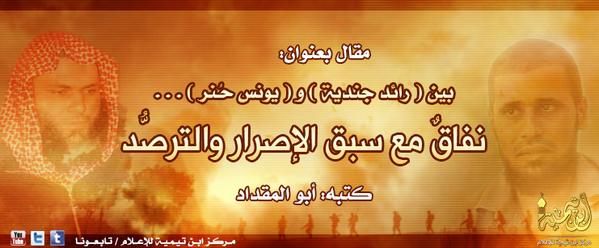
Ibn Taymīyyah Center for Media presents a new article from Abū al-Miqdād: "Between Rā'id Jundīyyah and Yūnis Ḥunr … Hypocrisy With Premeditation"

Click the following link for a safe PDF copy: Abū al-Miqdād — “Between Rā’id Jundīyyah and Yūnis Ḥunr … Hypocrisy With Premeditation”
_______________
To inquire about a translation for this article for a fee email: [email protected]
New article from Shaykh Ḥussayn bin Maḥmūd: “About the al-Jawlānī Interview #2"
Click here for the first part in this article series.
—
بسم الله الرحمن الرحيم
الحمد لله وحده ، والصلاة والسلام على من لا نبي بعده .. أما بعد ..
فقد شاهدت لقاء الجولاني مع مراسل قناة الجزيرة اليوم ، وكان اللقاء جيداً كسابقه إلا في قضية الخلاف مع الدولة الإسلامية الذي ناشدناه وغيره من قادة الجهاد أن لا يُبرزوه للناس ، ففي إبراز حيثيات الخلافات بين المسلمين مفاسد كثيرة على المسلمين ومصالح لا تخفى لأعداء الدين ، فلا يوجد عاقل على وجه الأرض يكشف ستره لعدوّه ويدله على عوراته ، فهذا من أعجب ما نرى – وما رأينا سابقاً – من بعض قيادات العمل الإسلامي على وجه العموم ، والمجاهدين على وجه الخصوص !!
الذي ذكره الأمير الجولاني في شأن إيران ، والذي أخذ حيزاً كبيراً من اللقاء ، هو عين ما ذكرنا في مقالات سابقة ، ولعل مقالة “نحن وإيران” تلخص جميع ما قال الجولاني ، وما قاله في عاصفة الحزم هو عين ما قلناه في مقالة “لا ترقصوا بعد” ومقالة “فهم عاصفة الحزم” ، وليس هذا عجيباً : فنحن كنا – وما زلنا – على فكر قاعدة الجهاد واجتهادها السياسي ورؤيتها لقضايا الأمة ، وهذه الرؤية موروثة عن الشيخين : أسامة وعبد الله عزام رحمهما الله ، وهي رؤية كثير من المفكرين والدعاة المصلحين في القرن المنصرم قبل أن تتغير المفاهيم وتتبدّل تحت ضغط الحكومات العميلة التي استعبدتها أمريكا ، فالمشكاة واحدة ، والمنبع واحد ، والأصول واحدة ..
النظرة السياسية التحليلية لم تتغير ولم تتبدّل ، ولولا الخلافات الأخيرة ، ولولا تلك الأحداث المتسارعة التي قسمت المجاهدين وقصمت ظهورهم لفترة تنفّس فيها النصيرية والرافضة الصعداء ، لولا تلك الفترة لكانت جبهة النصرة والدولة ، أو القاعدة والدولة : جماعة واحدة في الشام والعراق تقاتل النصيرية والرافضة معاً في خندق واحد .. هي ثغرة تغلغل عن طريقها الشيطان واستغلها الأعداء لبث الفرقة فآتى عملهم ثمره في غفلة منا وسوء إدارة لخلافنا بنشره على الملأ ..
أما ما قال الجولاني عن الخلاف مع الدولة الإسلامية : فهو مقصود قناة الجزيرة ومن ورائها من لقاءه ، فقناة الجزيرة لم تكن يوماً محايدة كما يظن البعض ، وها هي تلتقي بالجولاني في الشام وتُظهره بمظهر الحكيم المعتدل في الوقت الذي تحارب فيه “قاعدة الجهاد” في اليمن وتُظهرها بمظهر العميلة لعلي صالح !! كل ما كان يريده أعداء الأمة من لقاء الجولاني هو : إعلان عداوة جبهة النصرة للدولة الإسلامية ، لا أكثر ولا أقل ، أما رأي الجولاني في الأحداث الأخرى فهذا تحصيل حاصل عند أعداء الأمة ، وإن كان الجولاني يعلم ذلك فتلك مصية ، وإن لم يعلم فالمصيبة أعظم ، ولينظر الجولاني كيف يستغل أعداء الأمة كلامه عن الدولة مع إهمال كل ما قال عن الأمور الأخرى ليعلم أنه وقع في فخ الإعلام الخبيث عن حسن نيّة أو جهل .. وهذه بعض التعليقات على كلماته بشأن الخلاف مع الدولة :
أولاً : ظهر الجولاني بمظهر اليائس من الصلح ، وليس هذا شأن المؤمن ، فالله تعالى نهانا أن نقنط من رحمته ، ورحمته وسعت كل شيء ، والله تعالى يحب الصلح ويُبغض الخلاف بين المسلمين ، وقد رتّب على الخلاف الفشل وذهاب الريح ، فلا ينبغي للمسلم أن ييأس ، بل لا بد من الصبر على تحقيق المصلحة ، وهذا الصبر أشد من صبر المعارك ، هو يحتاج إلى عزيمة كبيرة وإيمان وحسن ظن كبير بالله تعالى ..
ثانياً : مسألة الخارجية لا ينبغي ذكرها من قريب أو من بعيد ، كما أن مسألة التكفير يجب أن تختفي من أبجديات المجاهدين ، ونقصد : تكفير المخالف أو المقاتل على إطلاقه ، فالتساهل في الأمرين مذموم ، فالتكفير إن لم يكن صحيحاً : حار على صاحبه ، والتصنيف بالخارجية إن لك يكن دقيقاً وفق منهج سليم – وليس هوى أو فجور في الخصومة أو ليٍّ لمعاني النصوص لإنزالها على جماعة – فإنه من الكذب على رسول الله صلى الله عليه وسلم الذي توعّد صاحبة بتبوؤ مكانه في النار ، فالأمرين أخطر مما يظن البعض ..
لقد تتبعت الفتاوى التي حكمت على الدولة الإسلامية بالخارجية ، وجميعها لا تتعدى البتر والترقيع بشكل مقزز ، ومثال ذلك أنهم يذكرون حديث “يَقتُلون أهل الإسلام” ولا يُكملونه ، وكماله “ويدَعون أهل الأوثان” (والحديث عند ابي داود وهو صحيح) ، فإن أكملته لهم قالوا : كان من الخوارج من يقاتل الكفار مع قتاله للمسلمين ، فنقول لهم : هلمّوا ننظر إلى سبب تسمية العلماء لهؤلاء بالخوارج ، فيقولون : نحن لا نأخذ إلا بالحديث وليس بأقوال العلماء ، وسبب قولهم هذا أن العلماء جمعوا ما اتفق عليه الخوارج من صفات واعتقادات فأدخلوا من وافقها في زمرة الخوارج وأخرجوا من لم يوافقها من الوصف ، فحكموا على هؤلاء بالخارجية لكونهم يدخلون تحت حدودهم التي وضعوها والتي يستدركها عليهم اليوم بعض المتعالمين ليأتوا بحدود جديدة على مقياس “الدولة الإسلامية” زعموا أنهم استشفوها من النصوص الشرعية ، وكأن ابن حزم والبغدادي والأشعري والشهرستاني وابن حجر وابن تيمية وغيرهم من كبار علماء الأمة أخذوا تعريف الخوارج من التوراة أو الإنجيل !!
مثال آخر على التخبّط : مسألة التكفير ، فهم يزعمون أن الدولة الإسلامية تكفّر عموم المسلمين – وكذبوا في هذه – فالدولة لا تكفّر عموم المسلمين وإنما تكفّر – باجتهادها – بعض الجماعات والأفراد ، ويقولون بأن الدولة تكفّر بالكبائر ، بل حتى بالصغائر أو بما ليس معصية ، وهذا كله كذب ، ولكن لنفرض جدلاً أنهم صادقون ، وأن الدولة تكفّر عموم المسلمين بما قالوا ، فأين في النصوص الشرعية بأن من يُكفّر عموم المسلمين فهو خارجي ؟ سيقولون : العلماء أجمعوا بأن هذه صفة للخوارج ، فنقول لهم : مَن من العلماء قال بذلك !! سيقولون فلان وفلان ، فنقول : هل تأخذون بتعريفهم للخوارج ؟ الجواب قطعاً : لا ، لأنهم إن أخذوا بتعريف هؤلاء العلماء للخوارج انتفت صفة الخارجية عن الدولة ..
لا يأخذون من أقوال العلماء والنصوص إلا ما يوافق أهوائم ، ثم يقولون بأن أفراد الدول الإسلامية “يقرؤون القرآن لا يجاوز تراقيهم” !! من أولى بهذا الوصف ؟!
ومن المضحك ما صنع البعض في مسألة “سيماهم التحليق والتسبيد” ، فهم يضحكون على من يستشهد بهذا الحديث في وصف الخوارج ، ولا ندري كيف يضحك مسلم على استشهاد بحديث صحيح للنبي صلى الله عليه وسلم !! ليس هذا هو المضحك ، المضحك أن هؤلاء ذاتهم يستشهدون بأثر “ضعيف جداً” في وصف جماعة تخرج في آخر الزمان “شعورهم مرخاة كشعور النساء” فينزلونه على جنود الدولة ، ويستشهدون بحديث “كلاب أهل النار” وهو مختلف في ثبوته فيصفون به الدولة جهلاً وبغيا ، ويستشهدون بحديث “حتى يخرج في عراضهم الدجال” وهو مختَلَف في صحته ،
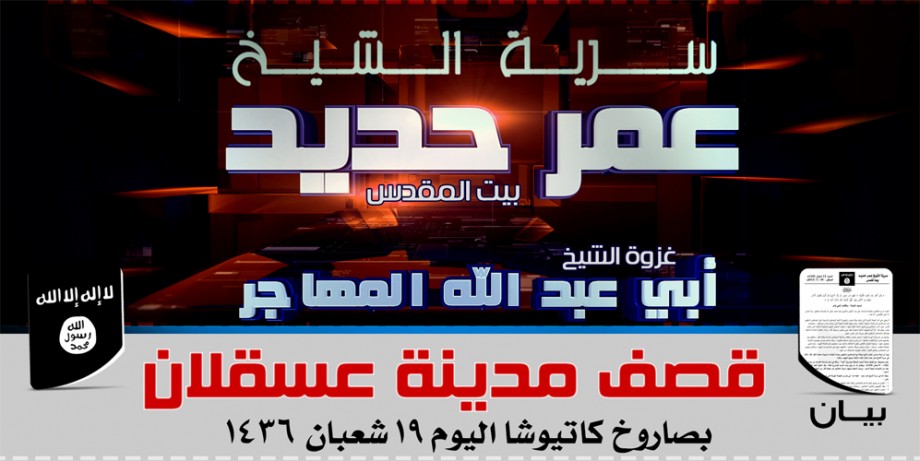
New statement from Sarayyah Shaykh 'Umar Ḥadīd – Bayt al-Maqdis: "Raid of Shaykh Abū 'Abd Allah al-Muhājir in Revenge for the Martyr Yūnis Ḥunr: Bombing Ashkelon, Netiv, and Ashkol with Three Grad Rockets"

Click the following link for a safe PDF copy: Sarayyah Shaykh ‘Umar Ḥadīd – Bayt al-Maqdis — “Raid of Shaykh Abū ‘Abd Allah al-Muhājir in Revenge for the Martyr Yūnis Ḥunr- Bombing Ashkelon, Netiv, and Ashkol with Three Grad Rockets”
____________
To inquire about a translation for this statement for a fee email: [email protected]
New video message: “Interview With Abū Muḥammad al-Jawlānī on al-Jazeera, Part 2”
GUEST POST: Ahrar al-Sham Spiritual Leader: The Idol of Democracy Has Shattered
Jihadology.net aims to not only provide primary sources for researchers and occasional analysis of them, but also to allow other young and upcoming students as well as established academics or policy wonks to contribute original analysis on issues related to jihadism. If you would like to contribute a piece, please email your idea/post to azelin [at] jihadology [dot] net.
Click here to see an archive of all guest posts.
—
Ahrar al-Sham Spiritual Leader: The Idol of Democracy Has Shattered
By Sam Heller
On 26 May, Ahrar al-Sham’s chief shari’ah officer “Abu Muhammad al-Sadeq” issued a treatise on Twitter titled “And the Idol Has Shattered” – the “idol,” in this case, being democracy. Drawing on Algeria and Egypt’s aborted democratic experiments, Abu Muhammad argued that democracy is, in real practice, a trap for would-be Islamist participants.
Abu Muhammad was, on one level, stepping into the middle of an intra-Islamist and -jihadist controversy that has been roiling over the past several weeks. In that sense, his tweets (translated below) are another example of Ahrar threading the needle, reconciling the forces of the Syrian revolution with global jihadism in the interest of rebel unity and victory. And on another level, Abu Muhammad’s argument provides further insight into what might be an acceptable post-Assad Syrian political order for Ahrar al-Sham – which by now is arguably the strongest, most relevant fighting force within the Syrian rebellion.
The intramural Islamist/jihadist blowup into which Abu Muhammad inserted himself dates back to McClatchy’s 20 May interview with Jeish al-Islam commander Zahran Alloush. Alloush – one of Syria’s most powerful Islamist rebel chieftains – seemed to moderate his earlier rejection of democracy, saying, “After the fall of the regime, we’ll leave the Syrian people to choose the sort of state it wants.” (To their credit, McClatchy’s Roy Gutman and Mousab Alhamadee challenged Alloush on his reversal.)
Salafi-jihadist ideologue “Abu Muhammad al-Maqdisi” then weighed in on Alloush’s comments, seemingly implying that Alloush was guilty of apostasy (translation). Al-Maqdisi employed a Quranic verse (12:103) originally intended for non-Muslims and, more bluntly, said that “surrendering the fruits of jihad on the path of God to the whim of the people” amounted to “a betrayal of God, His Prophet, and the martyrs’ sacrifices.”
This sort of back-and-forth is not purely abstract. Insofar as Alloush is among Syria’s top rebels and al-Maqdisi is the prime ideological reference for Jabhat al-Nusrah, this is the sort of argument that gets people shot. (Alloush is himself a Salafist, but he reportedly hews more to the less radical ‘Ilmiyyah school of Salafism and is seen with distrust by many Salafi-jihadists.)
Abu Muhammad al-Sadeq seems to have consciously staked out a middle ground in this debate. He devotes much of his treatise to mini-histories of the Algerian and Egyptian coups, which he uses to argue that democracy, merits aside, is basically a trick. If Islamists win democratically, in his telling, the West will simply conspire with the “Deep State” to subvert those elections and crush the Islamists. He is sympathetic to the Brotherhood, who “bear an Islamic project,” but he makes it clear that the path forward is armed revolution and jihad. Currying favor with the West, as the Brotherhood did, is a waste of time. Abu Muhammad’s closing line seems like a reminder to Alloush that it’s pointless to pose as a “good Islamist” to the West. The West ultimately won’t make those intra-Islamist distinctions – Islamists, he says, will rise or fall together.
Abu Muhammad seems to reserve stronger language for his critique of al-Maqdisi’s position. Those who target Muslims who participate in the democratic process are, flatly, “wrong.” Waging war on democracy is “foolish,” “reckless” and likely to “shed sacrosanct (Muslim) blood” – a grave offense. When Abu Muhammad says that an appropriately Islamic electoral process “is not a squandering of the fruits of the jihad,” he seems to be clapping back directly at al-Maqdisi. Abu Muhammad warns that rebels must unite around their own Islamic project “before any claim can be imposed on them from without,” maybe a reference to regional or Western meddling, or maybe another allusion to al-Maqdisi – who, after all, is not Syrian and has not himself come to Syria to join the fight.
It doesn’t seem like a throwaway point when Abu Muhammad emphasizes the need for the warrior’s jihad to be coupled with “wise, just policy,” siyassah shar’iyyah hakimah. “Siyassah shar’iyyah” is frequently invoked by Ahrar, and it seems to translate roughly to being realistic and savvy, or to setting priorities. “Siyassah shar’iyyah” means you adhere to your ideological precepts but, within those lines, you also don’t do something ignorant – like announcing a war on the whole world, all at once.
In terms of what Abu Muhammad’s treatise reveals about Ahrar’s preferred political end state, his argument is long on the need for Syria’s Islamic factions to unify around an Islamic project and short on the details of what that project should look like – and deliberately so, by all appearances. When Abu Muhammad references the Quran’s Surat Ali ‘Imran (3:7), he seems to be telling his audience of fellow rebels to focus on the points that clearly unite them and leave the ambiguous details for later.
What can be taken from Abu Muhammad’s points are that Ahrar doesn’t necessarily object to something democracy-like, or to a representative electoral process with a clearly Islamic reference. If Syrians want to elect representatives who will deliberate on how best to implement the rule of God as expressed in an Islamic constitution, fine.
This, of course, is not a new position for Ahrar. One of the threads that has run through the Syrian revolution is that Ahrar al-Sham – which went from some motivated Salafists in Lattakia and Hama to the premiere rebel fighting force – has basically remained a political and religious constant. The revolution around Ahrar al-Sham has changed with time; Ahrar has not. What Ahrar’s Abu Muhammad al-Sadeq is saying in May 2015, then, is basically what Ahrar (or the Ahrar-dominated Syrian Islamic Front) was saying in January 2013 (see page 19 of Aron Lund’s report on the SIF). Ahrar refuses to put the sovereignty of God up for a vote, but electoral structures are acceptable as part of the implementation of Islamic rule. In a later piece, Lund aptly compared this political arrangement to “a Sunni version of Iran,” a “republican theocracy.”
Given Abu Muhammad and Ahrar’s emphasis on rebel unity, it seems possible that Ahrar would sign onto a maximally inclusive political order within its religious conditions. And there is more than one way to have an Islamic state, ranging from the ultra-literal application of non-codified Islamic law to something as comparatively modern as a civil-looking body of law with the teachings of Islam enshrined as the supreme constitutional reference.
The fundamentally Islamic character of a post-Assad Syria, however, does not seem to be up for debate. Ahrar has seen the Algerian and Egyptian experiences and – as Abu Muhammad drives home with a recurring Quranic reference (Quran 59:2) – taken warning of democracy. Ahrar may be politically flexible, but any settlement in Syria that doesn’t satisfy Ahrar’s religious terms is apparently off the table.
=&0=&collected tweets=&2=&
=&3=&
Musings on Events in Egypt
Sayeth God Most High: “So take warning, O you with eyes to see!” [Quran 59:2] There is truth in the saying, “History repeats itself,” and yet are there those who take warning?!
The events of Egypt have recalled the events of Algeria some twenty years previous, demonstrating to all those with foresight the falseness and failure of democracy. I do not speak here about democracy in terms of the religious ruling on it. Rather, I speak about democracy’s practical utility as a means of change when those bearing the Islamic project are the leading candidates.
In Algeria in 1990, the Islamists won elections with more than 80 percent of the votes, empowering them, according to the principles of democracy, to form a government and change the constitution. The West and the East quickly took heed of that, and so they suggested to their associates that they dissolve the parliament. The Islamists started with protests and peaceful sit-ins, just as happened in Egypt recently. And in the same way, the military brought down its troops and tanks to suppress the demonstrators based on flimsy, worn-out pretenses. It drove the protesters to arms and tossed them into prisons and detention centers.
For man, by his nature, rejects humiliation. So [his choice], then, is either a defense of his freedom to decide and choose; or the life of sheep, chicken, and baby chicks!
And that is exactly what happened in Egypt some twenty years after the Algerian experience. The truth is that the same scene plays out once again!
Between the two experiences – Algerian and Egyptian – there are similar aspects. In fairness, though, the Egyptian play was more developed, as the Islamists governed the country for a year. Then a stick was jammed in the wheels, and the Brotherhood were obstructed from carrying out their duties and implementing their project. The coup took place, enforced by the military, and the idol of democracy shattered for the thousandth time.
And despite the West’s flirtation with the Brotherhood’s thought in previous decades – treating it as a necessary alternative and presenting on the political stage as an substitute for the growing jihadist project – that flirtation swiftly expired in favor of a Deep State that could safeguard the West’s interests. So now you have Morsi and his Brotherhood sentenced to death, while Mubarak leaves jail exonerated. Are there those, then, who take warning?
Indeed, the Algerian experience of old and that of Egypt in recent years puts us in front of a reality: Democracy is nothing but a lie tailored to the interests of the powerful.
It is naïve to look at what is happening in Egypt as if it is a matter of Morsi and his Brotherhood – rather, it is a matter of Islam, before which the idol shatters for the thousandth time. We call, then, for the support of all oppressed Muslims in Egypt, and we wish for the success of all who bear an Islamic project. We take these stands, urging others to take up the truth and searching for admonition.
Soft opposition and silent [ballot] boxes cannot uproot tyrants that have sunk their fangs into the depths of our land, gorged themselves on our bounty, and been imposed by the West through naked force [lit., “with iron and fire”].
It is among God’s set universal and religious lessons on the defense [of truth] and on change that there must be wise, just policy alongside a Godly, righteous jihad.
And while we state definitively that democracy is invalid, we see as wrong those who target Muslim peoples on whom democracy has been imposed, as our duty towards them is to make clear [the truth] and call on them to take up their religion. Just as democracy is an illusion that has failed time and again, so confronting an imposed democracy with a foolish, reckless war that sheds sacrosanct blood is also something that has proven a failure.
While jihadist groups are working now to correct their path and comprehend their errors, they still require more clarity, discipline, and openness. We call on and wait for those Islamic groups that have decided to ride the vessel of democracy to be open and undertake a review now that the vessel has crashed – and the idol has shattered.
The solution is for people to know the falseness of democracy and for the revolution’s factions to unite around the totalities of shari’ah and work to end people’s suffering in a legitimate way that satisfies God on High.
Our greatest objection to democracy is not just its hypocrisy, rather it is that it grants the right of unbounded legislation to man, whereas we hold that this is among God’s characteristics. When people choose those in whose righteousness and qualifications they trust under an Islamic constitution protected by these factions, however, then that is not a squandering of the fruits of the jihad.
Before then, it is inappropriate to make hasty statements and accusations, for the meaning is in the substance. When it is possible, one must turn from that which is ambiguous to that which is clear and defined [Quran 3:7], and it is thus that this revolution will not disobey its Islam, God willing.
The test of seriousness now is whether the factions can come together on an Islamic constitution, on a body to protect and implement that constitution, and on a project to save the country, before any claim can be imposed on them from without.
It is in this way that the absolute truths of religion might be protected; people’s suffering might be relieved; and benefit might be drawn from those things deemed permissible and in the public interest in terms of our dealings with our international surroundings, in keeping with religious constraints.
Any partial treatment or individual initiative that does not address this comprehensively will only divide us and push us further from realizing the fruits of the jihad and the aims of the revolution.
The West was able to abort the nascent Islamic projects that grew from the revolutions of the Arab Spring in Tunisia, Libya, Yemen, and finally Egypt. Now it can devote itself entirely to Syria, the neighbor of its beloved Israel.
If only I could say how much the Syrian people have suffered; massacres and murder around the clock, dragging on for years. How many battles now rage on their land, and how many nations plot against them?
And how many idols have shattered on this people’s threshold?
The idol of democracy and human rights.
The idol of the United Nations and Security Council.
The idol of the conferences of the Friends of Syria.
And so are there those who take warning?
Let everyone know that our fate is one. To the West, there is no difference between the revolution’s factions – however their names might differ – so long as they carry an Islamic project.
Sam Heller is a Washington-based writer and analyst focused on Syria. Follow him on Twitter: @AbuJamajem
New article from Dr. Iyād Qunaybī: "The International System, the State of Attrition, and the 'State' Organization"
______________
To inquire about a translation for this article for a fee email: [email protected]
al-Andalus Media presents a new video message from al-Qā’idah in the Islamic Maghrib’s Shaykh al-Ḥasan Rashīd al-Bulaydī: “Events of the Raids #5: Jihād Does Not Fall With the Death of a Man"
—

______________
To inquire about a translation for this video message for a fee email: [email protected]
New Fatwā from Shaykh Abū Qatādah al-Filisṭīnī, Shaykh Abū Muḥammad al-Maqdisī, Dr. Sāmī al 'Uraydī, Shaykh Abū Sulaymān al-Ustrālī, Dr. 'Abd Allah al-Muḥaysinī, et al: "Fatwā"
_____________
To inquire about a translation for this statement for a fee email: [email protected]

