As with all guest posts, the opinions expressed below are those of the guest author and they do not necessarily represent the views of this websites administrator and does not at all represent his employer at the Washington Institute for Near East Policy.
Jihadology.net aims to not only provide primary sources for researchers and occasional analysis of them, but also to allow other young and upcoming students as well as established academics or policy researchers to contribute original analysis on issues related to jihadism. If you would like to contribute a piece, please email your idea/post to azelin [at] jihadology [dot] net.
Click here to see an archive of all guest posts.
—
Heretics, Pawns, and Traitors: Anti-Madkhali Propaganda on Libyan Salafi-Jihadi Telegram
By Nathan Vest
On January 23, 2019, a Libyan salafi-jihadi Telegram channel posted a photo of a Libyan National Army (LNA) fighter reportedly killed in the eastern city of Derna.i The Telegram channel claimed that the deceased fighter belonged to a movement of salafis, colloquially known as Madkhalis after their spiritual leader—Saudi cleric Rabiՙa al-Madkhali. The Madkhali fighter is just one of the many killed in a sub-conflict within Libya’s civil war, pitting salafi-jihadis against traditionalist salafis, who are sometimes described as “quietest” for their avoidance of conflict with the state.
Since 2014, both sides have experienced waxing and waning fortunes; however, following victories in Benghazi, Sirte, and Derna, the Madkhalis are the ascendant faction. Subsequently, Libya’s salafi-jihadis are attempting to regroup and reverse Madkhali gains, and their efforts will largely depend on their ability to restore their diminished popular support. In line with these efforts, Libyan salafi-jihadis have taken to social media, particularly the messaging platform Telegram, to gain ideological and national legitimacy over the Madkhalis by portraying their traditionalist rivals as un-Islamic agents of foreign interests and traitors to Libya’s 17 February Revolution.
Salafi-jihadis and traditionalist Madkhalis may share ultra-conservative views, such as strictly applying Shariՙa law in everyday life, morally policing the public sphere, and returning Islam to its purist form, during and immediately following the life of the Muslim Prophet Muhammed. However, salafi-jihadis and traditionalists salafis diverge on the medium through which they pursue their socio-religious objectives. Whereas salafi-jihadis, as their title suggests, condone waging violent jihad against despotic regimes and their foreign backers, traditionalist salafis espouse the tenet of wali al-amr, or loyalty to the communal leader or head of state. While salafi-jihadis are quick to pronounce fellow Muslims as unbelievers and use violence to overthrow what they see as corrupt, despotic systems, traditionalist salafis abhor fitna, or intra-communal chaos and violence. Therefore, theyrefuse to disavow regimes and instead work through them to propagate their salafi ideologies. As such, regimes, including the Gaddafi regime and the Sisi regime in Egypt, often work by, with, and through traditionalist salafi movements. In doing so, they attempt to avert the argument that the regimes are anti-Islamic while simultaneously undermining the potential threat of salafi-jihadis to the system, via co-optation of their traditionalist rivals. Salafi-jihadis, therefore, often view traditionalist salafis as pro-regime pawns and enemies of the true salafi cause.
As other researchers have discussed, Madkhalis have evoked wali al-amr and sided with both the Government of National Accord (GNA) in the west and Khalifa Haftar’s LNA in the east to combat salafi-jihadi terrorist organizations, most notably the Islamic State (IS) and al-Qaeda-affiliated Ansar al-Shariՙa in Libya (ASL). Since 2016, salafi-jihadi groups have suffered stinging defeats in the east, and Madkhali power is growing in the west as well. These major battlefield defeats and the Madkhalis’ rising socio-political influence have greatly shaped how Libyan salafi-jihadis discuss their traditionalist adversaries, predominantly in Telegram-based propaganda.
Depicting Madkhalis as un-Islamic and enemies of proper Islamic practices is among the most prominent themes in anti-Madkhali propaganda salafi-jihadis circulate via Telegram, constituting an ad hominem attack meant to emphasize the salafi-jihadis’ religious legitimacy. For instance, on October 5, 2018, one salafi-jihadi channel accused Madkhalis of coercively working through the GNA’s President, Fayez al-Sarraj, to replace “legitimate religious education in schools which teach the al-Maliki madhhab to make room for the Madkhalis to live in mosques and schools.”ii Another channel echoed this accusation of Madkhalis undermining “legitimate” religious education, claiming that an LNA-affiliated militia in Derna was preventing studies in the city’s schools on Thursdays, replacing the classes with Madkhali lessons.iii
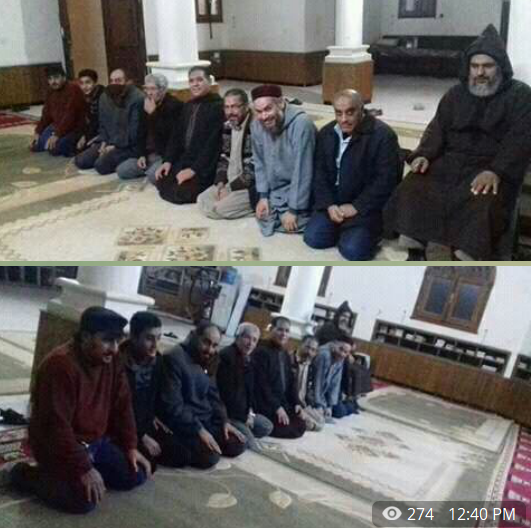
Libyan salafi-jihadis’ allegations of Madkhalis’ un-Islamic machinations also extend beyond Libya’s schools and into its mosques. For instance, they have also accused Madkhalis of closing Derna’s Al-Sahaba mosque, preventing locals from praying at one of the city’s most prominent religious centers.iv Additionally, while Madkhalis allegedly prevent “true” Muslims from worshiping, Madkhalis themselves are unable to pray correctly, “not knowing whether to pray or look at the camera,” one salafi-jihadi channel chided.v At other times, anti-Madkhali rhetoric is far less subtle, accusing Madkhalis of striving to “submit the tribe of Islam to the crusaders,” or western powers.vi Ergo, true Libyan Muslims must rally behind their religion’s legitimate champions—the salafi-jihadis—to save the Libyan religious sphere from heretical Madkhali domination.
Similarly, due to the Saudi origin of the Madkhali movement and their affiliation with the LNA and GNA—both backed by various international actors—salafi-jihadi Telegram channels regularly accuse Madkhalis of being agents of foreign interests—namely those of the UAE, Saudi Arabia, France, Russia, and Libya’s former colonizer, Italy. For example, one salafi-jihadi channel affirmed that the “scope of the conspiracy which the war criminal Haftar and the Madkhalis lead in eastern Libya” is facilitated “by Emirati and Saudi support against the people of the Qur’an.”vii
The UAE, in particular, has been among Haftar’s most ardent international backers in his fight against Islamist and salafi-jihadi actors in eastern Libya. The Emiratis have reportedly provided Haftar’s LNA with arms and training, according to the UN Panel of Experts on Libya. The UAE is also allegedly expanding the Al-Khadem air field in eastern Libya from which it could base larger fighter jets, such as the F-16 or Mirage 2000, in addition to the AT-802 Air Tractors and Wing-Loong drones already housed there. Reportedly, the UAE has deployed the Air Tractors and drones, flown by mercenary pilots, to conduct sorties in eastern Libya, and salafi-jihadi Telegram channels regularly reported drones, likely belonging to the UAE, flying missions over Derna.viii
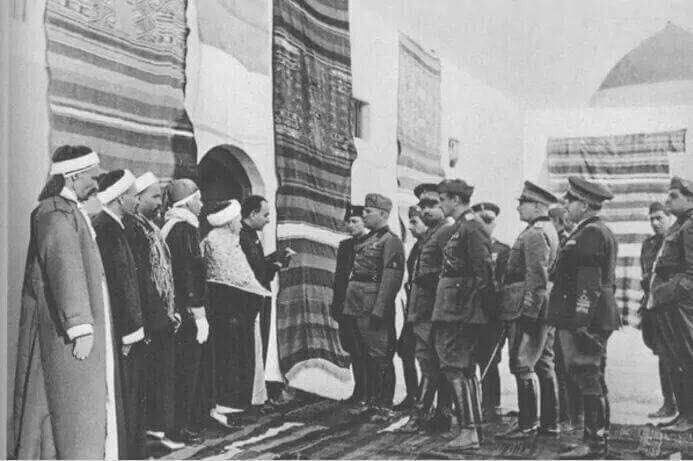
Libyan salafi-jihadi Telegram channels have also attempted to demonize their Madkhali rivals by associating them with their former Italian colonizers, who brutally ruled Libya from 1911 to 1947. In one such post, a salafi-jihadi channel posted a photo of alleged Madkhalis meeting with former Italian dictator Benito Mussolini and suggested they provided religious sanction to Mussolini’s efforts to fight Omar al-Mukhtar, a revered anti-colonial figure among Libyans.ix The implication is that just as the Madkhalis supported fascist Italy against al-Mukhtar, so too do they support Italy over patriotic Libyans today. Another salafi-jihadi channel was even more broad brushed in its attack, accusing “crusaders, Jews, Russian atheists, and their agents” of “mobilizing Haftar and the tyrants stepping on [Libya’s] neck, who are supported by fatwas of the people of crimes, the Madkhalis.”x
Conversely, many Libyan salafi-jihadis posit themselves as “the free sons of Libya” or the “heroes of Benghazi, Derna . . . Ajdabiyya and Misrata”, starkly contrasting their steadfast devotion to the Libyan people with the “foreign agents headed by the ‘Frigate’ Government and Haftar.”xi While they portray both the GNA and Haftar as subservient to foreign actors, salafi-jihadis argue that they are the sole legitimate representatives of Libyan interests, for which they have fought since the 17 February Revolution.
However, despite their zeal, salafi-jihadis are reeling from their losses in the east. After more than three years of fighting, Haftar finally declared victory over the Benghazi Revolutionaries’ Shura Council (BRSC), an umbrella group comprising ASL in December 2017. Haftar did the same against the Mujahideen of Derna Shura Council (MDSC) in June 2018, although fighting continued in Derna’s old city until February 2019. A post from January 14, 2019 captured the salafi-jihadi view that the Madkhalis greatly benefited from the deterioration of their position, stating that “Madkhalis form the largest, most crucial actor in politics and daily life in the east.”xii Salafi-jihadi groups such as BRSC and MDSC attempted to cultivate a society guided by the groups’ salafi ideology. However, having been defeated by the LNA and its Madkhali elements, Libyan salafi-jihadis in the east see their rivals “forming their religious vision for society in line with external Saudi politics” and see their own image of an ideal Libyan society being upended.
Having long been suppressed by the Gaddafi regime, many salafi-jihadis in Libya saw the 17 February Revolution and the post-revolutionary space as a means of constructing a puritanical