

_________
As-Saḥāb Media presents a Pashto translation of Abū Yaḥyā al-Lībī's 2009 video message: "Democracy: A Modern Idol"
Posted on
_________
NOTE: The forward for this book was written by Abū Yaḥyā al-Lībī. ‘Abd Allah Sa’īd died by drone in December 2009. He was an operational leader for AQ.
—

Click the following link for a safe PDF copy: Shaykh ‘Abd Allah Sa’īd — “The Sunnah of Tribulations”
_________

While debates ramped up over the past two weeks among Middle East specialists over the efficacy of a possible Western intervention in Syria (see here, here, and here), earlier this week, on January 23, the online global jihadi forums posted — in jubilation — a new video message ”For the People of Syria from the Mujahidin of Syria in the Fields of Jihad” from a purported new jihadi group named Jabhah al-Nusrah (The Victory Front) via its new media outlet al-Manarah al-Bayda’ (The White Lighthouse) Foundation for Media Production. Before this article discusses the video and reaction to it from Abu Basir al-Tartusi, a Syrian exiled in London, it is worthwhile to look deeper into the significance for why Jabhah al-Nusrah chose al-Manarah al-Bayda’ as the name of its media outlet. The answer is quite fascinating.
al-Fitan wa Ashrat as-Sa’ah
Although many do not look into it, there are many layers usually to why jihadis decide to choose names for their media outlets, forums, battalions, and titles for media releases. On many occasions they allude to historical figures, events, or places as well as allusions to Qur’anic verses and Ahadith. One area that is understudied is the role of millenarianism in jihadi thought. Ali Soufan covered aspects of it related to the black banners and Khurasan in his book The Black Banners: The Inside Story of 9/11 and the War Against al-Qaeda. Indeed, the name of Jabhah al-Nusrah’s media outlet al-Manarah al-Bayda’ alludes to a Sahih Muslim hadith #7015, which deals with the end of times. The whole hadith is long so I placed the entirety of it at the bottom of this article, but here is the segment that mentions al-Manarah al-Bayda’:
He (Dajjal) would then call (that young man) and he will come forward laughing with his face gleaming (with happiness) and it would at this very time that Allah would send Jesus, son of Mary, and he will descend at al-Manarah al-Bayda’ (the white lighthouse or minaret) in the eastern side of Damascus wearing two garments lightly dyed with saffron and placing his hands on the wings of two Angels. When he would lower his head, there would fall beads of perspiration from his head, and when he would raise it up, beads like pearls would scatter from it. Every non-believer who would smell the odour of his self would die and his breath would reach as far as he would be able to see. He would then search for him (Dajjal) until he would catch hold of him at the gate of Ludd and would kill him. Then a people whom Allah had protected would come to Jesus, son of Mary, and he would wipe their faces and would inform them of their ranks in Paradise and it would be under such conditions that Allah would reveal to Jesus these words: I have brought forth from amongst My servants such people against whom none would be able to fight; you take these people safely to Tur, and then Allah would send Gog and Magog and they would swarm down from every slope.
The ad-Dajjal figure mentioned in the above quote of the hadith represents a false prophet that comes during the end of times. It is similar to the anti-Christ, but somewhat different at the same time. Islamic tradition states that there are several ad-Dajjal throughout history, but during the end times it is considered the “big” ad-Dajjal (false prophet). According to Jean-Pierre Filiu in his book Apocalypse in Islam, “Throughout the whole of human history, from Adam until the resurrection, no thing or person will have caused greater turmoil than ad-Dajjal.” Additionally, al-Manarah al-Bayda’ or as local Damascenes call it the “Jesus Minaret,” refers to the eastern minaret at the Ummayyad Mosque, also called the Great Mosque of Damascus.
Click here to read the rest.

________
NOTE: The below nashīd is in response to Abū Usāmah al-Gharīb’s call yesterday.
—

Abū al-Walīd al-Shuhrī and Muḥammad al-Zahīrī — “A Cry for Umm Sayf- A Thousand Swords”
________

Click the following link for a safe PDF copy: Dr. Akram Ḥijāzī — “The Syrian Revolution and the Paths of Internationalization #1”
_________

Click the following links for safe PDF copies:
Shaykh Abū al-Mundhir al-Shinqīṭī — What is the Ruling on Enrolling As a Soldier in a Western Country?
Shaykh Abū al-Mundhir al-Shinqīṭī — What is the Ruling for the Killed Belonging to the Syrian Army From the Ahl al-Sunnah?
Shaykh Abū al-Mundhir al-Shinqīṭī — How Do I Deal With My Father Who is One of the Soldiers of the Tyrants?
__________
UPDATE 2/11/12 10:07 AM: Here is an Arabic transcription of the below video message:
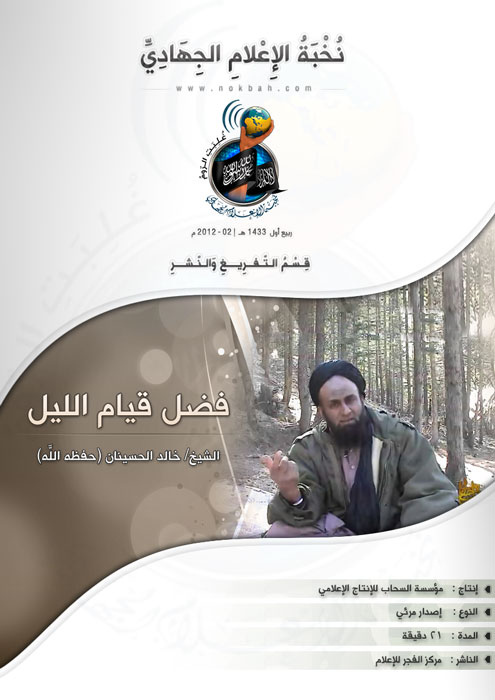
Click the following link for a safe PDF copy: Khālid bin ‘Abd al-Raḥman al-Husaynān [Abū Zayd al-Kūwaytī] — “Virtues of the Night Prayer” (Ar)
_________
To inquire about a translation for this transcription email: [email protected]
—

___________
To inquire about a translation for this video message email: [email protected]

Click the following link for a safe PDF copy: al-Ma’sadat Media Foundation presents a new poem from Muḥammad al-Zahīrī
__________

Click the following link for a safe PDF copy: Ḥāmid Bin ‘Abdullah al ‘Alī — “Political Concepts Must be Corrected!”
__________