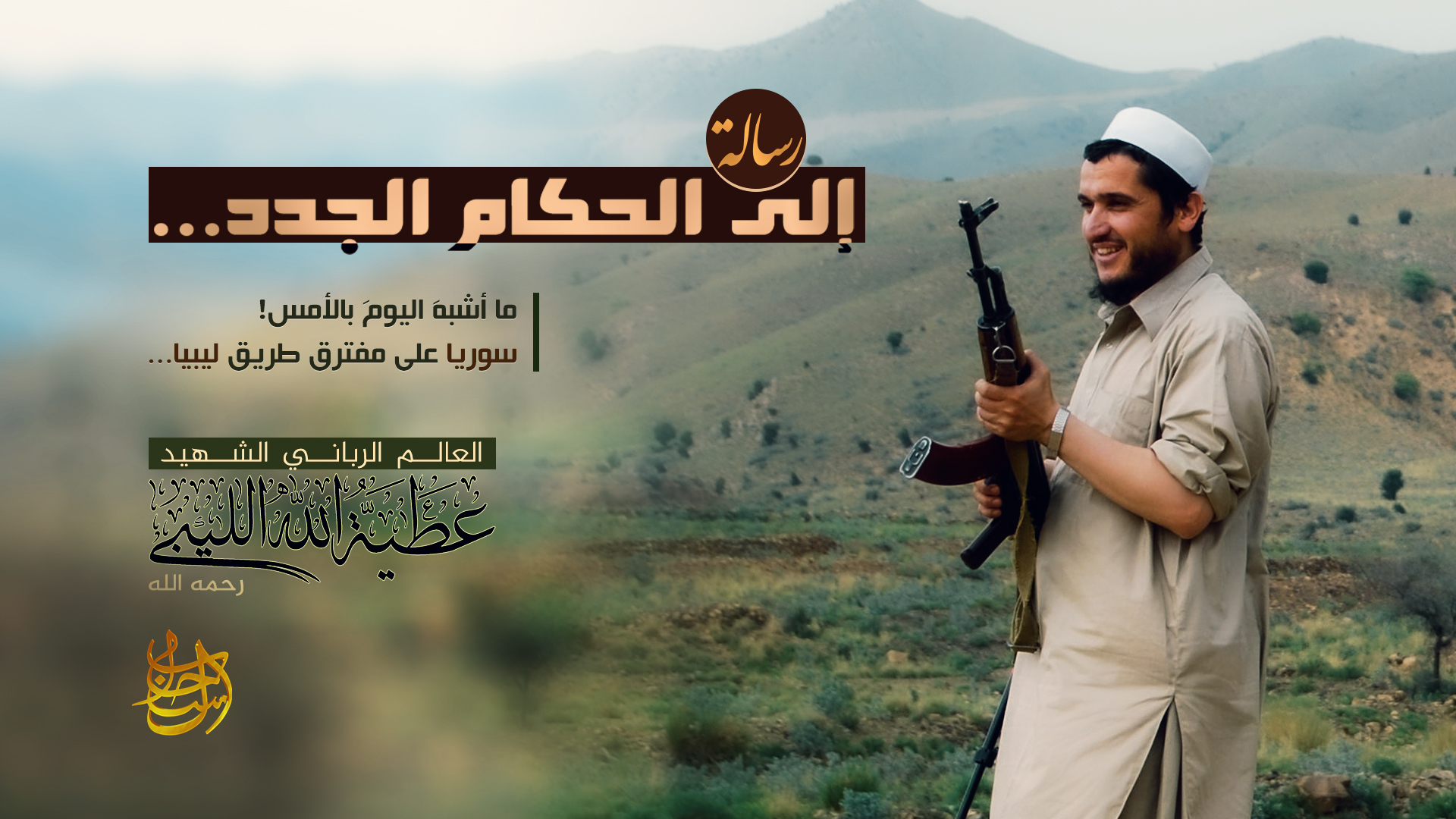
Ibn Taymīyyah Center for Media presents a new video message from Katībat al-Muhājirīn in Bilād al-Shām’s Abū Talḥah al-Lībī: “Oh Hamas, Fear God”

__________
Source: http://www.as-ansar.com/vb/showthread.php?t=89783
To inquire about a translation for this video message for a fee email: azelin@jihadology.net
Hizballah Cavalcade: Hizballah’s Multiplying Qusayr Martyrs
NOTE: For prior parts in the Hizballah Cavalcade series you can view an archive of it all here.
–
By Phillip Smyth
Hizballah Cavalcade: Hizballah’s Multiplying Qusayr Martyrs
Click here for a PDF version of this post

Figure 1: Hizballah fighters pose under a road sign pointing to the Syrian city of Qusayr. (Source: Facebook).
On April 30, 2013, Hizballah leader Sayyid Hassan Nasrallah finally made an official announcement signifying Hizballah would become more greatly involved in the Syrian Civil War. Coinciding with his speech were a number of Facebook, pro-Hizballah forum, and other online webpage posts (often with photographs) showing funerals of Hizballah members. These posts had also occurred for well over a month prior to the Nasrallah speech. While Hizballah had been more publicly involved in the conflict in Syria since the summer of 2012 (with the announcement of the first Hizballah members killed in Syria), the speech appeared to be the first truly publicized acknowledgement of what was originally covert Hizballah activity inside Syria.
The weekend spanning May 18-20, 2013 was one filled with martyrdom announcements from Lebanese Hizballah. These announcements coincided with some of the heaviest fighting witnessed since the start of an over-a-month-long, combined pro-Bashar Assad, and Hizballah offensive. This offensive targeted the strategic area of Qusayr. Qusayr serves as a communications link between Syria’s hilly coastal ‘Alawi heartland, Lebanon’s Hizballah-dominated Bekka Valley, and Syria’s capital, Damascus.[1]
Hizballah often obscures the activities of its fighters in Syria. When a Hizballah member is killed, the phrase, “Killed while performing jihad duties” is regularly utilized by the organization as a description for how and why the member died.
As the Qusayr offensive picked-up steam, the numbers of Hizballah dead multiplied greatly. On May 19, 2013, Hizballah officially released a list of 12 Hizballah members killed.[2] On the other hand, Pro-rebel sources claimed anywhere from 20-120 Hizballah members were killed. Hizballah Facebook pages posted different numbers, ranging from 8-15 killed. Additionally, not all of the newly killed Hizballah members had photographs of themselves posted online.
Pro-Hizballah Facebook groups have taken the brunt of responsibility in spreading the news of new Hizballah dead. These pages are often the first to post photographs of Hizballah’s fallen. In turn, pro-Hizballah Facebook pages demonstrate a high level of online organization. Posts announcing newly killed Hizballah members on different pro-Hizballah Facebook pages often occur within minutes of each other. Honing Hizballah’s message further, these pages also share similar photographs. Such activity underlines how information is vetted and then conveyed to the public about those killed. This fact may also demonstrate official Hizballah involvement in announcements of their dead on Facebook.
There are other dead Hizballah members who were killed in Qusayr before the turbulent weekend. However, the posted list includes individuals who were announced by Hizballah as “Martyred” during the fighting from May 18-20, 2013. Currently (May 20, 2013, 12:00PM EST), that number stands at 20 (though, it may be updated with more information). Additionally, only names which could be cross-referenced using a variety of Hizballah sources were incorporated. These sources included pro-Hizballah Facebook pages, Iranian websites, pro-Hizballah forums, official, and semi-official websites.
_
Name: Hassan Faysal Shaker
Death Announced: May 19, 2013
Notes: Shaker’s place of death was not listed on Facebook, forum, or official web posts. Shaker was originally listed as killed-in-action in an official Hizballah announcement. The announcement reported a group of 12 Hizballah fighters were killed while fulfilling their, “Jihad duties”. This photo was the only one released and could only be found on pro-Hizballah Facebook pages and on pro-Hizballah forums.

Name: (Al-Haj) Muhammed Salman al-Khalil
Death Announced: May 19, 2013
Notes: Khalil’s place of death was not listed on Facebook, forum, or official web posts.
Name: Muhammed Ali Assad Bakri
Death Announced: May 19, 2013
Notes: Bakri’s place of death was not listed on Facebook, forum, or official web posts.

Name: Abbas Muhammed Uthman
Death Announced: May 19, 2013
Notes: Uthman’s place of death was not listed on Facebook, forum, or official web posts. He was one of 12 dead, who were named in the official Hizballah notice.

Name: Fadi Muhammed al-Jazar
Death Announced: May 19, 2013
Notes: One pro-Hizballah Facebook page reported Jazar was killed fighting in Qusayr. This was one of the first announcements of a Hizballah fighter being killed in that area. The Times of Israel reported Jazar was a Hizballah “Field commander” at Qusayr and from 1991-2004 he was jailed by Israeli authorities after attacking Israeli positions on the Israel-Lebanon border. Jazar was part of a prisoner exchange in 2004.


Name: Muhammed Fouad Raba’
Death Announced: May 19, 2013
Notes: Raba’’s photo shows him holding a modified M4 carbine and posing in front of the 23mm quad-cannon toting ZSU-23 anti-aircraft gun. Raba’ was part of an official Hizballah announcement that a group of Hizballah fighters were killed fulfilling their, “Jihad duties”. This photo was the only one released and could only be found on pro-Hizballah Facebook pages.

Name: Ibrahim Husayn (A.K.A. Abu Ali or Hatem Husayn)
Death Announced: May 18, 2013
Notes: Husayn’s death was announced as part of an official Hizballah announcement that a group of Hizballah fighters were killed while fulfilling their, “Jihad duties”. On two pro-Hizballah Facebook pages, it was claimed that Husayn’s death occurred while “Defending the Zaynab Shrine”. This is a common narrative used to describe Hizballah members who have been killed in Syria. However, it is possible that Husayn could have been serving in Damascus with Hizballah-staffed front groups like Liwa’a Abu Fadl al-Abbas. Other dead Hizballah members from the weekend of May 18-19 did not repeat the claims of that note with their Facebook martyrdom announcement posts. The official website for the town of Bint Jbeil (which is Hizballah controlled) did not report that Husayn was killed defending the Zaynab Shrine. On May 20, an official Iranian website for the Young Journalists Club, reported Husayn was a Hizballah commander.

Name: Hassan Ali al-Shahrour
Death Announced: May 18, 2013. Funeral held on May 18, 2013.
Notes: According to YaHala.org, a pro-Hizballah website, Shahrour’s funeral was attended by many senior Shia religious leaders. Al-Ahed, one of Hizballah’s official news organs, reported that Hizballah MP Muhammed Ra’ad attended the funeral. This was the likely due to the fact that Ra’ad represents Nabatiyeh in Lebanon’s parliament. Photos were posted on Facebook pages, YaHala.org, and BintJbeil.org.


Figure 2: Shahrour’s funeral was led by members of the Mahdi Scouts (Hizballah’s official scouting program). To the right of Shahrour’s posters, Iran’s Ayatollah Khomeini is pictured on another poster.
Name: (al-Haj) Ahmed Wael Ra’ad
Death Announced: May 19, 2013.
Notes: No photo was posted. Ra’ad was part of an official Hizballah announcement stating a group of Hizballah fighters were killed fulfilling their, “Jihad duties”.
Name: (al-Haj) Radhwan al-‘Attar
Death Announced: May 19, 2013.
Notes: No photo was posted. ‘Attar was part of an official Hizballah announcement stating a group of Hizballah fighters were killed fulfilling their, “Jihad duties”.
Name: Hassan Hariri
Death Announced: May 19, 2013.
Notes: No photo was posted. Hariri was part of an official Hizballah announcement stating a group of Hizballah fighters were killed fulfilling their, “Jihad duties”.
Name: Radhi al-Sha’er
Death Announced: May 19, 2013
Notes: No photo was posted. Hariri was part of an official Hizballah announcement stating a group of Hizballah fighters were killed while fulfilling their, “Jihad duties”.
Name: Hussein ‘Amar Yaghi
Death Announced: May 19, 2013
Notes: No photo was posted. Yaghi was part of an official Hizballah announcement stating a group of 12 Hizballah fighters were killed while fulfilling their, “Jihad duties”.
Name: Abu Saman Qasas
Death Announced: May 19, 2013
Notes: No photo was posted. Qasas was part of an official Hizballah announcement stating a group of 12 Hizballah fighters were killed while fulfilling their, “Jihad duties”.
Name: Muhammed Qasim Abd al-Sater
Death Announced: May 19, 2013
Notes: No photo was posted. Sater was part of an official Hizballah announcement stating a group of 12 Hizballah fighters were killed while fulfilling their, “Jihad duties”.
Name: Khalil Yusuf Mizhar (A.K.A. Haji Bilal)
Death Announced: May 20, 2013
Notes: The announcement for Mizhar’s death, along with two photos, were released within minutes of each other on Facebook and semi-official Hizballah websites (E.G. BintJbeil.org).


Name: Ashraf Hasan ‘Ayyad
Death Announced: May 20, 2013
Notes: So far, the only photo of ‘Ayyad has been an official Hizballah martyrdom poster.

Name: Musen Samir Birro (A.K.A. Hassan al-Jataba)
Death Announced: May 20, 2013
Notes: So far, the only photo of Birro has been an official Hizballah martyrdom poster. On pro-Hizballah Facebook pages, it was claimed Birro was killed “defending the Zaynab Shrine.”

Name: Muhammed Husayn Barakat
Death Announced: May 20, 2013.
Notes: Barakat’s photograph (the first shown) was initially posted on pro-Hizballah Facebook pages.


Name: Talal Kasim Jezzini (A.K.A. Abu Saleh)
Death Announced: May 20, 2013
Notes: Jezzini’s death was first reported on pro-Hizballah Facebook pages.


[1] Amir Ahmed, Violence surges in strategic Syrian city, CNN, May 19, 2013, http://www.cnn.com/2013/05/19/world/meast/syria-civil-war/index.html.
Masāma’ al-Khayr l-l-Inshād presents a new Nashīd from Abū Ḥamzah al-Ḥamawi: “We Will Take Revenge Oh Syria”

_________
Source: http://www.as-ansar.com/vb/showthread.php?t=89665
To inquire about a translation for this nashīd for a fee email: azelin@jihadology.net
Hizballah Cavalcade: Roundup of Iraqis Killed in Syria, Part 2
NOTE: For prior parts in the Hizballah Cavalcade series you can view an archive of it all here. Click here for part one of ‘Roundup of Iraqis Killed in Syria’.
–
By Phillip Smyth
Roundup of Iraqis Killed in Syria, Part 2
The latest installment of Iraqi Shia killed in Syria demonstrates a more publicly acknowledged level of Iranian involvement. Two bodies of Iraqi Shia fighters killed in Syria were returned to Iraq through the Iran-Iraq border. Family members of one of the dead Iraqis told the Associated Press that he had gone to Iran before heading to Syria.[1]
The make-up of Liwa’a Abu Fadl al-Abbas’s (LAFA) — a Syrian-based Shia militant group—membership was also exposed. Demonstrating a slight departure from earlier martyrdom announcements, Asa’ib Ahl al-Haq (AAH) more broadly acknowledged that their fighters in Syria operate exclusively under LAFA’s moniker. Earlier announcements listed only one of AAH fighters as serving with LAFA.
Three of the Iraqis killed were reportedly not claimed as members by any Iraqi Shia parties (including pro-Iranian Iraq-based groups). This partially fits with LAFA’s narrative that they are staffed by volunteer fighters from throughout the Shia Islamic world. However, with the recent revelations, it becomes clearer that LAFA fighters are most likely vetted and trained by Iran before heading off to fight in Syria.
_
Name: Ala’a Muhsen Shahib al-Tamimi
Affiliated With: Asa’ib Ahl al-Haq/Liwa’a Abu Fadl al-Abbas
Death Announced: May 15, 2013. His death was first announced on Facebook.

Name: Ali Abdul al-Wahid ‘Awlan
Affiliated With: Asa’ib Ahl al-Haq/Liwa’a Abu Fadl al-Abbas
Death Announced: May 15, 2013. His death was first announced on Facebook on May 16, 2013.
Notes: Iran’s Supreme Leader Grand Ayatollah Ali Khamenei is pictured on the right and Iraqi cleric Grand Ayatollah Muhammed Sadiq al-Sadr is pictured on the left.

Name: Muhammed Aboud al-Maliki (A.K.A. Mohammed Aboud)
Affiliated With: Liwa’a Abu Fadl al-Abbas
Death Announced: May 17, 2013. Funeral held on May 17, 2013.
Notes: According to Elaph.com, Muhammed Aboud al-Maliki was a 27 year old Iraqi from Basra. Elaph also said he was not claimed by any Iraqi organization as a member. It was also reported by the Associated Press that Aboud went to Iran before heading to fight in Syria. Maliki’s body and that of fellow fighter Hassan Ali Farhud were also transferred back to Iraq via Iran. Since it was announced he was killed fighting around Damascus’s Zaynab Shrine, it is possible he was fighting as a member of Liwa’a Abu Fadl al-Abbas. One released photo of Muhammed Aboud al-Maliki, which was posted on pro-Lebanese Hizballah and pro-Liwa’a Abu Fadl al Abbas Facebook pages, also claimed he belonged to Liwa’a Abu Fadl al-Abbas.
The released photo may also point to al-Maliki’s training influences. Holding the magazine of the rifle is a common fire-control technique used by Hizballah and is featured in a number of their propaganda videos.

Name: Hassan Ali Farhud
Affiliated With: Liwa’a Abu Fadl al-Abbas* (?)
Death Announced: May 17, 2013. Funeral held on May 17, 2013.
Notes: According to Al-Sumaria News, Farhud was a 32 year old from Basra, Iraq. His body, along with Muhammed Aboud al-Maliki (see above) were returned to Iraq via Iran. It is unknown whether he engaged in training in Iran or which group he served with. Since it was reported he was killed fighting around the Zaynab Shrine in Damascus, it can be assumed he was part of Liw’a Abu Fadl al-Abbas. At the time this was written, no photos of Farhud were released.
NO PHOTO AVAILABLE
Name: Diya Mutasher al-Issawi
Affiliated With: Liwa’a Abu Fadl al-Abbas
Death Announced: May 5, 2013. Funeral held on May 6, 2013.
Notes: The Iraq-based Buratha News Agency reported the 30 year old was originally from Iraq’s Basra province. Issawi was not claimed by any Iraqi party as a member. Also, it is unknown whether Issawi was trained in Iran or elsewhere.

[1] “Bombings at Sunni mosque and funeral kill 47 in Iraq”, Associated Press, May 17, 2013, http://www.washingtonpost.com/world/middle_east/iraqis-in-southern-city-mourn-2-shiite-fighters-killed-in-syria/2013/05/17/a53d1988-bece-11e2-b537-ab47f0325f7c_story.html.
Hizballah Cavalcade: What is the Liwa’a Abu Fadl al-Abbas (LAFA)?: Assessing Syria’s Shia “International Brigade” Through Their Social Media Presence
NOTE: For prior parts in the Hizballah Cavalcade series you can view an archive of it all here.
–
What is the Liwa’a Abu Fadl al-Abbas (LAFA)?: Assessing Syria’s Shia “International Brigade” Through Their Social Media Presence
By Phillip Smyth
Click here for a PDF version of this post
Making its first appearances in the fall of 2012, Liwa’a Abu Fadl al-Abbas (Abu Fadl al-Abbas Brigades or LAFA) represents a new addition to the Syrian battlefield and serves as another example of increased sectarianism in the Syrian Civil War. The organization claims its role is to defend the Sayida Zaynab Shrine and surrounding Shia populated neighborhoods located in southern Damascus.[1] The group is made-up of a mixture of a small number of native Syrian Shia with a majority of foreign Shia Muslim fighters.
LAFA has also maintained an outward appearance which mirrors the same type of spirit once found with the volunteer International Brigades during the Spanish Civil War. Despite the presented narrative, this does not necessitate the group is an ad hoc collection of individual Shia Muslims. The group heavily utilizes fighters originating from Iranian-backed organizations (such as Iraq’s Kata’ib Hizballah and Asa’ib Ahl al-Haq), has uniformed personnel, new weapons, a recognizable leadership structure, and openly identifies with Lebanese Hizballah. These factors point to an extremely organized fighting group and deeper levels of Iranian involvement in the organization.
Unlike larger and more established militant Shia Islamist groups such as Lebanon’s Hizballah or Iraq’s Asa’ib Ahl al-Haq, LAFA has no official website or official online forums. The group finds most of its internet representation through a mixture of quasi-official Facebook pages and YouTube stations. In fact, for the Western and Arabic-language press, LAFA’s existence only came to light when a YouTube music video featuring the group’s fighters was made public.[2] Thus, fifteen pro-LAFA Facebook pages, five Facebook pages associated with Lebanese Hizballah, one Hizballah forum, three pro-Muqtada al-Sadr forums, and five pro-LAFA/pro-Hizballah YouTube stations were reviewed for this study.
“Labayka Ya Zaynab!”: Abu Fadl al-Abbas’s Messaging Campaign & Narrative
Designating itself firmly as a Shia militant organization, LAFA utilizes Shia Islamic imagery, slogans, and other symbols to push its case to Shia Muslims. As stated by the group and its supporters, the Abu Fadl al-Abbas Brigade’s main purpose is to “Defend the Saydah Zaynab Shrine”. Their specified raison d’etre, immediately projects an image of “Protectors” simply reacting to a foe bent on the destruction of Shi’ism.
A common chant heard and written by LAFA members and supporters is “Labayka Ya Zaynab!” (“We are here for you Zaynab”). The slogan directly refers to the defense of the Zaynab Shrine and has also become a rallying cry for Shia Islamist groups fighting in Syria. At funerals held for Lebanese Hizballah members killed in Syria, the same slogan regularly chanted. LAFA militants regularly say the phrase as they engage Syrian rebel forces. The cry reinforces the line that the group’s sole function is the protection of the Zaynab Shrine and that they are worthy of praise for their sacrifice for the entirety of Shi’ism.
The Shia Symbolism behind LAFA’s name originates with the story of Abu Fadl al-Abbas (A.K.A. Abbas Ibn Ali). Abu Fadl al-Abbas was a trusted and brave warrior who fought for his father, Imam Ali ibn Abi Talib.[3] Serving with Imam Husayn’s forces during the religiously important and historic Battle of Karbala, Abu Fadl al-Abbas had both of his arms cut off attempting to collect water for his besieged compatriots. Symbolizing his willingness to sacrifice and loyalty, until he was killed, Abbas continued to carry water back to his forces using his mouth.[4]
LAFA has attempted to utilize this story in their propaganda material. The image of a severed arm was actually featured in a number of pro-LAFA videos.[5] Additionally, the green flag on LAFA’s logo represents the flag Abu Fadl al-Abbas carried when he acted as flag bearer for Imam Husayn during the Battle of Karbala.
The story taps into the very roots of the Sunni-Shia split. For Shia, the Battle of Karbala symbolizes their rejection of oppressive Sunni rule. Combined with what appears to be a clear Sunni Islamist drive to dislodge Shia presence in Syria, for many Shia the story resonates in the contemporary sense. Since the shrine and neighborhoods LAFA claims to protect are surrounded by pockets of Syrian rebels, the field of battle is also reminiscent of the Battle of Karbala. With these prevailing themes, LAFA taps into the culturally important concept of Shia self-sacrifice. These themes were used extensively by Iran’s current leadership and has been refered to by some scholars as the, “Karbala narrative”.[6]

Figure 1: Another example of LAFA pushing the “Israel/Jewish-Sunni Gulf Arab” or “Israel/Jewish-Takfiri” conspiracy narrative. A LAFA member steps on a paper reading “Al-Saudia/Qatar/Al-Khaleej” (“Saudi, Qatar, the Gulf”) which are positioned under a Star of David. (Source: Facebook).
While LAFA describes its enemy as “Takfiris” or as “Gulf and Israeli” supported enemies, it neither specifically targets Sunni Muslims as a whole, nor marks the entire sect as apostates. Instead, the group brands its Syrian rebel enemies (no matter their political orientation, tactics utilized, or how secular) as “Wahhabists”, “Terrorists” and/or “Extremists”. Moreover, a number of online LAFA supporters refer to all Syrian rebels as “Kafirun” (“infidels”).
A major propaganda event for LAFA occurred when one of its members raised a red banner over the Zaynab Shrine’s golden dome. The message portrayal appeared to be one of valiantly opposing their Syrian rebel enemy and of embodying the flag-bearing role of Abu Fadl al-Abbas. The raising of the red banner signified willingness to become a martyr since it is the symbolic color for martyrdom in Shi’ism.[7] At the time of this writing, the film of the LAFA militant raising the red flag has been re-edited into eight YouTube films.

Figure 2: LAFA members and supporters raise a red banner reading “Ya Zaynab” (“O Zaynab”) over the shrine. (Source: Facebook).

Figure 3: A photo of a LAFA member raises the red flag reading, “Ya Zaynab” (“O Zaynab”). (Source: Facebook).

Figure 4: An example of the Zaynab Shrine in LAFA propaganda. “Liwa’a Abu Fadl Al-Abbas” is written in Arabic calligraphy. Wrapped around the shrine’s minaret is a flag reading, “Ya Zaynab” (“O Zaynab”). (Source: Facebook).

Figure 5: 7.62×39 rounds (the round used in the AK-47) have been arranged to spell, “Ya Ali” (O, Ali). The Ali reference refers to Imam Ali Ibn Abi Talib. For the Shia, he is considered the first Imam, his family. The ammunition also forms the Zulfiqar, Ali’s double pointed sword, which represents divinely guided power. (Source: Facebook).
Iranian-Backed Groups & Liwa’a Abu Fadl al-Abbas
The foreign fighter element of Liwa’a Abu Fadl al-Abbas has caught the attention of many analyzing the group. A key factor for new militia is that the majority of fighters killed come from both Iraq and Lebanon. The original parties they were aligned with were either beholden to Iranian radical ideology or created with Iranian aid. This factor points to a more direct Iranian involvement with the organization’s creation.
There has been a preponderance of reports citing large number of Iraqi Shia who have joined the group. Pro-LAFA social media is rife with many individuals praising Iraqi Shia efforts with the group. However, there have also been numerous Lebanese Shia—mainly Hizballah members—who fight or have fought with the group.
Journalist Nicholas Blanford identified that Hizballah involvement with the militia could be determined due to their utilization of semi-automatic fire, “a technique taught to Hezbollah combatants to improve accuracy and save ammunition”.[8] The clothing worn by LAFA members also points to another Hizballah-LAFA connection.[9] However, the links between the two organizations are far deeper than similar weapons techniques and uniforms.
As far back as August, 2012, there was unconfirmed evidence that Hizballah had positioned itself around the Zaynab shrine. At that time, Hassan Selim Meqdad, a Lebanese Shia was captured by Syrian rebels and was accused of being a Hizballah operative fighting in Syria. His family and Hizballah both denied the claims.[10] When Meqdad was filmed, he told his captors he was one of 250 Hizballah members who were based at the Zeinab Shrine and tasked with its defense.[11] While his answers were clearly attained under duress and possibly torture, there have been other more concrete examples demonstrating Lebanese Hizballah’s involvement with Liwa’a Abu Fadl al-Abbas.

Figure 6: A photo of Lebanese Hizballah’s Haidar Haj Ali fighting in Damascus’s Midan neighborhood with LAFA. In the background stands the damaged Hazrat Sakina Shrine.
In April, 2013, it was announced that Hizballah member, Haidar Haj Ali was killed while performing his “Jihad duties”—a common euphemism for Lebanese Hizballah to describe its members killed in Syria.[12] Ali was filmed firing a B10 recoilless rifle on a rooftop in the Damascus neighborhood of Midan. The damaged dome of the Hazrat Sakina Shrine can be viewed in the background.[13] The film was initially posted online (on YouTube and then recast on LAFA Facebook pages) as an example of the Abu Fadl al-Abbas Brigade defending the neighborhood. Even after it became known that Haidar Haj Ali was a Hizballah member, the video was circulated around most major pro-LAFA Facebooks and forums as an example of LAFA’s fighting abilities.
Figure 7 (Left): A screen capture from a Russia Today-Arabic report on Liwa’a Abu Fadl al-Abbas. The marker on the right features a dead fighter who may have been with Hizballah. Both the Syrian and Hizballah flags are pictured. Between the two tombstones another Hizballah flag stands in front of a poster of the revered Al-Abbas Ibn-Ali. (Source: YouTube).
Figure 8 (Right): Two Abu Fadl al-Abbas members rest on a car’s hood. The car is decorated with Bashar al-Assad and Hizballah leader Sayyid Hasan Nasrallah posters. (Source: Facebook).

The utilization of Hizballah iconography also serves as another giveaway that the group is built along the Hizballah-model. In many photos posted on social media, Hizballah symbols are often more common with Abu Fadl al-Abbas fighters than their own symbol. Logos for other pro-Iranian Iraqi Shia groups is also sparse. Thus far, the Brigade has only utilized simple patches with the group’s name emblazoned on them. At most, their more official symbol has only been seen online, particularly in their videos and semi-official photo releases. Since March, 2013, these releases have primarily occurred on YouTube and Facebook.


Figure 9 (Left): Behind an Abu Fadl al-Abbas Brigade member standing on the left, a Hizballah flag droops in front of a Syrian flag bearing “Al-Jaysh Arabi Suri” (“The Syrian Arab Army”). (Source: Facebook).
Figure 10 (Right): In Arabic the patch reads, “Khadam al-Saydeh Zaynab Liwa’a Abu Fadl al ‘Abbas”, or “Servants of the Lady Zaynab Abu Fadl al-Abbas Brigades”. It is interesting to note that the uniform’s camoflauge appears to be pattered off the U.S. woodland MARPAT design.
Examples of this camoflague can also be found in Iraq. (Source: Facebook).

Figure 11: The funeral for Rabieh Mahmud Fares. Fares was a Hizballah fighter killed in Syria. The same pattern of MARPAT-style camouflage worn by the Abu Fadl al-Abbas militants is also worn by Hizballah fighters. (Source: YouTube).
Figure 12: The same MARPAT-style camouflage worn by Hizballah members at the funeral for Haidar Hajj Ali. (Source: Nabatieh.org).
Leadership:
Like Lebanese Hizballah, Kata’ib Hizballah, and Asa’ib Ahl al-Haq, Liwa’a Abu Fadl al-Abbas has a designated “Secretary General”, Abu ‘Ajeeb. Little is known about ‘Ajeeb. Pro-Free Syrian Army forums and Facebook pages reported Abu ‘Ajeeb was captured on April, 2, 2013 by units belonging to Syria’s Al Qaida branch, Jabhat al-Nusra.[14] However, LAFA responded by posting a number of photographs of Abu ‘Ajeeb on their many Facebook pages. Another commander named by the group is Abu Hajar. It is likely both Abu Hajar and Abu ‘Ajeeb are both nom de guerres.

Figure 13: Abu ‘Ajeeb.
Figure 14: Abu ‘Ajeeb and other LAFA militants drinking Pepsi. (Source: Facebook).

Figure 15: Abu Hajar is pictured with a Syrian tank and in a hospital bed after being wounded. The yellow text reads, “Al-qaid Abu Hajar” (“The commander Abu Hajer”). (Source: Facebook).


Figure 16: Abu Hajar poses in two photos with a Syrian army T-72 tank. (Source: Facebook).

Figure 17: Abu ‘Ajeeb poses with two other LAFA militants. (Source: Facebook).

Figure 18: Abu Hajar stands with another LAFA fighter in the area around the Zaynab Shrine. (Source: Facebook).

Figure 18: Abu ‘Ajeeb (left), Abu Hajar (right), and other LAFA members.
A Close Relationship With the Syrian Army
There are strong indicators that the group, instead of operating as an independent entity and simply fighting for the “Protection of the shrine”, is in fact being utilized as another unit for the larger Syrian Army. Photos of LAFA members posing with Syrian army and police armored vehicles demonstrate some level of coordination. Also, some videos of LAFA personnel using heavy Syrian army equipment confirm the group operates alongside the Syrian army. Nevertheless, it is unknown whether the group has been utilized as an infantry component which compliments Syrian army units in other parts of Damascus.

Figure 19: Abu Fadl al-Abbas members pose in front of a Syrian Army T-72. (Source: Roafd.info. Note: Roafd.info is a leading pro-Muqtada al-Sadr forum website).

Figure 20: Abu Fadl al-Abbas members using a National Defense Force (NDF or Jaysh al-Sha’bi [People’s Army]) vehicle. (Source: Facebook).

Figure 21: Armed with a PKM machine gun, a member of the Abu Fadl al-Abbas Brigade stands in front of a Syrian police BRDM-2 armored personnel carrier. (Source: Facebook).

Figure 22: A group of Abu Fadl al-Abbas fighters collect around and on top of a Syrian army armored personnel carrier. (Source: Facebook).

Figure 23: Abu Fadl al-Abbas members offer infantry support for a Syrian army T-72. (Source: Facebook).
Figure 24: An Abu Fadl al-Abbas fighter poses with an RPG-7 on an upgraded Syrian army T-72M1 with explosive reactive armor. (Source: Facebook).
Figure 25: The video reportedly shows Karar Abed al-Amir Fatlawi Abu Assad, an Iraqi member of Asa’ib Ahl al-Haq and LAFA militant, firing a Syrian army artillery piece.
When Liwa’a Abu Fadl al-Abbas is Not Fighting:

Figure 25: A fighter checks his smartphone in a non-urban setting.

Figure 27: An Abu Fadl al-Abbas militiaman shows off a photo of Grand Ayatollah Sadiq al-Sadr, demonstrating this fighter is likely an Iraqi.

Figure 28: LAFA members share a meal in a trench.
Figure 29: Two LAFA members pose with Shia flags in front of graffiti reading, “Ya ‘Ali” (“O Ali”).
The Snipers of Abu Fadl al-Abbas
A reoccurring theme found in many photos of Abu Fadl al-Abbas is the preponderance of sniper rifles. Most of the sniper weapons photographed are Russian-designed, 7.62×54 caliber, SVD or “Dragunov”.

Figure 30: An Abu Fadl al-Abbas militiaman with a bolt-action sniper rifle engaged in combat.

Figure 31: An Abu Fadl al-Abbas militiaman takes aim with a modernized version of the “Dragunov”-style rifle, the Russian SVDS rifle.

Figure 32: Karar Abed al-Amir Fatlawi Abu Assad, a member of Iraq’s Asa’ib Ahl al-Haq who was killed fighting as a member of LAFA, poses with an SVD “Dragunov” rifle.

Figure 33: A member of Abu Fadl al-Abbas grabs a nap with his SVD “Dragunov”-style rifle.

Figure 34: Another Abu Fadl al-Abbas fighter takes aim with his SVD “Dragunov” type rifle. (Source: Facebook).
LAFA In Combat:
LAFA’s videos and photographs have demonstrated it is a unit which has knowledge of more advanced urban warfare tactics. Most small-arms pictured with LAFA fighters appear new types of Soviet or Russian design. In addition, the group has access to artillery, a variety of modified trucks (known as “technicals”), and mortars.

Figure 35: According to one pro-LAFA Facebook page, this photo shows an Iraqi LAFA member. He sits in the bed of a pickup truck with a 4-barrel rocket launcher. The same vehicle was shown launching a rocket in a video released by a pro-LAFA Youtube/Facebook page in April (See above video). (Photo Source: Facebook. Video Source: YouTube).

Figure 36: A LAFA fighter loads a mortar. (Source: Facebook).

Figure 37: A LAFA member mans a PKM machine gun. (Source: Facebook).

Figure 38: LAFA member with a Bulgarian AMD-65 rifle, 75 round drum magazine, and optics.
“Warning: Graphic”

Figure 39: LAFA members stand over a killed rebel fighter. (Source: Facebook).
[1] Mariam Karouny, “Shi’ite fighters rally to defend Damascus shrine”, Reuters, March 3, 2013, http://www.reuters.com/article/2013/03/03/us-syria-crisis-shiites-idUSBRE92202X20130303.
[2] Nicholas Blanford, “Video appears to show Hezbollah and Iraqi Shiites fighting in Syria”, Christian Science Monitor, January 18, 2013, http://www.csmonitor.com/World/Middle-East/2013/0118/Video-appears-to-show-Hezbollah-and-Iraqi-Shiites-fighting-in-Syria.
[3] Note: For Shia Muslims, Imam Ali ranks behind the Muslim prophet Muhammed in terms of importance.
[4] Seyed Ali Farid Mohammadi, “Shi’i Hagiography: Highlights About the Lives of Five Illustrious and Eminent Shi’i Personalities”, (London: MIU Press, 2013) pp. 88-93.
[5] See: http://youtu.be/AjJnPpNUaxg (0.32-0.34). Note: The Yousif al-Iraqi YouTube account was the same source for the original Abu Fadl al-Abbas music video cited in some Western reports.
[6] Kamran Scot Aghaie, “The Martyrs Of Karbala: Shi’i symbols and rituals in modern Iran”, (Seattle, Washington, University of Washington Press, 2004), pp.87-88.
[7] Hafizullah Emadi, Politics of the Dispossessed: Superpowers and Developments in the Middle East, (Westport, CT: Praeger Publishers, 2001), P.66.
[8] Nicholas Blanford, “Video appears to show Hezbollah and Iraqi Shiites fighting in Syria”, Christian Science Monitor, January 18, 2013, http://www.csmonitor.com/World/Middle-East/2013/0118/Video-appears-to-show-Hezbollah-and-Iraqi-Shiites-fighting-in-Syria.
[9] While Hizballah and LAFA militants have donned a number of camouflage patters, their use of the relatively new, digitally designed, MARPAT-style camouflage uniform stands-out.
[10] Nicholas Blanford, “One kidnapping in Syria prompts kidnapping of 20-plus in Lebanon”, Christian Science Monitor, August 15, 2012, http://www.csmonitor.com/World/Middle-East/2012/0815/One-kidnapping-in-Syria-prompts-kidnapping-of-20-plus-in-Lebanon.
[11] Syrian rebel recording, YouTube, August 13, 2012, http://youtu.be/FWCVQbGVDAU.
[12] Rakan al-Fakih, “Shells from Syria hit outskirts of Al-Qaa”, The Daily Star (Beirut), May 14, 2013, http://www.dailystar.com.lb/News/Local-News/2013/May-14/217067-four-rockets-from-syria-hit-outskirts-of-al-qaa.ashx#axzz2TK5XMb8H
[13] “Holy Shrine of Hazrat Sakina (AS) Damaged by Terrorists in Syria + Pic”, Ahlul Bayt News Agency, February 2, 2013, http://abna.ir/data.asp?lang=3&Id=390320.
GUEST POST: Jabhat al-Nusra’s Relations With Other Rebels After the Bay’ah to Zawahiri
NOTE: As with all guest posts, the opinions expressed below are those of the guest author and they do not necessarily represent the views of this blogs administrator and does not at all represent his employer at the Washington Institute for Near East Policy.
Jihadology.net aims to not only provide primary sources for researchers and occasional analysis of them, but also to allow other young and upcoming students as well as established academics or policy wonks to contribute original analysis on issues related to jihadism. If you would like to contribute a piece, please email your idea/post to azelin [at] jihadology [dot] net.
Past Guest Posts:
Aymenn Jawad Al-Tamimi, “Majlis Shura al-Mujahidin: Between Israel and Hamas,” May 6, 2013.
Hazim Fouad, “Salafi-Jihadists and non-jihadist Salafists in Egypt – A case study about politics and methodology (manhaj),” April 30, 2013.
Shami Witness, “On the Jabhat al Nusrah vs. Kataeb Farouq Fitna,” March 27, 2013.
Aymenn Jawad Al-Tamimi, “Famous Anasheed: ‘Madin Kas-Sayf’ by Abu Ali,” March 3, 2013.
Daveed Gartenstein-Ross and Tara Vassefi, “Perceptions of the “Arab Spring” Within the Salafi-Jihadi Movement,” November 19, 2012.
Jack Roche, “The Indonesian Jamā’ah Islāmiyyah’s Constitution (PUPJI),” November 14, 2012.
Kévin Jackson, “The Pledge of Allegiance and its Implications,” July 27, 2012.
Behnam Said, “A Brief Look at the History and Power of Anasheed in Jihadist Culture,” May 31, 2012.
Jonah Ondieki and Jake Zenn, “Gaidi Mtaani,” April 24, 2012.
Joshua Foust, “Jihadi Ideology Is Not As Important As We Think,” January 25, 2011.
Charles Cameron, “Hitting the Blind-Spot- A Review of Jean-Pierre Filiu’s “Apocalypse in Islam,” January 24, 2011.
Daveed Gartenstein-Ross, “Why Jihadi Ideology Matters,” January 21, 2011.
Joshua Foust, “Some Inchoate Thoughts on Ideology,” January 19, 2011.
Marissa Allison, “Militants Seize Mecca: Juhaymān al ‘Utaybī and the Siege of the Grand Mosque in Mecca,” June 9, 2010.
–
By Aymenn Jawad Al-Tamimi
Much discussion arose last month when Abu Bakr al-Baghdadi of the Iraqi al-Qa’ida branch Islamic State of Iraq (ISI) declared that his group and Jabhat al-Nusra (JAN) are in fact one and the same, prompting Sheikh Jowlani of JAN to reply that he was not consulted on this decision, while pledging allegiance to Ayman al-Zawahiri and making clear the links between ISI and JAN.
It is likely that the decision to have an ISI-JAN merger announced was Zawahiri’s idea. From this likely supposition, many commentators claimed a turning point in JAN’s fortunes in Syria for the worse. Thus did Brian Fishman attempt to draw an analogy with Iraq, asserting: “It wouldn’t be the first time he [Zawahiri] botched the terror group’s strategy in the region.”
Fishman’s analogy is that the al-Qa’ida pledge in Iraq inevitably translated to brutalization of local Sunnis, which, along with “U.S. pressure” on al-Qa’ida, proved the decisive turning point against al-Qa’ida after the rise of the Sahwa (Awakening) movement. Hence he concludes, “For better or worse, the reckoning between al-Qa’ida’s Syria affiliate and other rebel groups is beginning.”
However, I contend that this view is well overblown. “Syria is/is not Iraq” is of course a statement frequently brought up in common debates over whether the outside world should intervene in militarily or provide lethal aid to rebel forces. The problem is that the general debate over comparisons of Syria to Iraq does not appreciate that the dynamics of how the civil war progressed in Iraq are vastly different from Syria.
Iraq’s sectarian civil war was focused on what might be termed a decisive ‘Battle for Baghdad’ between rival Sunni and Shi’a militias, with the former- demographically in a minority- believing that Sunni Arabs were in fact the majority and could win that civil war. By the end of 2006, large-scale ethnic cleansing of Sunnis from Baghdad had convinced many insurgents who had been working with al-Qa’ida that they could not win, and hence a key driving force behind the turn against al-Qa’ida.
On a side note, I should point out that the belief in a Sunni Arab majority in Iraq is by no means dead, and is back on the ascendancy, being promoted by some mainstream Sunni Arab politicians like Osama al-Nujaifi and by groups organizing demonstrations such as Intifada Ahrar al-Iraq (IAAI).
IAAI is essentially the activist wing of the neo-Ba’athist Naqshibandi militia movement. Concomitant with that belief in a Sunni Arab majority is the notion of marching on Baghdad to retake the city and calling for jihad, sentiments apparent at IAAI protests in areas like Hawija and Tikrit.
In any case, the development of Syria’s civil war is not analogous. For one thing, the timescale is much greater than in Iraq, and Sunni insurgents in Syria are not a minority who falsely believe they are in the majority.
False analogies with Iraq aside, an overview of statements made by various other rebel groups as well as developments on the ground show that nothing has changed for the worse for JAN. Beginning with the issue of statements on JAN’s pledge of allegiance to Zawahiri, the sentiment can be summarized as follows: ‘While we appreciate your efforts against the regime, we do not believe a pledge of allegiance to al-Qa’ida is in anyone’s interests.’ Thus, not a repudiation of JAN itself, but just al-Qa’ida.
Consider, for example, a statement (courtesy of Charles Lister) put out by a Deir ez-Zor battalion known as the Jaish al-Tawhid, which is aligned with the Salafist rebel coalition called the Syrian Islamic Front (SIF). The statement read: “As for Jabhat al-Nusra’s allegiance to al-Qa’ida, this is a matter for their concern, even though we do not support them [in it] as they have come to hold this view, and we recognize that Jowlani’s pledge of allegiance to Sheikh al-Zawahiri is a course of action that does not achieve legitimate interests.”
In a similar vein, Harakat Ahrar al-Sham al-Islamiya- one of the largest battalions in the SIF- recently put out a statement indicating that they did not approve of Abu Bakr al-Baghdadi’s declaration of a merger between ISI and JAN, saying that his announcement was not done in consultation with any proper religious authorities in Syria.
At the same time, the battalion made clear its appreciation of “the self-sacrifice and courage of Jabhat al-Nusra in battles and its good deeds and the goodness of its treatment of the people,” declared to be advancing “the interests of the Ummah.”
Notably, the statement recognizes the risks of conflict spreading in the wider region, but makes clear that “this does not constitute an arbitrary judgment for the artificial borders between the sons of the Ummah.” In other words, Harakat Ahrar al-Sham al-Islamiya does not see the notion of an ideological project beyond Syria’s borders as somehow illegitimate.
Coming to reactions outside this Salafist framework, we have the case of a statement put out immediately after JAN’s al-Qa’ida pledge by a self-proclaimed Free Syrian Army military council in the Damascus area, indicating that while JAN is not part of its structure, “its role in the defense of our oppressed people facing the regime of the tyrant [Assad] is valued.”
The al-Furqan Brigades likewise weighed in on JAN’s pledge of allegiance to al-Qa’ida. Their statement cited Qur’an 5:51, “O you who believe, do not take the Jews and Christians as friends; they are in fact friends of each other. And whosoever among you takes them [as friends] is one of them; and verily God does not guide the people of wrongdoers.” The statement goes on to accuse Jews and their Western allies of causing the bloodshed in Syria by enabling the Assad regime.
As for JAN, the al-Furqan Brigades’ statement affirms: “We are proud of their precious sacrifices and their bloody fights…we see in Jabhat al-Nusra a fine model of faith and a guiding example of manliness and heroism, but we reject what has come from Jabhat recently- if Youtube is telling the truth- on its pledge of allegiance to Sheikh al-Zawahiri and al-Qa’ida, for we reject expansion of the land of the struggle outside Syria,” for the true goals are to achieve “freedom for the Syrian people, its [Syria’s] stability, and its territorial integrity.” Thus, in contrast to Harakat Ahrar al-Sham al-Islamiya, the al-Furqan Brigades maintain a strictly nationalist outlook, but again, the common thread of appreciating JAN’s war efforts while disapproving of the al-Qa’ida link.
On the ground, the announcement of the pledge to al-Qa’ida has changed little in terms of other battalions’ relations with JAN. Battalions of all ideological streaks are still willing to declare when they coordinate operations with JAN.
For example, at the end of April, the Farouq Battalions- associated with the Syrian Islamic Liberation Front (SILF- Islamist-leaning but to be distinguished from the Salafist SIF)- announced that they were conducting operations in Hama “with our brothers from Jabhat al-Nusra, Ahfad al-Rasul, Fajr al-Islam and other battalions.” Here is a video that corroborates Farouq’s announcement.
Similarly, Harakat Ahrar al-Sham al-Islamiya released a statement on 7 May on an operation against a military convoy in the Damascus area, carried out in coordination with three other rebel groups, including Jabhat al-Nusra.
Further, a video was recently released in which it was announced that JAN has taken over the eastern front in Deraa with the cooperation of a number of battalions, including Harakat Ahrar al-Sham al-Islamiya and the Martyrs of Yarmouk Brigade, the latter of which maintains an affiliation with the more moderate Syrian Military Council (SMC) headed by General Salim Idris.
In a similar vein, a recent joint-rebel offensive in Idlib was announced, involving battalions like Harakat Ahrar al-Sham al-Islamiya, Suqur al-Sham (SILF-affiliated), and Jabhat al-Nusra. Over in the east of the country, those who pledge allegiance to the ‘Free Army’ also work with JAN, particularly in the Deir ez-Zor area.
One need not go on with further examples. The point is that rebel battalions of all ideological streaks will coordinate with JAN when they feel necessary. There have of course been clashes between JAN and rival rebel groups, but one should not be so hasty as to ascribe them to ideological conflicts. They can generally be traced to more mundane roots like control over resources (especially oil), territory and border access points.
While reporters like Martin Chulov frequently produce interview testimony of rebel fighters who say they are prepared to form Sahwa militias to take on al-Qa’ida-aligned mujahideen, I would say that this is more a case of interviewees telling Western reporters what they think Westerners want to hear.
Given how fragmented rebel-held areas of Syria are, JAN clearly cannot exercise control over everything its members do, but there is no evidence to suggest any substantial change in the general approach to consolidating its hold on areas where it has a substantial presence: namely, providing services for the local populations and trying to implement its ideology through a gradualist approach and dissemination of propaganda, while not refraining from dealing ruthlessly with perceived pro-regime soldiers and destroying signs of Shi’i Islam. Thus, here we have a video of JAN arranging for the distribution of bread for the eastern town of Mayadeen.
In the city of Raqqah, which was taken over primarily by JAN and Harakat Ahrar al-Sham al-Islamiya, tolerance is accorded to a secular activist trend (see videos here, here and here), even as Shari’a courts have now arisen in the Raqqah to the discontent of some of its inhabitants. At the same time, the Shi’i shrine of Ammar ibn Yasir in Raqqah has been destroyed, according to the testimony of reporter Javier Espinosa.
In short, it can be seen how the pledge of allegiance to al-Qa’ida has done nothing apart from confirming what U.S. intelligence long suspected. The rebels and local populations on the ground were well aware of the affiliation too. I also predict that in the long term JAN’s affiliation will not translate to much either: rebel rivalries and conflicts are inevitable anyway even in a post-Assad environment.
In the midst of such chaos, I see it as unlikely that JAN will either substantially advance its position or lose ground beyond likely strongholds in the north and east. While JAN may routinely be described as the most effective fighting force, it can be too easy to overstate the group’s actual size and influence. To sum up, I see an equilibrium of disorder developing.
Aymenn Jawad Al-Tamimi is a student at Brasenose College, Oxford University, and a Shillman-Ginsburg Fellow at the Middle East Forum. His website is http://www.aymennjawad.org. All translations from Arabic here are his own.
New article from ‘Abd Allah bin Muḥammad: “Is It Better to Take the Fight to the Inside of Iran?”
وردني سؤال عن جدوى تنفيذ عمليات عسكرية داخل الأراضي الإيرانية وفيما يلي جواب مختصر عن ذلك
نقل المعركة لأرض العدو مطلب مهم في أي حرب حتى تتوازن كفة الرعب ويذوق الذي تذوقه ولكن يختلف تأثير ذلك من بلد لآخر فالدول الغربية تتأثر كثيرا بالعمليات الداخلية اقتصاديا وأمنيا وسياسيا وبكل النواحي وحادثة محاولة تفجيرالطائرة في “ديترويت” في أمريكا خير دليل على ذلك فمع ان العملية لم تنجح إلا انها تسببت في انفاق 40 مليار دولار على تشديد اجراءات السلامة في المطارات !
أما الدول الشرقية فهي غالبا لا تتأثر بالعمليات الداخلية لأن الأنظمة الشمولية والمافيوية كالصين وروسيا لا تقييم وزنا كبيرا للعامل البشري على عكس الدول الغربية التي قد تسقط حكوماتها بسبب التهاون في سلامة مواطنيها ! ولعل حادثة مسرح موسكو وميدان “تيانامن” ففي الأولى فتح الروس الغازات السامة داخل المسرح لانهاء عملية احتجاز الرهائن التي أخذت بعدا اعلاميا عالميا وأعادت تسليط الضوء على الحرب في الشيشان وتداعياتها التي جعلت مجموعة القائد عربي باراييف تقوم بمثل هذه المهمة فقامت القوات الخاصة الروسية بفتح الغاز وتسببت بموت 200 رهينة روسي لتنهي المسألة بدون أن تتأثر بموتهم لطبيعة النظام الذي لا يقيم وزنا لهم أساسا وكذلك الحال في المظاهرات الطلابية في ميدان تيانامن في الصين والتي قام الجيش بادخال الدبابات لسحق جثت الطلبة المعتصمين دون أي رحمة ! فمثل هذه التعديات لا يمكن أن تحدث إلا في مثل هذه الأنظمة الشرقية أما الأهداف الذي تتأثر بضربها كثيرا هذه الأنظمة فهي الأهداف الإقتصادية وخير مثال على ذلك ما حدث في الغزو السوفيتي لأفغانستان فعندما كان يقتل الآلاف من الجنود الروس لم تبدي موسكو تأثرا ولكن عندما طالت الحرب واستنزف الاقتصاد وبدأت المتاعب لم تمضي سنوات إلا وتفكك الإتحاد السوفيتي كسبب غير مباشر للإنفاق على حرب أفغانستان !
وإيران تصنف من القسم الثاني الذي لا يقيم وزنا كبيرا للعنصر البشري بالمقارنة مع الاقتصاد وما حدث في الحرب العراقية الإيرانية في الثمانينات يؤكد ذلك فقد قاد خوميني الحرب باسلوب الأمواج البشرية كي يقتحم التحصينات العراقية فكان الهجوم يبدأ ب 20 ألف مقاتل على شكل سلاسل وأمواج متلاحقة ليربك الجيش العراقي ومع أنه اسلوب بدائي إلا أنه حقق بعض النتائج ويكفي تخيل هذه المعارك لندرك مدى رخص مواطني إيران عند ملاليهم
ولذا اعتقد ان دعم الجهاد في سوريا سيكون له بالغ الأثر على إيران أكثر من أي عمليات داخل الأراضي الإيرانية – إلا ان استهدفت هذه العمليات أهداف اقتصادية – لأن سوريا الآن هي مسرح استنزاف اقتصادي مستمر لإيران فهي من تنفق على الحرب وعلى بقاء النظام وإن كانت تغطي ذلك من حليفها المالكي بالعراق إلا أنها خسارة لها في النهاية فهذه المليارات التي تنفقها إيران من خزينة النفط العراقي على الحرب في سوريا وعلى كسب ولاء مصر واغراء الأردن كان من الممكن ان تصب في خزينتها أو أن تقاوم بها العقوبات الاقتصادية المفروضة عليها بدرجة أكبر ! ولذا يمكن ان نقول أن قتالنا ضد إيران في سوريا هو كقتالنا ضد السوفيت في أفغانستان فكما أن الجهاد الأفغاني قد تسبب في تفكك الإتحاد السوفيتي فإن الجهاد الشامي سيؤدي بإذن الله إلى تفكك الهلال الشيعي وانكماشه ومن ثم تفكك إيران نفسها باستقلال البلوش والأحواز والأذريين كما حدث في انهيار المعسكر الشيوعي بعد حرب أفغانستان وتحرر أوربا الشرقية ومن ثم تفكك الإتحاد السوفيتي وانكماشه في روسيا الإتحادية والله أعلم
__________
Source: http://strateagy.wordpress.com/2013/05/13/%D9%87%D9%84-%D9%85%D9%86-%D8%A7%D9%84%D8%A3%D9%81%D8%B6%D9%84-%D9%86%D9%82%D9%84-%D8%A7%D9%84%D9%85%D8%B9%D8%B1%D9%83%D8%A9-%D8%A5%D9%84%D9%89-%D8%AF%D8%A7%D8%AE%D9%84-%D8%A5%D9%8A%D8%B1%D8%A7%D9%86/
To inquire about a translation for this article for a fee email: azelin@jihadology.net
Hizballah Cavalcade: Roundup of Iraqis Killed in Syria, Part 1
NOTE: For prior parts in the Hizballah Cavalcade series you can view an archive of it all here.
–
By Phillip Smyth
Reports of Iraqi Shia involvement in the Syrian Civil War surged from January-May, 2013.[1] In March, the first photos and bios of Iraqi Shia killed during the fighting were released. Many of these announcements, photos of those killed, and other information received much broader coverage after it was spread on forums and Facebook pages. Thus far, the only two Iraqi groups to have announced they have lost members have been Asa’ib Ahl al-Haq (League of the Righteous) and Kata’ib Hizballah (Hizballah Brigades).
It should be mentioned that Asa’ib Ahl al-Haq has not announced on its official webpage that it has had any “Martyrs” in recent months. Nevertheless, the group has set-up funeral processions for its dead in major Iraqi cities. In sharp contrast to Asa’ib Ahl al-Haq’s lacking web announcements; Kata’ib Hizballah updates its webpage regularly and in a more detailed fashion, regarding the fate of its members who have been killed and their funerals. Both Kata’ib Hizballah and Asa’ib Ahl al-Haq, like their Lebanese counterpart, Hizballah, do not mention where these fighters were killed. Regardless, on most forums and Facebook pages, those who post comments are generally aware that the two groups are actively involved in fighting in Syria.
Created during the height of Coalition operations during the Iraq War, together, Kata’ib Hizballah and Asa’ib Ahl al-Haq have received extensive assistance from Lebanese Hizballah and the Iranian Revolutionary Guard Corp.[2] Both Iraqi groups are also major supporters of Iranian Revolutionary Islamist ideology (Wilayat al-Faqih).[3] Thus, it is extremely likely both organizations are acting as proxy forces for Iran.
–
Name: Sa’ad Abed al-Qadr Abu Shamia’
Affiliated With: Kata’ib Hizballah
Death Announced: March 17, 2013


Name: Ahmed Mahdi al-Shuweili (A.K.A. Qassim Abu Mahdi)
Affiliated With: Kata’ib Hizballah
Death Announced: March 15, 2013


Name: Arfad Muhsein Al-Hamidawi (A.K.A. Abu Karar)
Affiliated With: Kata’ib Hizballah
Death Announced: April 2, 2013


Name: Karar Abed al-Amir Fatlawi Abu Assad (A.K.A. Karar Fatlawi and Karar Abed al-Amir Aziz Abu Assad)
Affiliated With: Asa’ib Ahl al-Haq and Liwa’a Abu Fadl al-Abbas
Death Announced: Early April, 2013.
Note: Karar has one of the best developed narratives of any of the Iraqis killed. His story comes complete with numerous photos, a Facebook page, and supposed videos of him engaged in fighting. It is also important to note that he is the only one to have significant acceptance from supporters that he was a part of both Asa’ib Ahl al-Haq and the Syria-based (members mainly come from Iraq and Lebanon) Liwa’a Abu Fadl al-Abbas.


Name: Ahmed Farhud Hashim al-Zerjawi (A.K.A. Ahmed Farhud Hashim)
Affiliated With: Asa’ib Ahl al-Haq
Death Announced: May 2, 2013 (for funeral held in Najaf, Iraq)
Note: Iran’s Supreme Leader Grand Ayatollah Ali Khamenei is pictured on the left and Iraqi cleric Grand Ayatollah Muhammed Sadiq al-Sadr is pictured on the right.

Name: Yahiya Sarmad Muhammed al-Fayli (A.K.A. Yahiya al-Fayli and Asu)
Affiliated With: Asa’ib Ahl al-Haq
Death Announced: Early May, 2013 (most forums list between May, 5-May,7)
Note: Iran’s Supreme Leader Grand Ayatollah Ali Khamenei is pictured on the right and Iraqi cleric Grand Ayatollah Muhammed Sadiq al-Sadr is pictured on the left.

[1] One example: Mariam Karouny, “Shi’ite fighters rally to defend Damascus shrine”, Reuters, March 3, 2013, http://www.reuters.com/article/2013/03/03/us-syria-crisis-shiites-idUSBRE92202X20130303.
[2] Elizabeth O’Bagy and Stephen Wicken , “Fact Sheet: Ali Musa Daqduq”, Institute For the Study of War, May 14, 2012, http://www.understandingwar.org/reference/fact-sheet-ali-mussa-daqduq. See also: Thomas Strouse, “Kata’ib Hezbollah and the Intricate Web of Iranian Military Involvement in Iraq”, Jamestown Foundation, Terrorism Monitor Volume: 8 Issue: 9, March 4, 2010, http://www.jamestown.org/single/?tx_ttnews%5Btt_news%5D=36109.
[3] [Absolute] Wilayat al-Faqih (also known by in Persian as “Velayat-e-Faqih) is an ideological concept first drawn up by Iran’s late Supreme Leader, Grand Ayatollah Khomeini. Khomeini posited that only learned clerics could rule over society and make political decisions. This was an extremely radical departure from the more traditional schools of Shi’ism. As a result, those currently following this ideology are religiously bound to follow the rulings of the Wali al-Faqih, who is currently Iran’s Supreme Leader, Ayatollah Khamenei. See also: Sam Wyer, The Resurgence of Asa’ib Ahl al-Haq, Institute for the Study of War, Middle East Security Report 7,December, 2012, http://www.understandingwar.org/sites/default/files/ResurgenceofAAH.pdf.
Expanding the Scope of Jihadology: Intro to the Hizballah Cavalcade
Three years ago, in May 2010, Jihadology.net was established to provide easy access to primary source materials from Sunni global jihadi groups affiliated or sympathetic to al-Qaeda’s worldview. I never would have imagined how large this site would become and want to thank everyone for that support and I hope it has been a useful resource. That being said, one of the largest conflicts embroiling the greater Middle East is the current civil war in Syria. As a consequence of the sectarianization of the war, non-state Shia jihadi groups aligned with the Iranian regime and Hizballah have joined the fight on the side of the Assad regime. It is important to note, that while both AQ-sympathetic and Iranian/Hizballah-sympathetic are ’jihadi’ in nature, this site is not conflating these two separate movements and strands of thought. Due to the dearth of information on Shia jihadi organizations, Jihadology hopes to fill the same type of gap it did when covering the study of AQ-type groups. For more on this new project (which will take a slightly different approach to what I have done as it relates to Sunni global jihadis), see the introduction to it below from Phillip Smyth.
–
What is Hizballah Cavalcade?
The new and improved Hizballah Cavalcade has now moved to its new home and will present new information here at Jihadology. Beginning as a humble Twitter hashtag (#HizballahCavalcade) by Phillip Smyth, Hizballah Cavalcade initially sought to post photos of Lebanese Hizballah members killed in Syria and their funerals.
Hizballah Cavalcade will now also focus on (but is not limited to) organizations such as: Lebanon’s Hizballah and Harakat Amal (Amal Movement); Iraq’s Asa’ib Ahl al-Haq’s (League of the Righteous), Kata’ib Hizballah (Hizballah Brigades), and Liwa’a al-Yum al-Mawud (Promised Day Brigades); and Syria’s new Liwa’a Abu Fadhl al-Abbas (The Abu Fadl al-Abbas Brigade).
By utilizing data found on sympathetic Facebook pages, YouTube accounts, and on forums, the new Hizballah Cavalcade will attempt to display available photos of all funerals and martyrdom posters belonging to Shia groups which are fighting in Syria. In addition, funeral, combat, and even music videos belonging to these groups pertaining to the fighting in Syria will also be posted.
About the Author:
Phillip Smyth is currently a researcher focusing on Hizballah for University of Maryland’s Institute for Advanced Computer Studies’ Lab for Computational Cultural Dynamics.
New statement from Jabhat al-Nuṣrah in Wilāyat Dara’ā: “Important Notifications About Some Sharī’ah Questions”

Click the following link for a safe PDF copy: Jabhat al-Nuṣrah in Wilāyat Dara’ā — “Important Notifications About Some Sharī’ah Questions”
___________
Source: http://www.as-ansar.com/vb/showthread.php?t=89025
To inquire about a translation for this statement for a fee email: azelin@jihadology.net