Check out my new ‘Policy Watch’ for the Washington Institute: "The Caliphate Project in Iraq Post-Mosul"


The battle of Mosul was a hard-fought victory for Iraq and the U.S.-led anti-Islamic State coalition. It cost lives as well as destruction to the old city. Moreover, the Islamic State (IS) as a militant jihadist group is far from dead: it continues to conduct insurgent and terrorist attacks along with maintaining some governance in pockets in Iraq. While Iraqi prime minister Haider al-Abadi noted in late June that the fall of Mosul “marks the end of the IS state of falsehood,” the group remains active in pursuing its so-called caliphate project through varying levels of continued, if limited, governance efforts in different areas of Iraq.
Based on IS governance-related official media output, as archived and documented, one can deduce that the group’s capabilities in Iraq peaked in summer of 2015. Today, it retains only a roughly estimated 6.5 percent of that governance capability, illustrating that even as IS has contracted mostly to an insurgent force, it still does uphold state-like structures in some areas of Iraq, particularly in four of its self-styled provinces: Wilayat al-Jazirah (northwest Iraq), Wilayat al-Furat (west-central Iraq), Wilayat Dijlah (north-central Iraq), and Wilayat Karkuk (north-central Iraq). Each province has varying degrees of strength, with Wilayat Karkuk having the most active administration. To better illustrate how IS continues to govern certain locales, this piece will examine content from each province, starting in April 2017.
In assessing the group through this lens, one should note that while following IS official media does help illuminate the group’s governance capabilities, it likely cannot document the full scope of such endeavors. Yet this approach gives a relatively consistent snapshot of IS governance over time, as evidenced by differences observed in the group’s abilities over the past three years.
Moreover, understanding the Islamic State’s continued power projection in certain areas of Iraq can provide a road map for driving the jihadists out of the territory they still control. It can also impart insights into locales that might be easier to retake, providing quicker victories and more momentum. Based on the evidence provided here, the best order in which to tackle IS’s three main spheres is Tal Afar first, then Hawija, and finally al-Qaim.
Click here for the full article.

Weekly Eye on Jihadis in Libya Update – July 11, 2017

Other Jihadi Actors On 5 July, Field Marshal Khalifa Haftar declared that the Libyan National Army (LNA) had fully liberated Benghazi from the coalition of jihadists including the Benghazi Revolutionaries Shura Council (BRSC) and the Islamic State (IS). However, skirmishes have continued to take place between the LNA and fleeing jihadists since the official liberation announcement. Door to door sweeps in the al-Sabri and Sidi Khribish areas are ongoing in an attempt to uncover landmines and IEDs planted by the jihadists, as well as to root out any remaining jihadists still hiding in the area. Four LNA fighters died on 7 July as they tried to seize buildings where jihadists were hiding in Sidi Khribish. On 9 July, Colonel Miloud Zwei, a spokesman for the LNA, said that fighting continued in the district of Souq al-Jarid, located between Souq al-Hout and al-Sabri. Zwei said 20 LNA soldiers had been killed by jihadists since 5 July, while 3 others were killed on 9 July in mine blasts as they carried out search operations. He added that LNA forces had killed several jihadists and arrested 17 since victory was declared. On 10 July, a suicide bomber blew himself up as he tried to escape from Benghazi’s Salmani district, injuring LNA fighters. On 9 July, the Higher Committee of Fatwa (HCF) which belongs to the House of Representatives’ (HoR) parallel government in eastern Libya, issued a takfiri fatwa declaring that followers of Ibadism, an Islamic doctrine dominant in Oman but also followed by Amazigh communities in the Nafusa mountains as well as in areas of Tunisia and Algeria, are infidels. The fatwa has been widely criticized by most Libyans in western Libya, including politicians, human rights organizations, and activists. The National Commission for Human Rights in Libya (NCHRIL) denounced the takfiri fatwa, saying in a statement that such fatwas undermine the national security and social peace. In response to the HCF fatwa, the Tripoli-based Fatwa House reposted a fatwa it made in 2015 regarding Ibadism which called for coexistence between the Sunnis and Ibadis. On 10 July, the Amazigh Supreme Council responded with a statement declaring its absolute rejection of the HCF’s fatwa. The statement said the accusation that Ibadhi Muslims are kafir or deviants is tantamount to an incitement to genocide of the Amazigh people in Libya, a violation of international treaties, and threatens the social peace in Libya and the wider region. — A weekly update of ISIS’s actions, the Western response, and developments pertaining to Libya’s other militias is available by subscribing here. To read about Western countries’ responses to ISIS in Libya this week, click here, and to read about the developments within the anti-ISIS Coalition of Libyan militias, click here. To read all four sections of this week’s Eye on ISIS in Libya report, click here. Eye-on-Isis-Logo-001

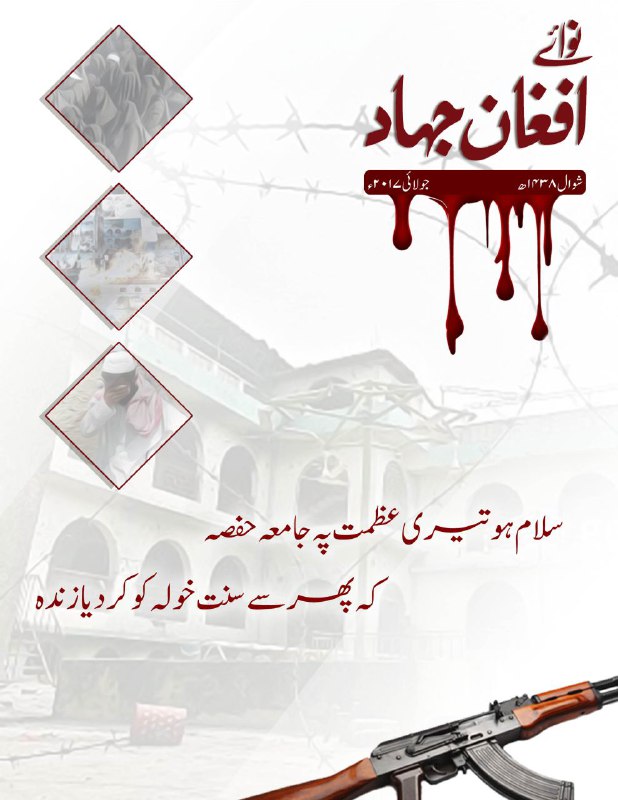
New issue of al-Qā’idah in the Indian Subcontinent’s magazine: “Nawaī Afghān Jihād Magazine – July 2017”

Previous releases- 2017- June issue. May issue. April issue. March issue. February issue. January issue. 2016- July issue. June issue. May issue. April issue. March issue. 2015- November issue. March issue. February issue. January issue. 2014- December issue. November issue. October issue. September issue. August issue. July issue. June issue. April/May issue. March issue. February issue. January issue. 2013- December issue. October/November issue. September issue. August issue. July issue. June issue. May issue. April issue. March issue. February issue. January issue. 2012- December issue. November issue. October issue. September issue. August issue. July issue. June issue. May issue. April issue. March issue. February issue. January issue. 2011– December issue. November issue. September/October issue. August issue. June/July issue. May issue. April issue. March issue. February issue. January issue. 2010– December issue. November issue. October issue. September issue. August issue.


Click the following link for a safe PDF copy: al-Qā’idah in the Indian Subcontinent — “Nawaī Afghān Jihād Magazine – July 2017”
___________

To inquire about a translation for this magazine issue for a fee email: [email protected]

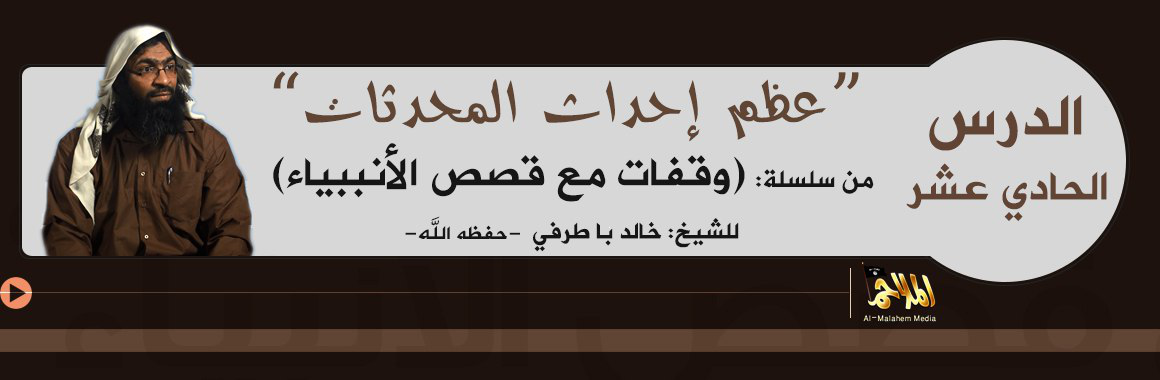
New video message from al-Qā’idah in the Arabian Peninsula’s Shaykh Khālid bin ‘Umar Bāṭarfī (Abū al-Miqdād al-Kindī): “Stances From the Stories of the Prophets #10: The Essence of the Creation of the Ḥadīths"

For prior parts in this video series see: #10#9#8#7#6#5#4#3#2, and #1.


____________

To inquire about a translation for this video message for a fee email: [email protected]