
As-Saḥāb Media presents a new video message from al-Qā’idah’s Khālid bin ‘Abd al-Raḥman al-Husaynān [Abū Zayd al-Kūwaytī]: “Ramaḍān Lessons: Lesson #8: The Importance of Ethics"
Posted on

Mererani, (27/07/2012) – MYC in Kenya has recently been sent a link (https://www.un.org/ga/search/view_doc.asp?symbol=S/2012/544) to the latest UN Monitoring Group report on Somalia in which the UN again levels false claims against Muslim youths in Kenya.
After careful reading of the lies by the so-called UN investigators on Somalia, there can be no doubt that the UN Monitoring Group is acting on behalf of the Great Satan and the Government of Kenya. The report as expected, is an attack on Islam and Muslims in Kenya. It conveniently equates Jihad as terrorism a known view held by Kuffars.
Reading through the very brief section on MYC it is obvious that the UN has attempted to repeat old lies and stories it reported in July 2011. As part of its attempt to engineer a climate of confusion and lies, the UN report claims its investigation into MYC is “strictly confidential”. This is laughable as there is no such thing as “strictly confidential” in the context of UN Monitoring reports. More importantly, the use of “strictly confidential” is firm evidence that the UN spies in Nairobi and in East Africa have failed in penetrating MYC. In short, MYC has embarrassed the UN by maintaining operational security in Kenya, Tanzania and in Somalia.
Likewise, in its desperation, the UN links MYC and Sheikh Aboud Rogo. MYC’s association with our dear Sheikh Aboud Rogo is hardly a secret but a fact that is well known. MYC has a close relationship with Sheikh Rogo and looks forward to working even closer with the Sheikh against the reign of the Kuffar over Muslims.
With the Government of Kenya and its puppet masters of Great Satan, UK and Turkey in Nairobi losing the battle against MYC and our brothers in Al-Shabaab, they have turned to the UN, a body that has always stood for injustice against Muslims. MYC is proud to have stood firm against the UN since July 2011.
In conclusion, there should be no mistake concerning MYC’s future both in Kenya and as part of AQEA: Jihad is our only way. MYC is determined and committed to waging Jihad to liberate our Muslim brothers in Somalia and the rest of East Africa under the banner AQEA. In achieving this MYC will continue to focus its efforts on keeping Kenya on the front pages of global Jihad.
MYC
Press Office
____________
Source: https://themovingcaravan.wordpress.com/2012/07/27/for-immediate-release-un-report-on-myc/
NOTE: As with all guest posts, the opinions expressed below are those of the guest author and they do not necessarily represent the views of this blogs administrator and does not represent at all his employer at the Washington Institute for Near East.
Jihadology.net aims to not only provide primary sources for researchers and occasional analysis of them, but also to allow other young and upcoming students as well as established academics or policy wonks to contribute original analysis on issues related to Global Jihadism. If you would like to contribute a piece, please email your idea/post to azelin [at] jihadology [dot] net. Pieces should be no longer than 2,000 words please.
Past Guest Posts:
Behnam Said, “A Brief Look at the History and Power of Anasheed in Jihadist Culture,” May 31, 2012.
Jonah Ondieki and Jake Zenn, “Gaidi Mtaani,” April 24, 2012.
Joshua Foust, “Jihadi Ideology Is Not As Important As We Think,” January 25, 2011.
Charles Cameron, “Hitting the Blind-Spot- A Review of Jean-Pierre Filiu’s “Apocalypse in Islam,” January 24, 2011.
Daveed Gartenstein-Ross, “Why Jihadi Ideology Matters,” January 21, 2011.
Joshua Foust, “Some Inchoate Thoughts on Ideology,” January 19, 2011.
Marissa Allison, “Militants Seize Mecca: Juhaymān al ‘Utaybī and the Siege of the Grand Mosque in Mecca,” June 9, 2010.
—

By Kévin Jackson
Defining al Qa’ida’s membership has always represented a divise issue among analysts. I’ll approach this topic by focusing on a fundamental practice commonly used by jihadi organizations, namely vowing an oath of allegiance or bay’a.
In a nutshell, the bay’a procedure constitutes the cornerstone defining one’s membership. A longstanding ritual featuring in the early Islamic tradition, giving bay’a (individually or collectively) consists in recognizing the legitimacy of a group/state leader authority. The covenant between the amir (leader) and the one who gives the bay’a lies in listening and obeying, in hard and easy times, as long as the amirship follows the right path. Rendering allegiance to the amir of al Qa’ida, for example, would thus imply not to dispute his and/or al Qa’ida’s commanders’ directives and to fully support the organization’s agenda.
The Bay’a has been institutionalized within the jihadi milieu for the doctrinal foundations it acts upon stress the mandatory aspect of such a practice. Given that joining a jama’ah (group) of mujahidin is seen as an obligation (wajib) upon every Muslim and cannot be done except with a pledge of allegiance, the bay’a is thus considered as such too. From an organizational perspective, these doctrinal regulations secure the loyalty and cohesion within the ranks, while preventing core attrition by tightly binding new recruits through a formal covenant.
It is worthwhile underlining the contractual aspect of this longstanding ritual drawing lines of demarcation between jihadi organizations. If the one giving the oath promises to listen and obey whatever the hardships, the one receiving it is also entitled to fulfill his obligations as the amir. This counterpart from the leader amounts to a continuous commitment to respect the covenant provisos and serve the interests of Islam and Muslims through the policy he implements. The amirship also requires certain characteristics, which, for al Qa’ida, revolve around knowledge, experience, ethical qualities, etc.
On the other hand, a bay’a has to be accepted before one can be considered as a sworn member/organization. This decision falls upon the amir‘s goodwill and depends on the extent to which would-be comers meet the required criteria prescribed by the organization leadership. As a result, groups rendering their allegiance to Ayman al Zawahiri cannot be labeled al Qa’ida in the absence of an official recognition from the Pakistan-based leadership. This explains why assertions dubbing some al Qa’ida’s affiliates/franchises on the only basis that an oath has been sworn should be met with skepticism at the very least.
For example, while Harakat al Shabab al Mujahidin had pledged their loyalty to Usama bin Ladin in September 2009, the Somali group couldn’t be portrayed as being part of al Qa’ida without any further confirmation by the mothership in the Pakistan’s tribal areas. This changed only after February 2012, following a joint statement of Ayman al Zawahiri (amir of al Qa’ida) and Mukhtar Abu’l Zubayr (amir of al Shabab), where the Egyptian officially accepted al Shabab under al Qa’ida’s direction. This is the type of acknoweldgement which should be looked at to draw accurate distinctions between jihadi factions.
A cherished autonomy
Well-understood by jihadis, the binding burden of the oath can be sensed through the lens of militants’ own trajectory. The life story of Khalid Shaykh Muhammad (KSM) is a case in point. Even after having moved to Kandahar to work directly with al Qa’ida’s leadership in the late 1990’s, the 9/11 mastermind was still reluctant to formally join. Translation: while he had decided to play on al Qa’ida’s team via close work relationships, he was still refusing to swear allegiance to bin Ladin so as to maintain his operational room for manoeuvre. KSM became a core member only after 9/11 attacks were carried out, following pressures from his peers arguing that the persistent refusal of someone with his pedigree would establish a worrisome precedent for others.
Given how the pledge of allegiance undermines one’s autonomy, it should not come as a surprise that others have shared KSM’ sentiments by postponing the bay’a as long as they could or simply rejected it.
Before bin Ladin formally declared Mulla Muhammad Umar as his direct leader, the Saudi and his entourage made their best to avoid this option to ensure a complete freedom to their global jihad. Notwithstanding external pressures and an increased tense context, the late amir of al Qa’ida still kept using pretexts to shelve a proposal put forward by Abu’l Walid al Misri, a respected senior Egyptian mujahid, designed to improve his relationship with the Afghan Taliban leader. Bin Ladin eventually resigned himself to perform the bay’a in late November 1998 but (and this is a big one) only through Abu’l Walid acting as his proxy. The indirect oath would enable bin Ladin to play it both ways according to the circumstances and as a result, despite being virtually tied by his pledge, still retain his independence. And indeed, the following years, bin Ladin continued to by-pass Mulla Umar’s instructions, namely stopping his media campaign and external operations against the US.
Also instructive is Abu Jandal’ story, which outlines another way of keeping one’s room for manoeuvre. The Yemeni, along with some of the group of combatants he came with, vowed allegiance to bin Ladin after a three-day meeting with the al Qa’ida’s leader in Jalalabad in 1997. Except that it was not an integral but a conditional one. Hence, while Abu Jandal had accepted bin Ladin as his leader in Afghanistan, the deal was that he will not take his orders from the Saudi should he be in another battlefield. Later in 1998, the then bin Ladin’s bodyguard decided that the time has come and eventually pledged an unconditional oath, thereby making him a core member of al Qa’ida.
Muhammad al Owhali’s interrogation provides a further insightful glimpse into the meaning of the bay’a in terms of command and control, as well as the wariness it provokes among some. The 1998 East Africa bombing operative told his FBI interrogators that his refusal to formally join al Qa’ida, despite having been urged to do so, was linked to his fear that, once a core member, he might end up working in non-military activities while having a strong desire in armed jihad. His non-membership would thus enable him to accept or refuse a mission assigned to him by al Qa’ida’s leaders/ commanders according to his own will. As put it in his interrogation: « Once you take the bayat you no longer have a choice in what your missions would be. »
Theses various episodes clearly outline the concrete implications of pledging an oath of allegiance and also explain jihadis’ lack of promptness in giving it. Not

Click the following link for a safe PDF copy: Shaykh Ḥusām ‘Abd al-R’uūf (‘Abd al-Hādī Muṣṭafā) — “If I Was Mūrsī and Sat on the Chair”
___________
To inquire about a translation for this video message for a fee email: [email protected]
UPDATE 11/10/12 9:31 AM: Here is an English translation of the below Arabic audio message and transcription:

Click the following link for a safe PDF copy: Hārith bin Ghāzī al-Naẓārī [Muḥammad al-Mirshadī] — “The Mujāhidīn in the Cities” (En)
__________
—
UPDATE 7/26/12 1:42 PM: Here is an Arabic transcription of the below audio message:
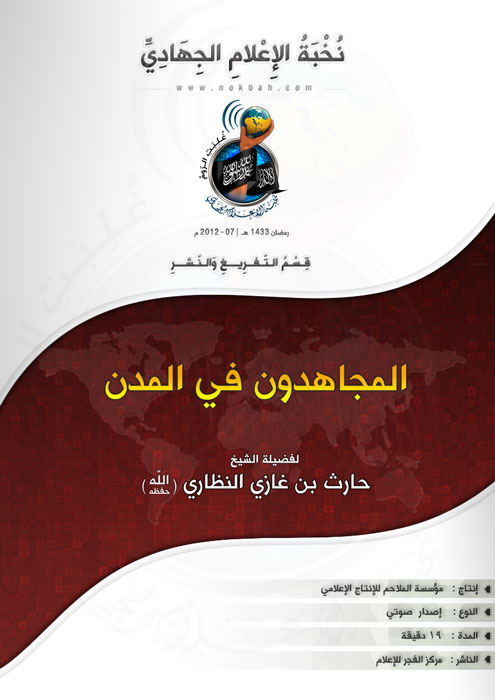
Click the following link for a safe PDF copy: Hārith bin Ghāzī al-Naẓārī [Muḥammad al-Mirshadī] — “The Mujāhidīn in the Cities” (Ar)
____________
—

Hārith bin Ghāzī al-Naẓārī [Muḥammad al-Mirshadī] — “The Mujāhidīn in the Cities”
___________
To inquire about a translation for this audio message for a fee email: [email protected]

___________
To inquire about a translation for this statement for a fee email: [email protected]
NOTE: For earlier videos in this series see: #4, #3, #2, and #1.
—

__________
To inquire about a translation for this video message for a fee email: [email protected]