NOTE: For prior parts in The Archivist series you can view an archive of it all here. And for his older series see: Musings of an Iraqi Brasenostril on Jihad.
—
26 Unseen Islamic State Administrative Documents: Overview, Translation & Analysis
By Aymenn Jawad Al-Tamimi
Introduction
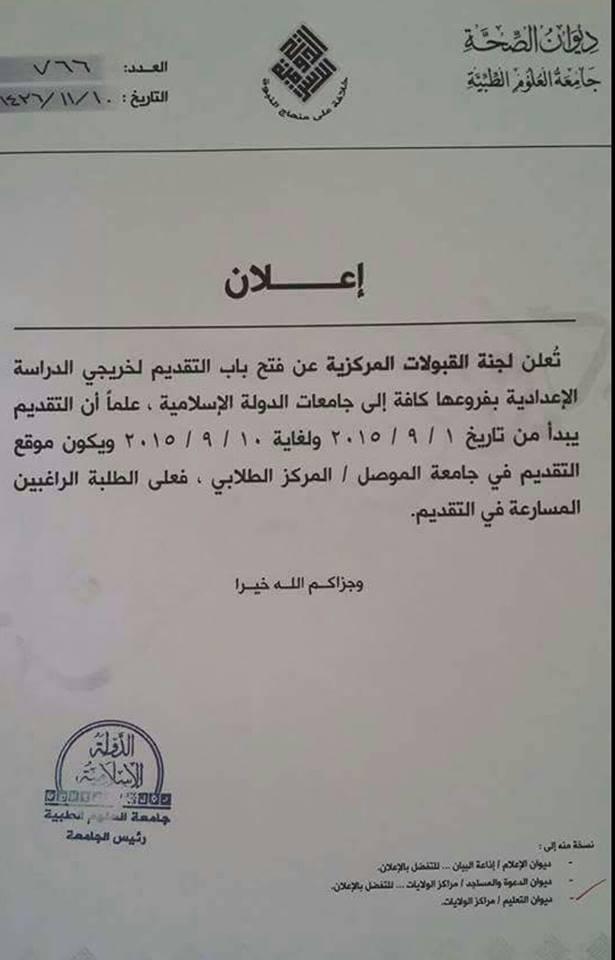
Of all jihadist groups, the Islamic State [IS] by far has presented the most comprehensive, ostensible bureaucratic structure as part of its claimed state project, embodied foremost in a system of diwans (government departments) since the declaration of the Caliphate in June 2014. The best means to analyse the nuances of this set-up is through looking at documents issued by these departments that have not been officially released in IS’ media outlets.
Here, numerous shades emerge that go beyond simple statements such as ‘IS provides services.’ For example, one pattern in the documents from the IS takeover of parts of Iraq is that the Diwan al-Khidamat (services department) in a given city is normally composed of the same staff, workers and offices of already existing government service offices in that city. It is simply that the personnel have been compelled to return to work under threat of confiscation of their homes. For a more in-depth survey, see my recent paper in the academic journal Perspectives on Terrorism primarily based on my current archive of IS documents and other collections of mine currently totalling over 200 specimens.
This post presents 26 further documents not previously in the public domain, obtained from a businessman from a town in northeast Aleppo province that is currently a stronghold of IS. For reasons that are self-evident, this person’s exact location and identity cannot be revealed, but it may be added that this person does business across IS territory, including regular trips to Mosul and Anbar. Though not necessarily a hardline, ideological supporter of IS, he nonetheless finds the security environment amenable to doing business: a common advantage perceived by Syrians who make investments and conduct transactions in IS territory.
Islamic State vs. Jabhat al-Nusra Administration
Before proceeding to the selection of documents, one question worth pondering- first suggested to me by Aaron Zelin- is comparing the IS administration with that of Jabhat al-Nusra, Syria’s al-Qa’ida affiliate. To put it briefly, Jabhat al-Nusra’s administrative structures lack the same sense of comprehensiveness and consistency. Jabhat al-Nusra does not have the same level of contiguous territory and urban strongholds, and the extent of its presence varies considerably from one place to another. Further, Jabhat al-Nusra is not claiming yet to be a state.
The main Jabhat al-Nusra administrative bodies that can be identified are the Dar al-Qada (Judicial Body), the Maktab al-Da’wa wa al-Irshad (Da’wa and Guidance Office) and al-Idarat al-Aama lil-Khidamat (Public Administration for Services). Broadly speaking, the Dar al-Qada corresponds to IS’ Diwan al-Qada wa al-Mazalim and Diwan al-Hisba, dealing with legal matters such as real estate and enforcement of Shari’a justice (including harsher hudud punishments like stoning fornicators to death), while the Maktab al-Da’wa wa al-Irshad corresponds to IS’ Diwan al-Da’wa wa al-Masajid (Da’wa and Mosques department), and al-Idarat al-Aama lil-Khidamat to the Diwan al-Khidamat.
However, these bodies do not exist in every place where Jabhat al-Nusra has a presence, and sometimes functions are blurred. The Dar al-Qada can be clearly identified in Idlib towns controlled by Jabhat al-Nusra, such as Sarmada, Salqin and Darkush, but in at least one instance the Dar al-Qada seems to have assumed entered into the realm of provision of public services, with the undertaking of a project to reform the main road in Sarmada. Even so, evidence suggests that Jabhat al-Nusra continues to allow civilian local and service councils in Sarmada to operate and provide services such as fixing water pumping lines, contrasting with IS co-optation of such bodies in cities like Raqqa whereby they only have the Diwan al-Khidamat label now. More recently, as part of the Jaysh al-Fatah coalition that has driven the regime out of all major towns in Idlib province since the spring, Jabhat al-Nusra has agreed with the other factions in Jaysh al-Fatah on the formation of a judicial council that is supposed to be “independent in its decisions and rulings, with no right for any faction to intervene in it.” The council is also supposed to unify judiciary authority in all areas liberated at the hands of Jaysh al-Fatah. This development comes amid complaints from the Islamic Commission for the Administration of Liberated Areas (mainly linked to Ahrar al-Sham) that some members of Jabhat al-Nusra have attacked its branches in places like Kafr Nabl.
Moving toAleppo province, one will note the Dar al-Qada branch in Hureitan, which claims authority also over Kafr Hamra and Anadan. Here the Dar al-Qada is undoubtedly supported by the jihadi coalition Jabhat Ansar al-Din that has a presence in these towns (most notably the coalition’s main component Jaysh al-Muhajireen wa al-Ansar). Further up north in Azaz, the Jabhat al-Nusra presence has been limited to bases with control of one of the mosques in the town (the Mus’ab ibn Umair mosque), railing against the public school system in Azaz and offering alternative education for children.
Nevertheless, with talk of the establishment of a U.S.-Turkish safe zone stretching from Azaz to Jarabulus in the north Aleppo countryside, Jabhat al-Nusra has evacuated most of its bases in the Azaz area and is primarily operating as a small military force to provide limited reinforcements for the rebels fighting IS to the east of Azaz (these rebels being primarily the Levant Front and Ahrar al-Sham, with smaller contributions from mainly Levant Front break-offs like Thuwar al-Sham and Jaysh al-Mujahideen elements). These Jabhat al-Nusra members on the frontlines are mostly locals, while the remainder have already gone to Idlib province.
Thus it can be seen how much more complex the picture is with Jabhat al-Nusra administration. The bodies do not have a uniform presence and the group’s approach seems split between a more hardline approach embodied in the rise of the Dar al-Qada and the more traditional picture of Jabhat al-Nusra as a faction willing to work with others in administration. In 2013 what was then the Islamic State in Iraq and al-Sham (ISIS) indulged in the latter to a degree in the occasional issuing of joint statements for defensive projects and the like.
The Documents
Below, each document is translated and notes provided where applicable.
Specimen A: Activities of the services office, Manbij, Aleppo
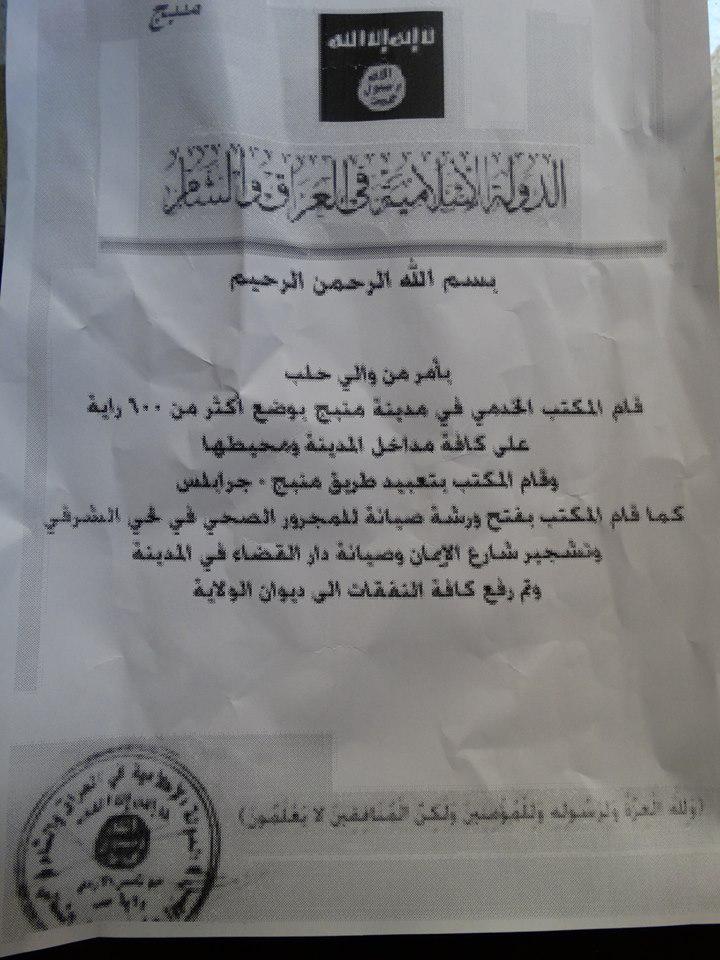
Manbij
Islamic State in Iraq and al-Sham
In the name of God, the Compassionate, the Merciful
By order of the wali [provincial governor] of Aleppo, the services office in the town of Manbij has placed more than 600 flags on all the entrances to the town and its surrounding. The office has also made the Manbij-Jarabulus road passable for traffic, and has opened a maintenance workshop for the sewage system in the eastern quarter, has planted trees on al-Imaan street, and has done maintenance work on the Dar al-Qada in the town. And all the expenses have been referred to the Diwan al-Wilaya.
And glory belongs to God, His Messenger and the believers but the hypocrites don’t know it.
Islamic State in Iraq and al-Sham
Abu [?] Al-Azadi
Wilayat Halab
Notes: Dating uncertain. The ‘Diwan al-Wilaya’ (Province Department) appears to be the same as the “General Administration” (al-Idarat al-Aama) for a given Islamic State province. A similar interchange of names can be observed in some documents regarding healthcare labelled ‘Diwan al-Siha’ (Health Department) and others labelled ‘al-Idarat al-Tibbiya’ (Medical Administration).
Specimen B: Prohibition on hoarding of goods, Yarmouk, Damascus
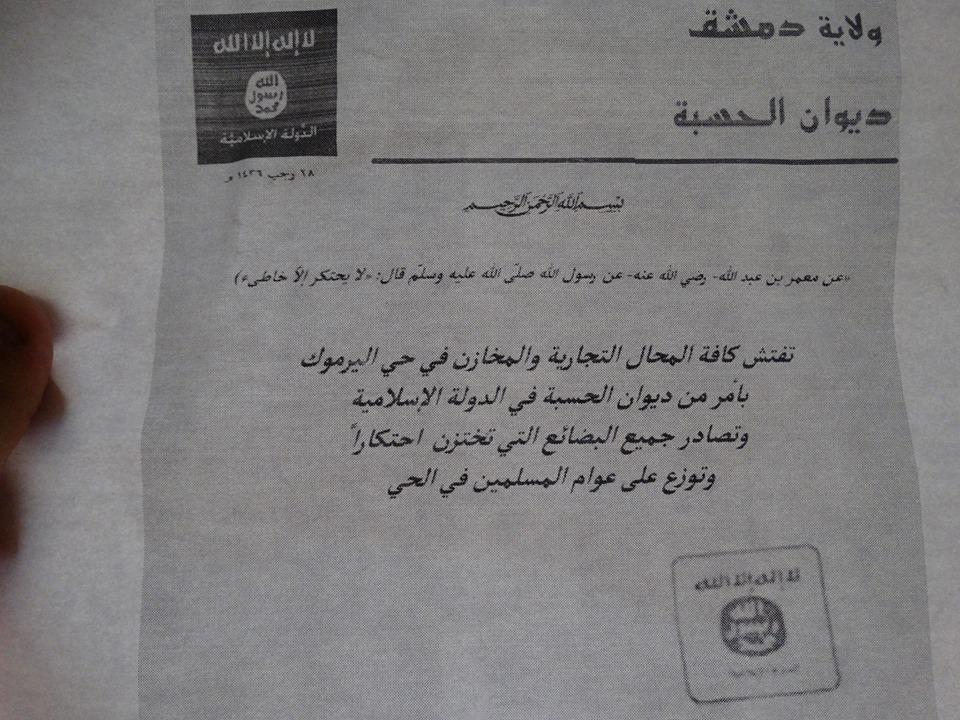
Islamic State
Wilayat Dimashq
Diwan al-Hisba
28 Rajab 1436 AH [17 May 2015]
In the name of God, the Compassionate, the Merciful
On