The Archivist: 'Go Forth, Lightly and Heavily Armed': New Mobilization Calls By the Islamic State in Aleppo Province

NOTE: For prior parts in The Archivist series you can view an archive of it all here. And for his older series see: Musings of an Iraqi Brasenostril on Jihad.

“Go Forth, Lightly and Heavily Armed”: New Mobilization Calls by the Islamic State in Aleppo Province
By Aymenn Jawad Al-Tamimi
Introduction: Context and Analysis

With the intensification of Russia’s overt intervention inside Syria, regime forces and allied militias have launched multiple offensives in the north of Syria. One of these offensives is taking place in Aleppo province and has three primary aims: to expand the line of control to the southwest of Aleppo city, to attempt (again) to complete the encirclement of Aleppo city and break the rebel sieges of the Shi’a villages of Nubl and Zahara’ to the northwest of Aleppo city, and finally to push eastwards against the Islamic State [IS] and break IS’ long-standing siege of Kweiris military airbase.

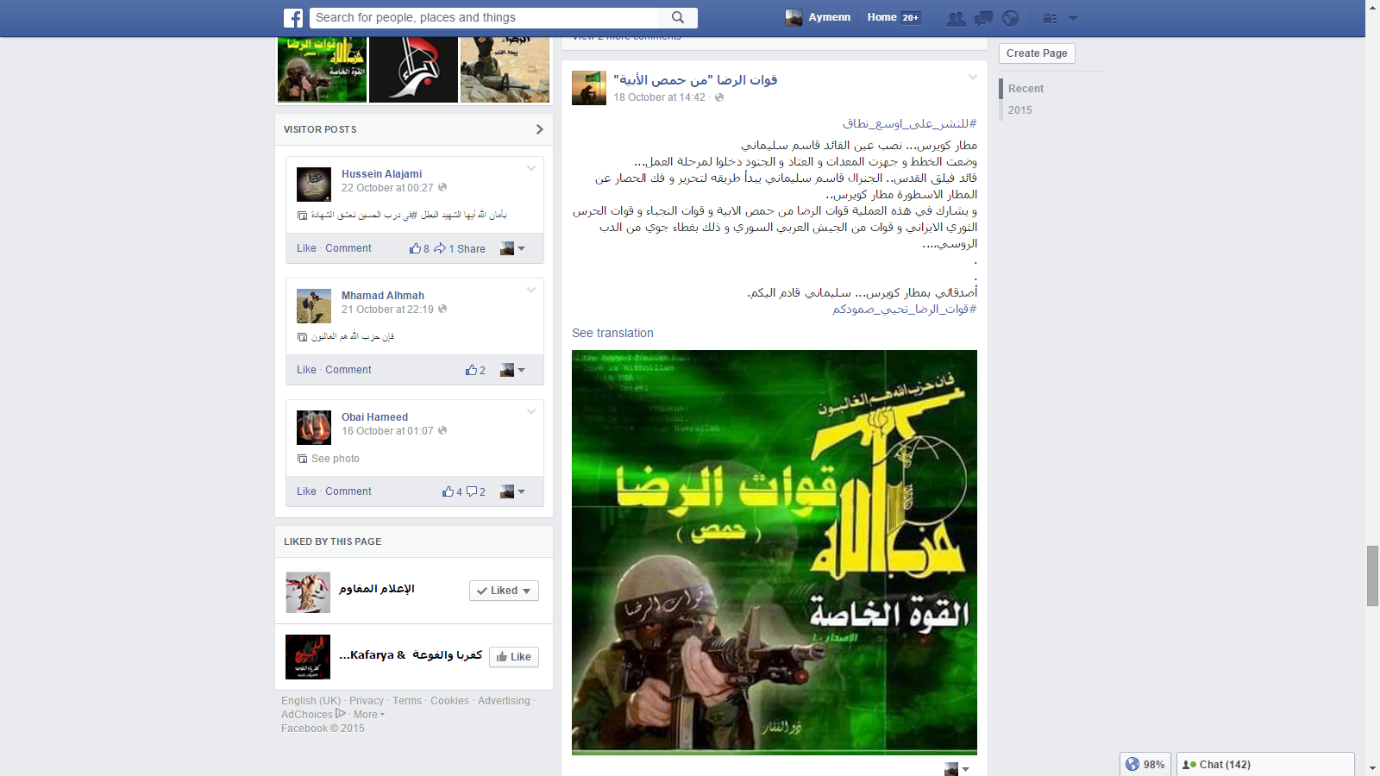
The question of the Iranian involvement in the new Aleppo offensives is the subject of some debate. Though there have been reports of deployments of thousands of Iranian ground troops, it should be noted that such a move does not suit Iranian modus operandi in Syria, which prefers to rely on proxies to supply the bulk of manpower under elite Iranian Revolutionary Guard Corps supervision. Note the following post from the main Facebook page for Quwat al-Ridha (native Syrian Hezbollah primarily recruiting from the Shi’a in Homs province) on 18 October, which leaves no doubt as to who the main ground commander of the new Aleppo operations is:
ISAleppomobilization
“Kweiris airbase, in front of the Commander Qasim Suleimani’s eye. The plans have been put in place, the equipment and munitions have been prepared, and the soldiers have entered the operation stage. The leader of the Quds Force, General Qasim Suleimani, is beginning his path to liberate and break the siege of the legendary airbase, Kweiris airbase. And participating in this operation are Quwat al-Ridha from Homs al-Abiya, Quwat al-Nujaba’ [Harakat al-Nujaba’, an Iraqi Shi’a militia], the Iranian Revolutionary Guards forces and forces from the Syrian Arab Army, under air-cover from the Russian Bear. My friends in Kweiris airbase, Suleimani is coming for you.”

Besides Harakat al-Nujaba’, which has been a long-established player on the Aleppo fronts, an official from Kata’ib Hezbollah– another Iraqi proxy of Iran- claimed to the Washington Post that 1000 fighters have been sent as part of Suleimani’s Aleppo offensive. Newer, more obscure Iraqi militias that have been advertising recruitment to fight in Syria in recent months may also be supplying manpower to the Aleppo area. The Assad Allah al-Ghalib Forces, an Iraqi Shi’a militia that initially operated in the Damascus area as part of Liwa Abu al-Fadl al-Abbas, also appears to have a presence in the Aleppo area.

The combination of manpower boosts and Russian air support helped score gains against both rebels and IS, but as shown by the unseen documents I have obtained, IS has responded to the eastward push by launching new mobilization calls within Aleppo province (Wilayat Halab), including the opening of new training camps. Linked to these mobilization calls has been the launch of IS counter-offensives that are threatening to cut regime supply lines to Aleppo city, including ongoing clashes in the vicinity of the regime stronghold of al-Safira and IS assaults further southward along the Khanaser-Athariya road heading into Hama province.  

Previously, the last major mobilization call that produced results for IS took place in late April, with an internal directive issued by Abu Bakr al-Baghdadi throughout the Syrian provinces to reinforce the fighting fronts in Salah ad-Din and Anbar provinces [archive: Specimen 3E], with particular emphasis on recruitment of suicide bombers and commandoes. Some weeks later, the mobilization call took the form of an official al-Furqan Media speech from Abu Bakr al-Baghdadi. The aims of IS were clear: continue the stalemate in Baiji in northern Salah ad-Din province and pin down Iraqi forces, while intensifying the assaults on Ramadi, where Shi’a militia deployments were very limited, in a bid to take control of the city. After all, as the provincial capital of Anbar province, Ramadi undoubtedly has greater value than Baiji, where the oil refinery and town infrastructure have largely been destroyed.

In the overall analysis, one should not overstate the IS capacity to mobilize and launch new offensives. It is impossible to commit with the same degree of intensity on every front where IS faces enemy forces. That said, for Aleppo province at least, IS’ enemies- rebels and regime forces- do not have the ability to pose a serious threat to IS’ main strongholds. With the rebels in particular, disorganization in the ranks (witness the case of the Shami Front and its multiple fractures) and a two-way war have meant that the overall trend is that IS has pushed ever further westward, though it is unlikely that the international coalition will allow IS to reclaim its one-time ‘Emirate of Azaz.’

Among the specimen documents of the new mobilization call are the first documents I have seen from an IS “Shari’a Committee” since the declaration of the Caliphate. The Aleppo province Shari’a Committee may be a provincial manifestation of IS’ greater Shari’a Council. On this analytical reading, the Diwan al-‘Eftaa wa al-Buhuth (fatwa issuing and research department: also Diwan al-Buhuth wa al-‘Eftaa) in Aleppo province may be a subset of the Aleppo province Shari’a Committee, just as the greater Diwan al-‘Eftaa wa al-Buhuth is reportedly a subset of the greater Shari’a Council.

Perhaps in support of this reading, one can note that based on the dates given, the mobilization call from the Aleppo province Shari’a Committee comes first (1 Muharram 1437 AH) and then further details- including specifics on locations- are given by the Diwan al-‘Eftaa wa al-Buhuth statements, one of which is dated 6 Muharram 1437 AH.

GUEST POST: From al-Shabab to the Islamic State: The Bay‘a of ‘Abd al-Qadir Mu’min and Its Implications

As with all guest posts, the opinions expressed below are those of the guest author and they do not necessarily represent the views of this blogs administrator and does not at all represent his employer at the Washington Institute for Near East Policy.
Jihadology.net aims to not only provide primary sources for researchers and occasional analysis of them, but also to allow other young and upcoming students as well as established academics or policy wonks to contribute original analysis on issues related to jihadism. If you would like to contribute a piece, please email your idea/post to azelin [at] jihadology [dot] net.
Click here to see an archive of all guest posts.

From Al-Shabab to the Islamic State: The Bay‘a of ‘Abd al-Qadir Mu’min and Its Implications
By Christopher Anzalone
Note: These are not definitive conclusions but initial thoughts.
1
On October 22 a poor quality mp3 recording was posted online of Shaykh ‘Abd al-Qadir Mu’min pledging allegiance (bay‘a) to the amir of the Islamic State (IS), Abu Bakr al-Baghdadi, and thus switching his allegiance from the Somali jihadi-insurgent group Al-Shabab to IS.  Mu’min, a longtime Al-Shabab preacher, ideologue, and leader, created a stir among jihadis and jihadi supporters online, particularly those supportive of IS, as well as analysts.  There is no doubt that his defection from Al-Shabab to IS is of major symbolic importance in the competition between Al-Qa‘ida Central (AQC) and its regional affiliates and IS, which has succeeded in attracting pledges of allegiance from a host of groups, from Jama‘at Ahl al-Sunna li-l-Da‘wat wa-l-Jihad (“Boko Haram”) in Nigeria and Ansar Bayt al-Maqdis in Sinai to a faction of the former unified Tehrik-i Taliban Pakistan umbrella led by Hafiz Sa‘id Khan, the former TTP amir of the Orakzai tribal agency in Pakistan’s Federally Administrated Tribal Areas.  It is important, however, to keep Mu’min’s defection with a group of rank-and-file fighters from Al-Shabab’s Puntland branch in and around the Golis mountain range in perspective and not to exaggerate its immediate impact.  In this article, which is based on two long series of tweets posted a few days ago (see here and here), the symbolic importance of Mu’min’s bay‘a to al-Baghdadi and its potential impact will be examined in order to provide some additional context to the preacher’s role within Al-Shabab and shed more light on why his departure from its ranks is significant.
Mu’min, a onetime resident of London, returned to Somalia in mid-2010 and by the summer of 2011 had publicly emerged as a player within Al-Shabab, making great use of his status as a religious scholar (‘alim) and skilled preacher in giving the jihadi-rebel group an added aura of “religious” authenticity and support.  In the summer of 2011, he played an integral role in the insurgents’ outreach to local communities and clan elders at a time when Al-Shabab was facing a renewed African Union Mission in Somalia (AMISOM) and Somali federal government offensive.  Mu’min and other Al-Shabab officials, including the then-Shabab governor of the Banaadir region, Muhammad Hasan ‘Umar Abu ‘Abd al-Rahman, met with local community leaders, merchants, religious scholars (‘ulama), and poets in neighborhoods around Mogadishu in an attempt to win their support against AMISOM and the Somali government.  Mu’min was particularly active in making pitches to other ‘ulama in order to win their support.  In May 2011, Mu’min was one of the Al-Shabab officials chosen to speak at the group’s official memorial conference and ceremony for the late AQC amir Usama bin Laden.  Mu’min also was a featured speaker in February 2012 at another major Al-Shabab event, its official celebration in Lafoole in the Lower Shabelle region of the formalization of its affiliation with AQC.  
5
The preacher’s symbolic importance also comes from the promotion previously by Al-Shabab and its media apparatus of his lectures, including a lengthy series of lectures of his oral tafsir of the Qur’an, featured roles in a series of official propaganda films, and the promotion of his recorded remarks and statements on its radio stations.  In 2012, Mu’min relocated to Puntland where he worked to further Al-Shabab’s goals of expanding in that region.  As part of this campaign, he continued to record interviews and statements that were broadcast on Al-Shabab’s terrestrial radio stations and in 2015 he was featured in a series of official films produced by the group’s Al-Kata’ib Media Foundation.  His most recent appearances were in a series of three Ramadan lectures filmed in the Golis Mountains released in July.  Up until mid-September, he was still participating in Al-Shabab’s media operations campaign.
The exact number of rank-and-file fighters from Al-Shabab’s Puntland branch who left with Mu’min remains unknown with any certainty.  The majority of initial reports placed the number at being between 20 and 25, though other sources claimed that a much higher number of fighters, perhaps the majority of the 300 or so strong Puntland branch, had also defected with the preacher.  Although the number is important, and a higher number of defections would more greatly affect Al-Shabab logistically since it is suffering from defections of fighters who have taken advantage of offers of amnesty from the Somali government, Mu’min’s defection is still a symbolic blow to the group regardless of the exact number.  This challenge, however, while important, is not necessarily insurmountable as of this time.
3
Recent signs suggest that the central Al-Shabab leadership, including regional governors, are disposed to remaining loyal to AQC amir Ayman al-Zawahiri, though they have clearly been struggling for some time about how to react to the growing popularity of IS.  The late amir of Al-Shabab, Ahmed Godane, uneasily navigated this question and ultimately decided to remain loyal to al-Zawahiri.  His successor, Ahmad “Abu ‘Ubayda” ‘Umar, also quickly reaffirmed the group’s loyalty to the AQC chief upon taking over the rebel group.  Al-Shabab was also one of the first AQC-aligned groups to eulogize Mullah Muhammad ‘Umar, the founding amir of the Afghan Taliban.  After it was made public in late July that ‘Umar had died of natural causes in April 2013, Al-Shabab organized funeral prayers (salat al-janaza) for him and continued referring to him as “amir al-mu’minin” (commander of the faithful), a title also claimed by Abu Bakr al-Baghdadi.  
Al-Shabab’s media, though it has always been attracted to Abu Mus‘ab al-Zarqawi and the late Islamic State of Iraq leaders Abu ‘Umar al-Baghdadi and Abu Hamza al-Muhajir, continues to speak respectfully of al-Zawahiri.  Al-Shabab’s senior leadership has not responded publicly yet to Mu’min’s defection, but his move has been criticized by Al-Muhajiroun, a group of Swahili-speaking jihadis aligned with the Somali insurgents and particularly Ahmad Iman Ali, the Kenyan jihadi preacher in charge of Al-Shabab’s Kenyan foreign fighters coming from the Muslim Youth Centre/Al-Hijra recruiting networks in Nairobi, Garissa, and the Swahili Coast.  It also took the Al-Shabab leadership some time to formulate an official response to dissident American foreign fighter Omar Hammami in 2012, with Hammami publicly announcing his break with the group and commencing with extensive online criticism of it in March but Al-Shabab not releasing a detailed response to his allegations until mid-December of that year.  IS has yet to officially accept Mu’min’s bay‘a, though there is little question that the group’s leadership will do so because it is an economical way of projecting an image of expansion and influence without having to make any significant initial investment of resources.  
4
Ultimately, the medium and long-term impact of the defection of Mu’min and those Puntland-based fighters who left with him rests on future on-the-ground developments in Somalia and East Africa.  If the preacher is joined by other important figures and factions within Al-Shabab’s ranks, for example Ahmad Iman ‘Ali and significant numbers of Kenyan and other East African foreign fighters, who make up a significant number of Al-Shabab’s strength now, the balance could shift against the group’s AQC-aligned leadership.  If discord grows within Al-Shabab’s ranks, it may also enable the Somali government and AMISOM to woo away fighters disillusioned with internal infighting and violence.
Christopher Anzalone is a PhD candidate (ABD) in the Institute of Islamic Studies at McGill University.  He has published articles previously on Al-Shabab, the Kenyan Muslim Youth Centre/Al-Hijra, Al-Qa‘ida, the Tehrik-i Taliban Pakistan, the Islamic Movement of Uzbekistan,  jihadi media operations, foreign fighters, Islamist visual cultures, and the Islamic State.  You can follow him on Twitter and Academia.edu.

New audio message from The Islamic State: "Will of the Martyr Abū Isḥāq al-Ḥijāzī: Raid Upon the Temple of Rejectionist Ismā'ilīs in Najrān – Wilāyat al-Ḥijāz"

Jihadology Podcast: Jihadism in the Land of the Pharaohs

Mokhtar Awad comes on the show to discuss jihadism in Egypt. Some of the topics covered include:

  • The development of jihadism in the Sinai prior to the Egyptian uprising in January 2011
  • What jihadi individuals and movements were doing between the 2011 uprising and the coup in July 2013
  • A deep dive on Jama’at Ansar Bayt al-Maqdis (ABM)
  • How ABM has changed since it became Wilayat Sinai of the Islamic State
  • The role of IS’ provinces in Libya in the Western Desert of Egypt
  • Background on the ABM splinter faction al-Murabitun that is pro-AQ and led by Hisham Ashmawy that pledged baya to Ayman al-Zawahiri

This episode also features a Primary Sources segment covering releases from September 20th to October 14th, and a #SocialMedia segment covering postings from October 14th to 23rd.
Links:

Thanks to Haakon Jahr, Raihan Kadir, and Kaspars Gasuns for supporting the show! You can help support the show, and get some great rewards, by visiting the show’s Patreon page
The podcast is produced by Karl Morand. If you have feedback you can email [email protected], or find us on Twitter: @JihadPod.
You can subscribe to the show in iTunes, Stitcher, or with our RSS feed.

Download this episode (60MB mp3)