NOTE: For prior parts in The Archivist series you can view an archive of it all here. And for his older series see: Musings of an Iraqi Brasenostril on Jihad.
—
Unseen Islamic State Financial Accounts for Deir az-Zor Province
By Aymenn Jawad Al-Tamimi
The question of where the Islamic State [IS] acquires its funding has been a subject of much discussion. Though ideological partisans often see a private Gulf Arab funding hand behind IS, the general consensus now seems to accept that IS is not dependent on foreign donors in any meaningful way, and thus largely acquires its revenues from resources within the territories it operates, including taxation, sales of oil and gas, antiquities and the like. Thus, the majority of the debate now focuses on trying to determine the relative importance of each of these sources of revenue.
A number of analyses have been produced relying on local sources within Iraq and Syria, and in this regard I highly recommend Die Zeit’s investigation from December 2014, the fruit of a team of researchers including my colleague Yassin Musharbash.
However, a deficiency in all the work thus far on IS finances is a lack of statistics from IS itself on income and expenditures, and so a degree of guesswork in estimating has always been involved. The exclusive documents that will be presented below- obtained from IS’ Diwan Bayt al-Mal (financial ministry) in eastern Syria’s Deir az-Zor province (Wilayat al-Kheir)- provide a remedy in giving a first time view of IS budgets by its own account for the month of Rabi’ al-Awal 1436 AH (c. 23 December 2014-22 January 2015).
For context, Deir az-Zor province has been almost entirely under the control of IS since July 2014, while a regime presence still holds out in parts of Deir az-Zor city and at a military airport. In defeating the rebels in Deir az-Zor province, IS has gained a monopoly on oil and gas resources in the province. The province’s long-standing importance to the oil and gas sector of the Syrian economy is well-known, and it undoubtedly constitutes the largest pool of oil and gas resources in Syria that IS has been able to exploit.
As part of its narrative of ‘breaking the borders’ between Syria and Iraq, IS created a ‘Euphrates Province’ that spans eastern Deir az-Zor province and western Anbar province, including the districts of Albukamal in Syria and al-Qa’im, Rawa and Anah in Iraq.
Figures in the documents help us to quantify IS financing. From IS’ richest province in fossil fuels, revenues and expenditures for the province come in the form of millions of dollars on a monthly basis, not tens or hundreds of millions. Further, despite the significant holdings of oil and gas resources, these sources of revenue by no means constitute the majority of IS’ income in the province. Statistically, revenue streams for the province can be divided as follows using the data from the documents:
| Source | Percentage of Revenue |
| Oil & Gas | 27.7% |
| Electricity | 3.9% |
| Taxes | 23.7% |
| Confiscations | 44.7% |
As can be seen, a plurality of the income actually comes from confiscations of property and money. This may take place for a number of reasons: e.g. residents who fled their homes, violations of IS regulations and illicit smuggling of goods, particularly forbidden items like cigarettes and alcohol. Movement across border areas is important in this regard when combined also with transit fees for legitimate travel and transportation of goods.
Meanwhile, IS’ expenditures primarily go towards military upkeep in the form of expenditures for bases and paying fighters’ salaries. Conspicuously absent from the expenditures are accounts for salaries of workers officially under the authority of the Diwan al-Ta’aleem (education). The reason for this is that the IS process of revamping the education system in accordance with its ideology required the closing of many schools in this period to subject teachers and staff to ‘repentance’ and Shari’a lessons, while the regime continued to pay salaries though under strict conditions for the recipients to come in person to the relevant places stipulated by the regime. Note that the Islamic Police comes under the Diwan al-Hisba working closely with IS’ judiciary department (Diwan al-Qada wa al-Mazalim), and both these diwans play key roles in confiscations of goods and property. Here is the breakdown of expenditures by percentage.
| Expenditure | Percentage of Expenditure |
| Expenditures for bases | 19.8% |
| Fighters’ salaries | 43.6% |
| Media | 2.8% |
| Islamic Police | 10.4% |
| Diwan al-Khidamat (Services Department) | 17.7% |
| Diwan Bayt al-Mal: aid sums | 5.7% |
Some more points of analysis to consider:
– Popular conceptions of IS income need to have a more sober and realistic perspective on the role oil and gas revenues. Daily revenues from the oil wells here (total divided by 30) yield on average $66,433. If this is the average revenue from IS’ best oil holdings in Syria and one engages in reasonable extrapolation, then one will come nowhere near the total figure of $3 million a day for IS in oil sales that was widely touted in the media in summer 2014, even when making allowances for subsequent damage to infrastructure from coalition airstrikes. A sounder estimate would put such income at no more than 5-10% of that figure.
– On a related historical note, one should dismiss accounts that portray IS’ predecessors as being suddenly enriched from eastern Syrian oilfields and antiquities beginning in late 2012, based on hearsay about alleged computer flash sticks revealing IS finances and off-base regarding the dynamics of control of eastern Syrian oil over the course of the Syrian civil war (pace the Guardian report, IS’ predecessor ISIS did not exist in late 2012, let alone ‘commandeer’ eastern Syrian oilfields).
– The sale of antiquities under the authority of the antiquities subdivision of the Diwan al-Rikaz is not explicitly mentioned in the accounts here, but it is most likely included within taxation as part of the IS bureaucratic structure. Documents captured from the Abu Sayyaf raid by U.S. forces appear to show a 20% tax to be paid on antiquities sold in Deir az-Zor province. Two of the individual transactions presented from December 2014 illustrate tax payments of more than $10,000, while the third constitutes a little over $1000.
– Despite IS’ propaganda on ‘breaking the borders’ and the creation of ‘Euphrates Province’, the inclusion of Albukamal within Deir az-Zor province financial data and transactions is an example of how IS still deals in prior administrative boundaries. Compare with a previous July 2015 document I published from Wilayat al-Kheir’s Diwan al-Khidamat ordering for an Abu Dujana al-Libi to be paid $100,000 for a road project between Albukamal and al-Qa’im. Other administrative documents from ‘Euphrates Province’ indicate that IS administration rarely seems to deal with the territory as a united entity, but rather by its Syrian and Iraqi halves. This is so even as travel within ‘Euphrates Province’ is relatively easy, as a friend of mine from Rawa now works in Albukamal, and residents on both sides of the Iraq-Syria border regularly cross both ways for business, market shopping etc.
– Ultimately, the most vital IS revenues depend on the continued existence of its bureaucratic structure within the territories it controls, and there is little one can do to disrupt that short of destroying that structure militarily. The suggested siege-like strategy to trigger a collapse from within is impossible to realize in the current circumstances, as one cannot wholly isolate IS territory from interactions with the outside world, and so cash flows will continue. The Iraqi government’s decision to cut off direct salary payments to workers in IS-held areas will certainly help reduce IS taxation revenues, but it was not the sole avenue for cash flow, and though hardships for residents will increase, IS’ rigid security apparatus is still highly capable of suppressing major revolt.
Below are the documents with translation.
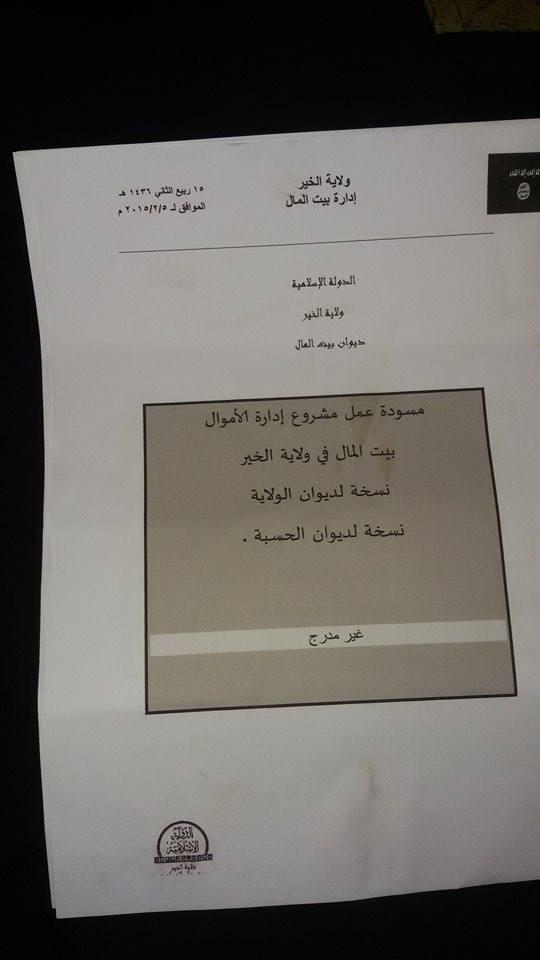
Islamic State
Wilayat al-Kheir
Diwan Bayt al-Mal
Bayt al-Mal Administration
15 Rabi’ al-Thani 1436 AH
5 February 2015
Rough draft of the operation of the management of wealth project.
Bayt al-Mal in Wilayat al-Kheir
Copy to the Diwan al-Wilaya [governor’s office]
Copy to the Diwan al-Hisba [checks for potential irregularities in the records etc.]
Uncirculated
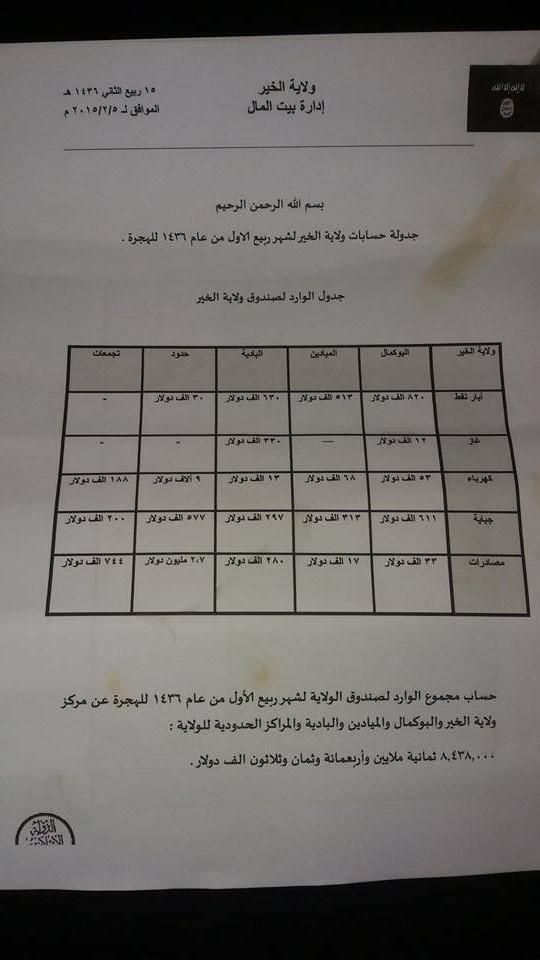
In the name of God, the Compassionate, the Merciful
Table of accounts for Wilayat al-Kheir for the month of Rabi’ al-Awal of the year 1436 AH
Table for income to the treasury of Wilayat al-Kheir.
| Wilayat al-Kheir | Albukamal | Al-Mayadeen | Al-Badiya | Borders | Tajammu’at [Deir az-Zor area residential districts] |
| Oil wells | $820,000 | $513,000 | $630,000 | $30,000 | |
| Gas | $12,000 | $330,000 | |||
| Electricity | $53,000 | $68,000 | $13,000 | $9,000 | $188,000 |
| Taxes | $611,000 | $313,000 | $297,000 | $577,000 | $200,000 |
| Confiscations | $33,000 | $17,000 | $280,000 | $2,700,000 | $744,000 |
Total accounting of income for the treasury of the Wilaya for the month of Rabi’ al-Awal of the year 1436 AH from the centre of Wilayat al-Kheir, Albukamal, al-Mayadeen, al-Badiya and the border centres for the Wilaya is $8,438,000.
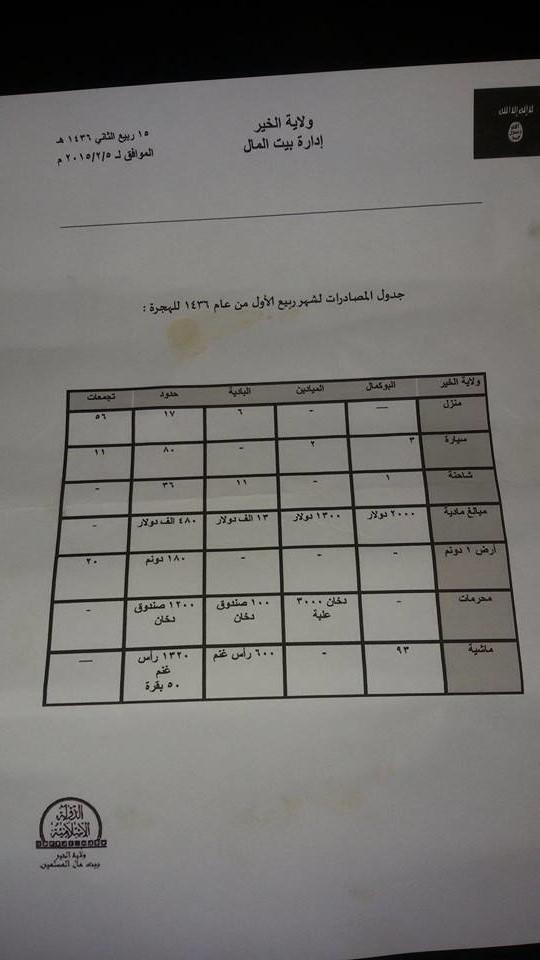
Table of confiscations for the month of Rabi’ al-Awal of the year 1436 AH:
| Wilayat al-Kheir | Albukamal | Al-Mayadeen | Al-Badiya | Borders | Tajammu’at |
| House | 6 | 17 | 56 | ||
| Car | 3 | 2 | 80 | 11 | |
| Truck | 1 | 11 | 36 | ||
| Material sums | $2000 | $1300 | $13,000 | $480,000 | |
| Land (in dunams) |
180 dunams | 20 | |||
| Forbidden items | Cigarettes: 3000 packs | 100 cases of cigarettes | 1200 cases of cigarettes | ||
| Livestock | 93 | 600 head of sheep | 1320 head of sheep, 50 cows |
In what follows is a table of expenditures for Wilayat al-Kheir for the month of Rabi’ al-Awal of the year 1436 AH:
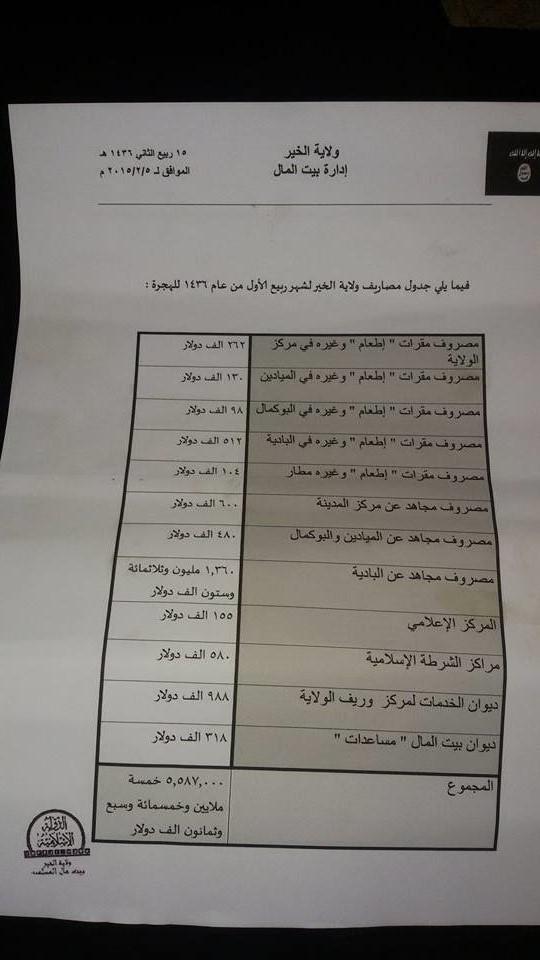
| Expenditure for the bases: “Provision of food” etc. in the centre of the wilaya | $262,000 |
| Expenditure for the bases: “Provision of food” etc. in al-Mayadeen | $130,000 |
| Expenditure for the bases: “Provision of food” etc. in Albukamal | $98,000 |
| Expenditure for the bases: “Provision of food” etc. in the Badiya | $512,000 |
| Expenditure for the bases: “Provision of food” etc.: airport | $104,000 |
| Mujahid allowance [monthly salaries for fighters] from the city centre | $600,000 |
| Mujahid allowance from al-Mayadeen and Albukamal | $480,000 |
| Mujahid allowance from the Badiya | $1,360,000 |
| Media centre | $155,000 |
| Islamic Police centres | $580,000 |
| Diwan al-Khidamat for the centre and countryside of the wilaya | $988,000 |
| Diwan Bayt al-Mal: aid sums | $318,000 |
| Total | $5,587,000 |
Zakat taxes in Wilayat al-Kheir for the month of Rabi’ al-Awal of the year 1436 AH: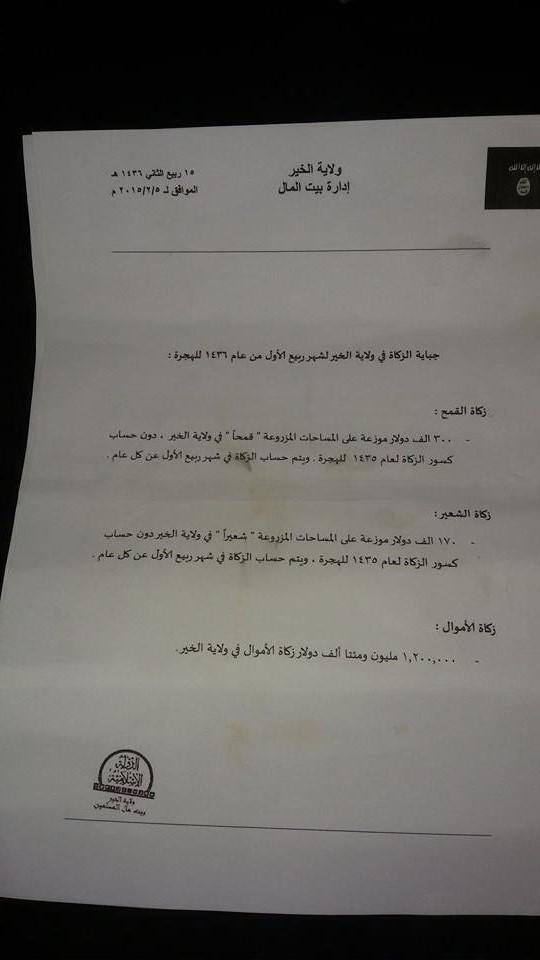
Zakat on wheat:
. $300,000 distributed upon [i.e. imposed as zakat taxation on] the cultivated lands in ‘wheat’ in Wilayat al-Kheir, without taking into account the kusur of the zakat [zakat that could not be paid] for the year 1435 AH, and accounting of zakat will be accomplished in the month of Rabi’ al-Awal every year.
Zakat on barley:
. $170,000 distributed upon the cultivated land in ‘barley’ in Wilayat al-Kheir,