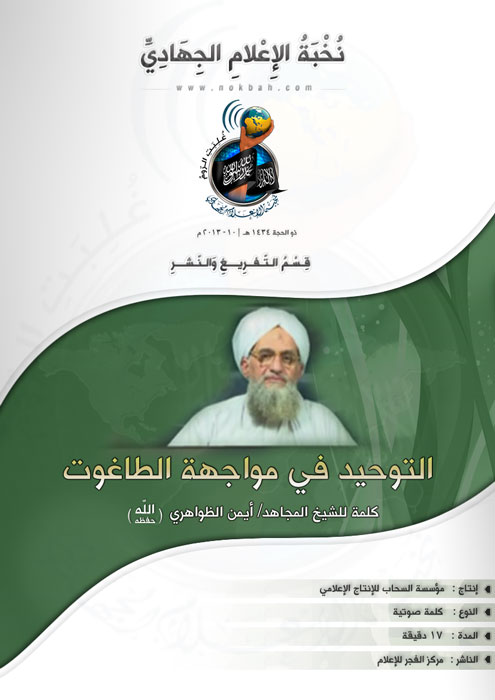
GUEST POST: Ayman al-Zawahiri on Jihadist Infighting and the Islamic State of Iraq and al-Sham

NOTE: As with all guest posts, the opinions expressed below are those of the guest author and they do not necessarily represent the views of this blogs administrator and does not at all represent his employer at the Washington Institute for Near East Policy.
Jihadology.net aims to not only provide primary sources for researchers and occasional analysis of them, but also to allow other young and upcoming students as well as established academics or policy wonks to contribute original analysis on issues related to jihadism. If you would like to contribute a piece, please email your idea/post to azelin [at] jihadology [dot] net.
Click here to see an archive of all guest posts.

Ayman al-Zawahiri on Jihadist Infighting and the Islamic State of Iraq and al-Sham
By Daveed Gartenstein-Ross
On April 18, a jihadist social media user tweeted links to two parts of an Al-Sahab Establishment for Media Production interview with al-Qaeda emir Ayman al-Zawahiri. Entitled “Reality Between Pain and Hope,” the interview’s first part was 54 minutes and 15 seconds, while the second part was 28 minutes and 45 seconds. Since the interview was first posted by a social media user rather than Al-Sahab, this appears to be a leak, similar to the recent leak of an unpublished Adam Gadahn video criticizing the Islamic State of Iraq and al-Sham (ISIS) following the death of al-Qaeda emissary Abu Khalid al-Suri.
Given analysts’ focus on recent jihadist infighting in Syria, it is worth noting Zawahiri’s comments on the matter, and on ISIS more broadly. ISIS was, of course, famously expelled from al-Qaeda in a pronouncement that the jihadist group issued in early February.
Zawahiri on Jihadist Infighting
In the interview, Zawahiri is asked about infighting among jihadist groups in Syria. His response is thunderous yet non-specific about which individuals or factions are responsible for the problems. Zawahiri blames the infighting on “the control of whims, ignorance, and injustice over some people,” and further suggests that jihadist factions in Syria may have been infiltrated, perhaps by intelligence services or else just by “misguided advice” and “bad incitement among the mujahedin.”
Asked about al-Qaeda’s efforts to end the infighting, Zawahiri renews the organization’s demands for addressing these disputes. At the time ISIS was expelled from al-Qaeda, they had been ordered to undergo arbitration with other mujahedin factions. While paying lip service to the arbitration process, ISIS in fact refused to comply. Zawahiri renews his calls for arbitration, stating that jihadists should refer their dispute to an independent sharia commission capable of obliging the conflicting factions to submit to its rulings.
Zawahiri implies that there could be severe consequences for factions who refuse to submit to arbitration. He says that all mujahedin and supporters of jihad should “take a stance of promoting virtue and preventing vice against all those who delay the work of this commission, ignore responding to it, or do not abide by its decisions.” In referring to the promotion of virtue and prevention of vice, Zawahiri makes clear that he is speaking of drastic measures: the withdrawal of legitimacy and financial and moral support from factions who fail to submit to arbitration. “Stripping off the legitimacy is a very serious thing,” Zawahiri says. He points to Algeria, where “the legitimacy was revoked from the militant Islamic group”: Zawahiri is referring to the Armed Islamic Group (GIA), which al-Qaeda played a role in helping the Salafist Group for Preaching and Combat (GSPC) splinter group to supplant. After GIA’s legitimacy was stripped from it, Zawahiri says, “it vanished.”
Though Zawahiri’s words are clearly intended as a warning to ISIS, he denies that he is speaking of them. “I do not address here an organization in itself or a group in particular,” Zawahiri says. Instead, he claims that his statement is a general one meant for all the mujahedin and their supporters. Indeed, he includes himself among the emirs whose commands should not be followed if their orders transgress God’s dictates. “Neither al-Zawahiri nor al-Jawlani [Jabhat al-Nusra’s leader] nor al-Baghdadi [ISIS’s leader] will protect you from God’s punishment if you wage aggression against your mujahedin brothers,” Zawahiri says.
Zawahiri says that jihadists joined the fight in Syria to “make the word of God supreme and to make the word of the infidels humiliated,” and thus they should be wary of being used by commanders “in their disputes over powers, ranks, positions, or gains.”
Zawahiri’s comments on jihadist infighting point to possible approaches al-Qaeda may adopt in dealing with ISIS, including the potential for a strategy of delegitimizing its leadership and drying up its funding streams. There is evidence to suggest that al-Qaeda has already been following this approach, but Zawahiri’s language and prioritization of arbitration and cohesion among the mujahedin also leaves open the possibility of a cooperative relationship or reconciliation with ISIS emerging. (Since a lot of behind-the-scenes maneuvering is occurring, my analysis in this piece doesn’t attempt to determine probabilities, but instead to understand the thrust of Zawahiri’s message.)
On the Split with ISIS
The interviewer asks Zawahiri about the justifications for al-Qaeda’s expulsion of ISIS. Zawahiri articulates two rationales. First, he notes that al-Qaeda is focused on the U.S. and its allies, while being cautious to shed Muslim blood. “We avoid the operations where impermissible blood may be shed in the markets, mosques, and residential areas and even among the jihadist groups,” Zawahiri says. He notes that the purpose behind al-Qaeda’s issuance of a general guidance for jihadist action was to unify the ummah, and taking Muslim blood can thwart that goal. “It is not possible to unify the ummah if we have the image of a tyrant and a usurper of its rights,” Zawahiri says, thus implying that this is ISIS’s image.
Zawahiri’s second rationale for expelling ISIS is that it failed to abide “by the fundamentals of teamwork.” Asked to explain this point, Zawahiri points to ISIS’s declaration of states without getting permission in advance and its failure to submit to the arbitration process.
Zawahiri emphasizes the need for al-Qaeda to maintain its image in order to propagate its message, describing the jihadist group as “a message before it is an organization.” Noting that al-Qaeda’s goal is to serve as a role model for the ummah, Zawahiri warns that the ummah won’t trust them if it “finds that we fight over spoils of war before achieving empowerment.” Further, al-Qaeda’s enemies will exploit such failures. As evidence of this, Zawahiri refers to Hizballah leader Hasan Nasrallah’s statement “in which he justifies fighting to support the criminal regime in the Levant” on the basis that Nasrallah “seeks to protect the people in the Levant against the crimes of the takfiris.”
Daveed Gartenstein-Ross is a senior fellow at the Foundation for Defense of Democracies and an adjunct assistant professor in Georgetown University’s security studies program. The author or volume editor of thirteen books and monographs, he holds a Ph.D. in world politics from the Catholic University of America and a J.D. from the New York University School of Law.

The Jihad Media Elite presents a new audio message from the ‘Abd Allah ‘Azzām Brigades’ Mājid bin Muḥammad al-Mājid: “From the Wise to the Wise: The Maturity in Coming Down to al-Shām in the Announcement of the Islamic State: Message to Dr. Ayman al-Ẓawāhirī"

The Clairvoyant: The Guidelines: Measuring Zawahiri's Influence

NOTE: For prior posts in The Clairvoyant sub-blog you can view an archive of it all here.

LL6Wv
Over the past few years since the American operation against Usama bin Ladin in Pakistan, there has been much debate over the leadership capabilities and influence that Bin Ladin’s successor Dr. Ayman al-Zawahiri still has over the global jihadi movement generally and al-Qaeda branches in particular. Endowing al-Qaeda franchise-status upon Harakat al-Shabab al-Mujahidin in Somalia, slow response to the Arab uprisings, and inability to resolve the conflict in Syria between the Islamic State of Iraq and al-Sham (ISIS) and Jabhat al-Nusra highlight how many have become skeptical of Zawahiri’s importance or relevance. And while this is all certainly true, those within the movement that are still true believers in the cause and view Zawahiri and al-Qaeda’s general command (AQGC) in Pakistan/Yemen as the fountainhead of the jihad against the Zionists and Crusaders still heed Zawahiri’s advice.
One potential area of measuring this is the guidelines that Zawahiri released for the movement in September 2013. In some ways, it is a codification of issues and ideas that Zawahiri and Atiyatallah ‘Abd al-Rahman al-Libi argued for in letters to Abu Mus’ab al-Zarqawi last decade when attempting to reign in his excesses during the Iraq jihad. Two recent examples highlight how those that are still loyal to Zawahiri and AQGC have internalized these guidelines. Recently, both al-Qaeda in the Arabian Peninsula (AQAP) and the ‘Abd Allah ‘Azzam Brigades (AAAB) apologized for killing civilians and non-combatants in their military operations (more on this below). While not seeming like much, it highlights how those that are tied to AQGC have become very sensitive to Muslim public opinion as well as the movement becoming more mature, even if it is still ideologically fringe and militarily radical overall.
Here are some examples from Zawahiri’s guidelines:

  • Avoid fighting the deviant sects such as Rawafidh, Ismailis, Qadianis, and deviant Sufis, except if they fight the Ahl as Sunnah.
  • Avoid meddling with Christian, Sikh and Hindu communities living in Muslim lands.
  • Refrain from killing and fighting against non-combatant women and children, and even if they are families of those who are fighting against us, refrain from targeting them as much as possible.
  • Refrain from harming Muslims by explosions, killing, kidnapping or destroying their wealth or property.
  • Refrain from targeting enemies in mosques, markets and gatherings where they mix with Muslims or with those who do not fight us.

While there is not definitive proof, it is likely that these guidelines helped inform the responses of AQAP and AAAB to acts committed that they then either regretted or realized could harm their public image and therefore apologized and then noted how it was outside the normal framework for how they interpret the shari’a and operate in the battlefield.
0f0hr
On December 21, 2013, AQAP’s military commander Qasim al-Raymi released a video message titled “Comment on the Targeting of the Defense Ministry in Sana’a’” apologizing for members of his organization killing medics and patients in the military hospital as well as those in the prayer room within the ministry. Al-Raymi stated: “We do not fight in this manner, and this is not what we call people to do. This is not our manhaj (methodology) … We confess to this mistake and fault. We offer our apologies and condolences to the families and the victims.” He later offered blood money compensation and medical treatment to the individuals and families affected by the attack.
ixhtz
More recently, on March 7, 2014, AAAB released a statement titled “On the Raid of the Iranian Chancellery in Beirut” claiming that there was faultiness in the second suicide bombers belt. It stated: “The two bombs were meant to be in a place where the explosion would not reach the main road and cause damage to passersby … The military operations of the ‘Abd Allah ‘Azzam Brigades do not target Shiites, or other sects.” Rather the attack was aimed at Hizb Allah, which while Shi’a is actively militarily fighting Sunnis in Syria. Illustrating how AAAB wanted to show that they were attempting to be discriminant in targeting and only defensively responding to attacks upon them and their fellow Sunni Muslim brethren.
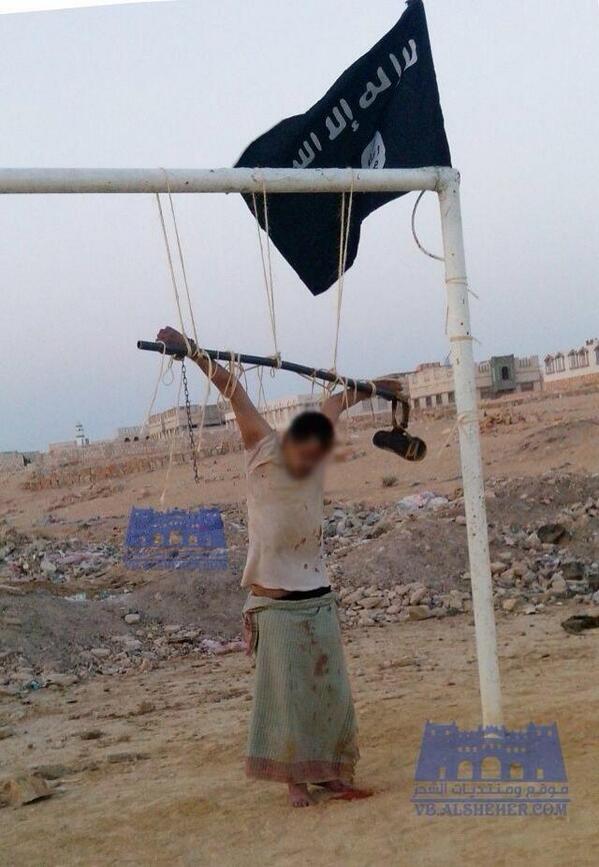
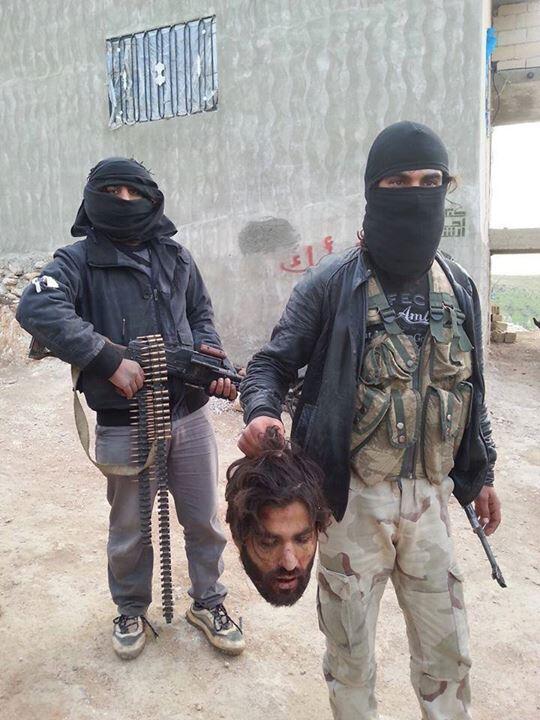
Both of these examples highlight that the groups that still maintains allegiance to AQGC have become more astute and smarter in how they massage public opinion. That does not mean though they are now all of a sudden moderate actors. To the contrary, this past week for example, AQAP crucified a man for allegedly spying on them to help with drones strikes, while AAAB’s allies in Syria Jabhat al-Nusra still are actively beheading individuals on the battlefield that fight for the Assad regime (see both graphic photos below).
AQAP-Ansar al-Sharia has crucified a man (accused of being American spy) in Hadhramaut #YemenJabhat an Nusra from Al Numr checkpoint with a beheaded Rafidi
That being said, it appears that in some areas jihadi groups aligned with Zawahiri and AQGC are indeed listening to his advice and actively attempting to be more mature and pragmatic actors in some aspects. This is in contradistinction with the now rival global jihadi faction ISIS, which appears to have no rules of engagement and does as it pleases no matter what the consequences. How these guidelines continue to play out and what impact they may have with the AQGC-aligned groups remains to be seen, but it appears that as of now it has made slight differences in their on the battlefield methodologies, albeit imperfectly.

Musings of an Iraqi Brasenostril on Jihad: "They have closed ranks and pledged bay'ah to Baghdadi": Nasheed for the Islamic State of Iraq and ash-Sham

NOTE: An archive of the Musings of an Iraqi Brasenostril on Jihad column can  be found here.

“They have closed ranks and pledged bay’ah to Baghdadi”: Nasheed for the Islamic State of Iraq and ash-Sham
By Aymenn Jawad Al-Tamimi

Preface
This is an Islamic State of Iraq and ash-Sham nasheed released earlier in 2013 (around September time) and translated by me below. The term bay’ah means a pledge of allegiance, and in this case it is to ISIS’ leader Sheikh Baghdadi: a fundamental aspect of joining ISIS, not requiring a bay’ah to Sheikh Zawahiri of al-Qa’ida Central (see my previous Jihadology post for more information).
On the other hand, pledging allegiance to Sheikh Zawahiri, according to the testimony related to me by a representative of the Katiba Mus’ab bin Umair- a Deraa-based battalion that recently pledged allegiance to Jabhat al-Nusra- is a key part of properly integrating into Jabhat al-Nusra, Syria’s official al-Qa’ida affiliate that has emphasized its loyalty to al-Qa’ida Central by calling itself “Tanzim al-Qa’ida fi Bilad ash-Sham.”
Contrasting with this point, a representative of Jabhat al-Nusra in Qalamoun, which vowed to protect members of ISIS on the grounds of having the same manhaj (ideological program: i.e. Caliphate and world domination) even as the “politics” differ, affirmed to me that the political difference between Jabhat al-Nusra and ISIS is that the latter has no bay’ah to Sheikh Zawahiri.
This point is corroborated by some more testimony I recently gathered from members and supporters of ISIS. Thus, one native Syrian member of ISIS from Aleppo denied to me the existence of an ISIS bay’ah to al-Qa’ida central and affirmed to me that the original al-Qa’ida in Iraq had pledged bay’ah to and thus was absorbed by the Islamic State. Prominent ISIS source and supporter who used the Twitter handle zhoof (who is notably anti-Jabhat al-Nusra, deridingly referring to it on occasion as the “Jowlani Front”) elaborated to me further on whether ISIS has bay’ah to Sheikh Zawahiri:

“Zawahiri is a soldier with Mullah Omar, so if there is a bay’ah [from ISIS to al-Qa’ida Central], it will be to Mullah Omar, but all that there is of bay’ah is on Nusra which Sheikh Baghdadi established for Zawahiri, but every word Baghdadi utters is as though he is under bay’ah to Zawahiri as his sheikh, and this is from the discipline and humility of the sheikh [Baghdadi].”
In objection to these points, it is argued that if ISIS were really independent of al-Qa’ida Central, why does Sheikh Baghdadi not simply say so explicitly? Indeed, he has made no explicit declaration of a break, but I would argue that this is so because it would simply stir up too much fitna in the global jihadist movement. After all, Sheikh Baghdadi understands that al-Qa’ida Central is ultimately working towards the same ideological goals, so why bother deepening an already serious disagreement?
In short, as Will McCants says, Sheikh Baghdadi is playing a “clever game.” I would also agree with McCants about being skeptical of ISIS supporters’ and members’ narrative of the independence of the Islamic State from al-Qa’ida Central from the very beginning with its founding in late 2006, for there is no doubt that al-Qa’ida in Iraq was initially the main component of the Islamic State.

In any case, the lack of an explicit leadership declaration of independence does not mean there is no independence. On this reasoning, one could argue that the Green Battalion- a muhajireen battalion founded by Saudis last summer and primarily operating in Damascus province- is not an independent group. However, all reliable testimony on the ground (e.g. my interview with the Jabhat al-Nusra in Qalamoun representative) points to its independence.
Though it shares the ideology of ISIS and Jabhat al-Nusra, the Green Battalion is independent for “personal reasons”: that is, its founders and leaders had personal problems with ISIS and Jabhat al-Nusra in that they preferred not to take sides in the dispute over Sheikh Baghdadi’s announcement of a merger. Of course, it is not advantageous to anyone to declare explicitly a break of this sort.
Translation of the Nasheed
“They have closed ranks and pledged bay’ah to Baghdadi,
For [he is] our amir in our Iraq and ash-Sham.
For the Caliphate of God: I am its sign,*
Its glory decreed by our blood.
They have promised each other to protect its [the Caliphate’s] corners,
They have sold life at a cheap price for its survival.
They have closed ranks and pledged bay’ah to Baghdadi,
For [he is] our amir in our Iraq and ash-Sham.
They have undertaken bay’ah together to our amir,
They are your heroic knights and our weapon.
For he [Baghdadi] is the one to whom bay’ah is pledged in our land of Iraq
And [he is] the amir of the Muslims and of our land of Sham.
They have closed ranks and pledged bay’ah to Baghdadi,
For [he is] our amir in our Iraq and ash-Sham.
Preserve the soldiers of God, oh custodian of ours.
The cross has returned to our land and our abodes.
And on our skulls will be our life,
Laying low and vanquishing oppression, our enemy.
They have closed ranks and pledged bay’ah to Baghdadi,
For [he is] our amir in our Iraq and ash-Sham.
We have not forgotten the incident of the throwers,**
Verily it is an excellent lesson for whomsoever after it,
When some of the throwers resisted our Prophet,
For grace remains on our heroes [?].***
They have closed ranks and pledged bay’ah to Baghdadi,
For [he is] our amir in our Iraq and ash-Sham.”
Further Notes
* cf.My previous post for Jihadology in which I discuss ISIS discourses focus on establishing the Caliphate.
**- cf. This video lecture by Yahya Abd al-Rahman.
**- I am slightly uncertain about this phrase. Alternative suggestions are welcome.

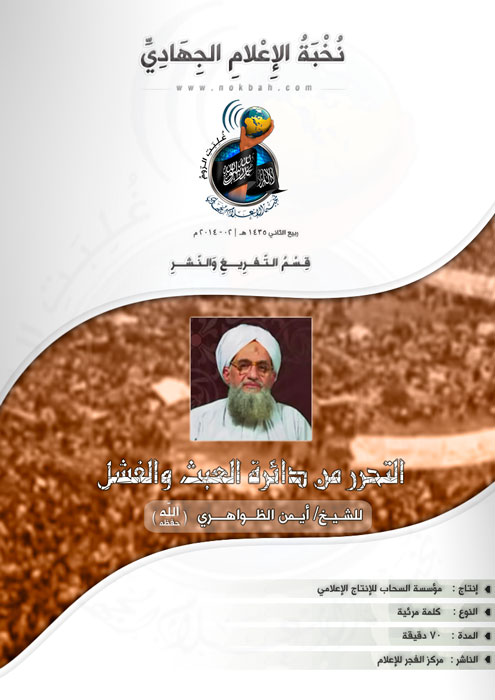
As-Saḥāb Media presents a new video message from al-Qā’idah's Dr. Ayman al-Ẓawāhirī: "Emancipation From Futility and Failure"

UPDATE 2/4/14 10:55 AM: Here is an Arabic transcription of the below video message:
V10UC
Click the following link for a safe PDF copy: Dr. Ayman al-Ẓawāhirī — “Emancipation From Futility and Failure” (Ar)
___________


1SsGF

__________

To inquire about a translation for this video message for a fee email: [email protected]

As-Saḥāb Media presents a new audio message from al-Qā’idah's Dr. Ayman al-Ẓawāhirī: "Urgent Call to Our People in al-Shām"

WaTlc
Audio:
Dr. Ayman al-Ẓawāhirī — “Urgent Call to Our People in al-Shām”

Arabic Transcription:
Dr. Ayman al-Ẓawāhirī — “Urgent Call to Our People in al-Shām”
__________

To inquire about a translation for this audio message for a fee email: [email protected]

As-Saḥāb Media presents a new video message from al-Qā’idah's Dr. Ayman al-Ẓawāhirī: "Tawḥīd in the Face of Tyrants"

UPDATE 10/13/13 5:16 PM: Here is an Arabic transcription of the below video message:
1381582406821
Click the following link for a safe PDF copy: Dr. Ayman al-Ẓawāhirī — “Tawḥīd in the Face of Tyrants” (Ar)
______________


q7HjM


______________

To inquire about a translation for this video message for a fee email: [email protected]